By Azerbaijan.US Editorial Board
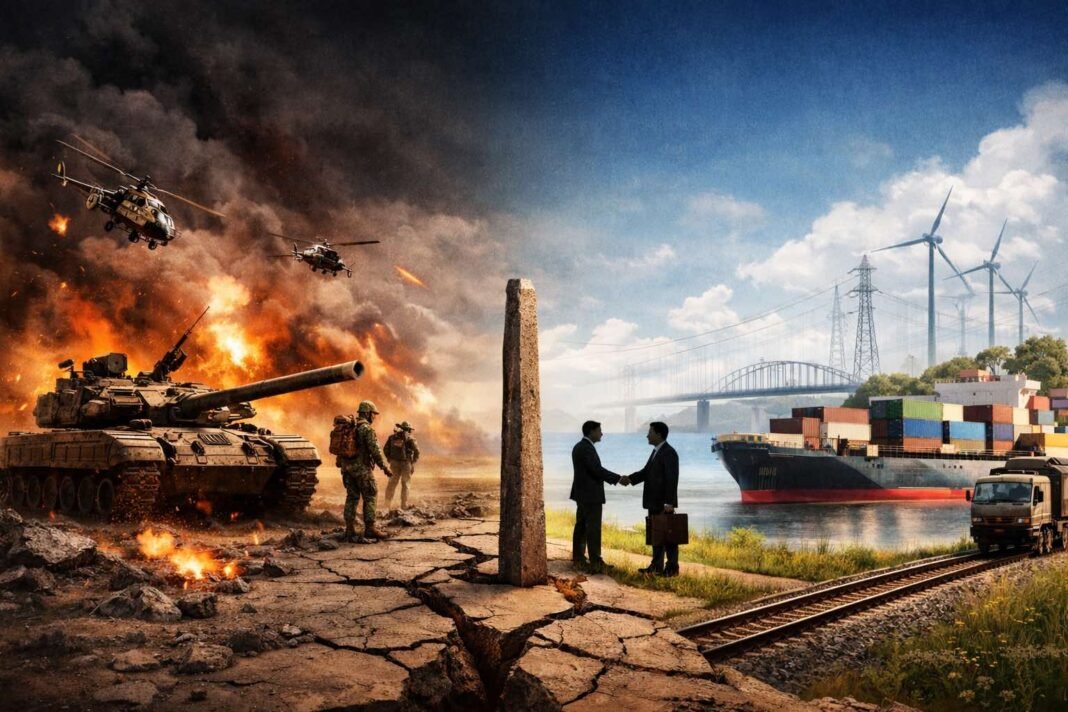
In debates about the future of the South Caucasus, one argument is repeated with growing confidence: peace is impossible without constant military buildup.
According to this view, economic cooperation, trade, transit routes, and joint infrastructure projects are either meaningless or outright dangerous-a façade that allegedly masks the inevitability of a new war.
The argument is emotionally understandable. The region has lived through wars, displacement, and decades of mistrust. But emotional clarity should not be mistaken for strategic correctness.
The idea that security can be achieved only through military strength rests on a simple assumption: fear prevents war. The stronger the armies, the safer the peace. In reality, this logic often produces the opposite result. Persistent militarization normalizes the expectation of conflict and turns war from a possibility into a forecast.
Economic interaction is frequently dismissed as naïve. Critics point to history: countries traded before-and still went to war. But such comparisons ignore a crucial difference between the past and the present. Today’s world is defined by deep interdependence: supply chains, energy networks, transit corridors, and financial systems are tightly connected. Disrupting them now carries far higher costs than it did in earlier eras.
Economic ties do not magically eliminate conflict. But they change the calculation. When war threatens not only an abstract “enemy,” but domestic growth, employment, logistics, and social stability, the decision to escalate becomes far more costly-and therefore less likely.
Equally dangerous is the belief that conflict in the South Caucasus is somehow inevitable, that the region is condemned to permanent hostility. This mindset freezes societies in the past. Every compromise becomes “weakness,” every dialogue a “concession,” every attempt at normalization a betrayal.
Security is more than military capacity. It includes functioning institutions, predictable rules, economic incentives, and mechanisms for de-escalation. Armies may deter-but they do not build trust. And without at least minimal trust, even the strongest military balance eventually fails.
The region does not face a choice between “tanks or trade.” That is a false dilemma. What is needed is balance: credible security arrangements alongside economic cooperation that makes renewed conflict irrational rather than inevitable.
Peace rarely begins with friendship. More often, it begins with pragmatism-with the recognition that stability is more profitable than war, and development more sustainable than permanent mobilization. Rejecting that reality in favor of endless militarization risks trapping the South Caucasus in a cycle it already knows too well.