Azerbaijan.US
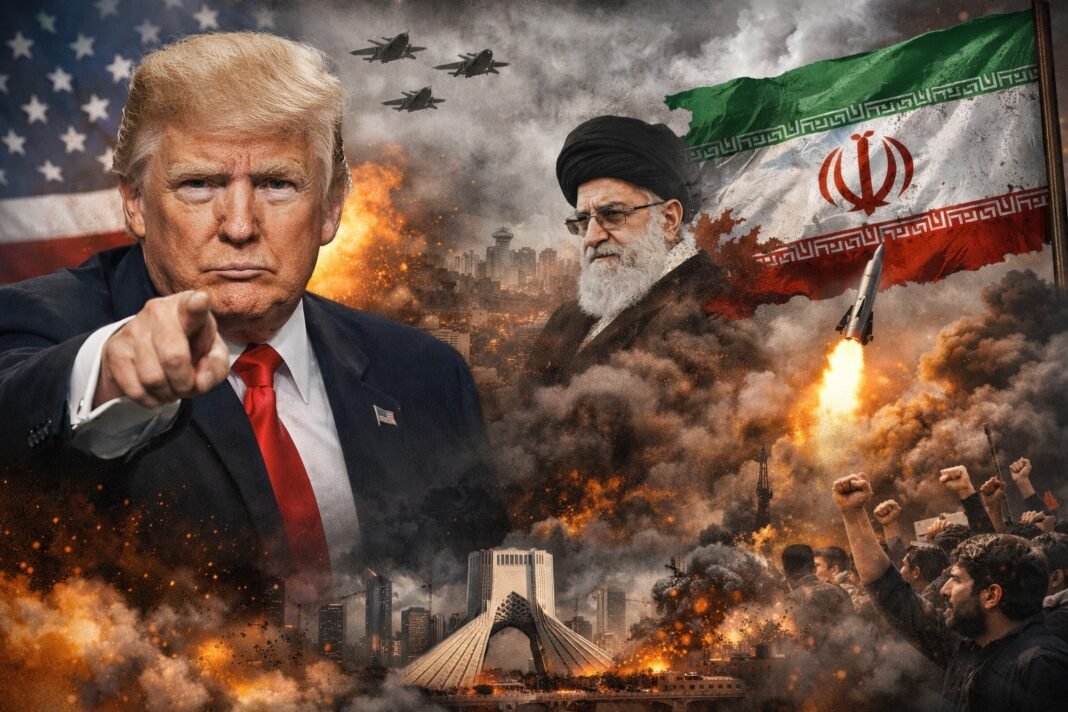
For weeks, speculation over whether the United States would strike Iran has dominated headlines. From talk of limited, surgical operations to warnings of a wider regional war, scenarios have multiplied. What remains constant is uncertainty: while potential targets can be identified, the consequences of any escalation are far harder to predict.
U.S. President Donald Trump had warned Tehran earlier that Washington would not tolerate continued violence against protesters during Iran’s recent unrest. His rhetoric raised expectations among opposition groups, many of whom openly looked to Washington for support. That support, however, never fully materialized, leaving Iran’s protest movement caught between internal repression and external ambiguity.
The United States has effectively given Tehran what officials describe as a final window for compliance. The deployment of additional naval and air assets closer to Iranian waters has sharply raised the risk of confrontation, alarming not only Tehran but also neighboring states already uneasy about regional stability. Washington’s demands are uncompromising: a complete halt to Iran’s nuclear program, strict limits on its ballistic missile capabilities, and an end to support for armed proxy groups across the Middle East.
Iranian officials say they remain open to negotiations, but accepting these conditions outright would amount to an ideological collapse of the Islamic Republic. Analysts note that Tehran is entering this phase weakened-its economy under heavy sanctions, its society strained after waves of protest, and its regional position more fragile than in previous years.
Any U.S. strike would not be confined to Iran alone. Gulf states hosting American military bases fear retaliation, while energy markets and shipping routes would face immediate disruption. A broader conflict could quickly spill beyond a bilateral clash, drawing in regional and global actors.
Israel’s relative silence has also drawn attention. Observers interpret this restraint as strategic: allowing Washington to lead, while preserving freedom of action should the situation deteriorate. At the same time, both Washington and Tehran face mounting internal pressures that limit their room for maneuver.
Despite sharp rhetoric, Trump has so far stopped short of authorizing an attack. American media have reported on possible timelines and contingency plans, yet the White House continues to pair military signaling with diplomatic ultimatums: reach a deal, or face unpredictable consequences.
Some analysts compare the approach to a “Venezuela-style” strategy-seeking not an outright overthrow, but gradual coercion that forces systemic concessions without full-scale war. Under such a model, the goal is not immediate regime change, but compliance under sustained economic and political pressure.
Against this backdrop, three broad scenarios are emerging. The first is escalation: U.S. strikes trigger renewed protests and potentially a change in Iran’s political system. The second is forced accommodation, with Tehran softening its stance and accepting negotiations largely on Washington’s terms. The third, and most dangerous, is prolonged destabilization-rising centrifugal forces that could weaken central authority and push the country toward fragmentation.
For now, diplomacy remains on the table. But analysts warn that the margin for error is narrowing. A miscalculation could transform a high-stakes standoff into a regional crisis-one whose costs would extend far beyond Iran itself.

