By Dr. Namiq Aliyev
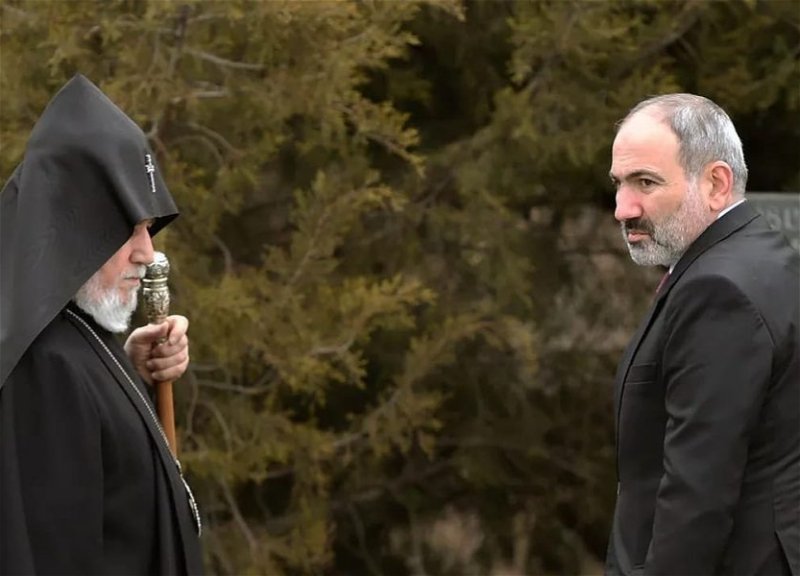
Armenia is witnessing an unprecedented showdown: senior clerics are now facing arrest and criminal charges—an event without precedent in the country’s modern history. This escalation marks a dramatic shift in the balance between the secular state and the Armenian Apostolic Church.
Historic Tensions Reignite Post-2020
After Armenia’s defeat in the 2020 Nagorno‑Karabakh war, the Church took an assertive political stance, publicly calling for Prime Minister Nikol Pashinyan’s resignation. The government responded by decrying this as a “shameful anti‑church campaign” that infringed on Armenia’s constitutional principle of separation between church and state.
From Public Accusations to Arrests
May 29, 2025: Pashinyan launched a frontal attack on Catholicos Karekin II, accusing him of moral misconduct—violating his celibacy vows and fathering an illegitimate child. He demanded concrete evidence and called for Karekin’s removal.
June 8–9: The Holy Synod denounced the accusations and Pashinyan’s remarks as actions that threatened national unity and violated constitutional secularism.
Tensions escalated:
June 17: Businessman Samvel Karapetyan, returning from Moscow, was arrested after showing support for the Church.
June 25: Authorities detained Archbishop Vazgen Galstanyan and others, accusing them of plotting a coup by recruiting “over 1,000” supporters, stockpiling weapons and explosives, and planning acts of sabotage—claims covered by Al Jazeera.
June 27–28: Another case unfolded around Archbishop Gevorg Adjapahyan, whose arrest attempt led to public protests. Ultimately, he surrendered and was granted a two-month detention, with critics calling the move politically motivated.
Arrests were justified under charges of plotting an armed overthrow, reflecting historical echoes of clergy involvement in political unrest (e.g., hidden arsenals before the 1905 Russian Revolution).
Growing Backlash and International Reaction
This crackdown triggered widespread protests. As Eurasianet reported, church supporters physically blocked arrests, demonstrating the Church’s deep societal roots. Pashinyan then appealed to Russia, telling Moscow to refrain from interfering, a move viewed by many as politically calculated.
Church vs. State: Politics or Preservation?
Government’s narrative: The Church has become a destabilizing force—engaged in ideologically motivated plots to subvert state authority.
Church’s response: Calls the government’s actions a “national disgrace,” an assault on Armenia’s sovereignty, and an unconstitutional violation of religious freedom. Church leaders argue for their historical role as guardians of the Armenian nation and accuse the state of using secularism as a political tool.
Opposition political figures—including ex-president Levon Ter-Petrosyan—have rallied behind the Church, citing similar concerns.
Legal Stakes and Geopolitical Fallout
Analysts believe the government could prosecute church leaders under articles such as:
Article 300 (attempted coup)
Article 301 (public calls for overthrow)
Articles 303–304 (terrorism, sabotage)
Potential charges under articles 223–224 (participation in armed groups)
So far, figures like Karekin II remain politically, not legally, implicated.
An arrest could ignite a national crisis—religious sentiment runs deep and Church misuse could unify social opposition against the state. Moreover, Armenia’s trajectory toward EU and Western alignment may suffer, risking alienation from European partners who prioritize religious freedoms.
In contrast, Russia—closely allied with the Armenian Church—could frame itself as its protector, increasing Moscow’s influence at Armenia’s expense.
What Lies Ahead?
Despite fiery rhetoric, a crackdown against Catholicos Karekin II appears unlikely in the near term. Analysts expect further coercion and legal pressure, but not an outright arrest. Conflict will likely unfold through media, court cases, appeals to international law, and constitutional tactics rather than force.
This power struggle now defines Armenian politics. It remains to be seen whether the impasse ends in a negotiated compromise, or if it plunges the country into deeper political instability—with serious implications for Armenia’s democratic future and regional standing.