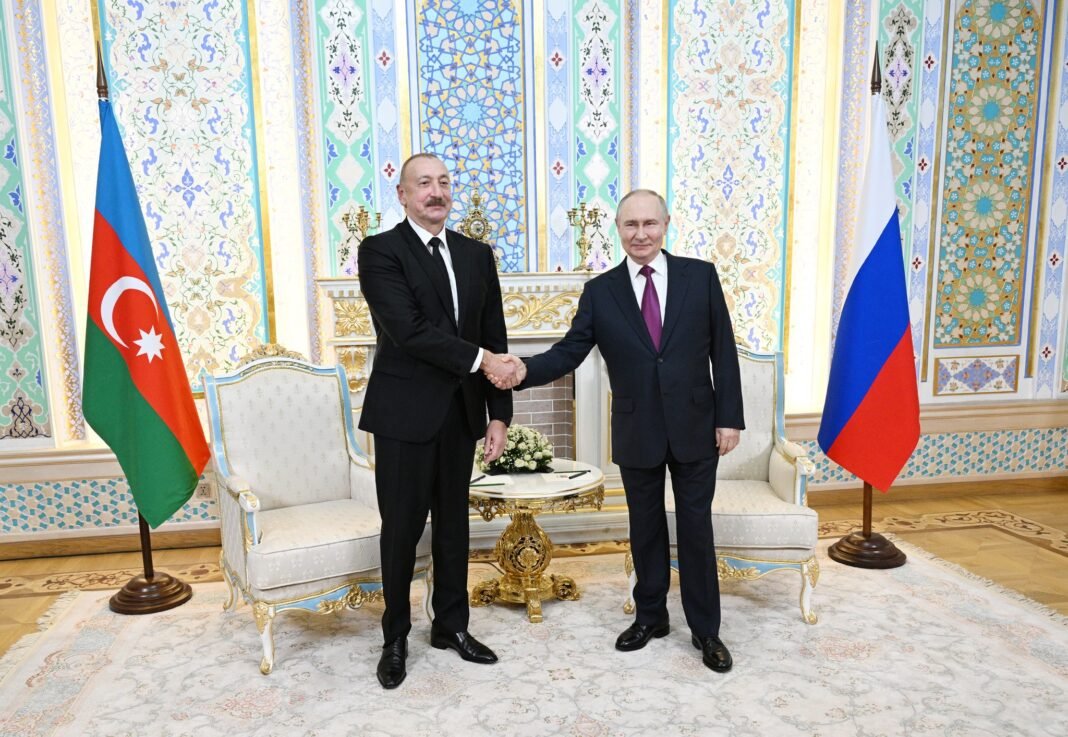
The long-anticipated meeting between Azerbaijani President Ilham Aliyev and Russian President Vladimir Putin has been described by political analysts as a signal of mutual intent to normalize relations after nearly a year of political and diplomatic chill.
The talks, held in Dushanbe, marked the first substantive contact between the two leaders since the AZAL plane crash in December 2024 – an incident that triggered unprecedented tensions between Baku and Moscow.
Putin Admits “System Failures” in AZAL Plane Crash
During the meeting, Putin publicly revisited the causes of the crash of the Azerbaijan Airlines (AZAL) flight, which was downed over Kazakhstan en route from Baku to Grozny, killing 39 of 67 people on board, including seven Russian citizens.
“It’s now possible to speak of the causes of this tragedy,” Putin said.
“The first factor was the presence of a Ukrainian drone in the airspace. The second involved technical malfunctions in our air defense system. Two missiles were fired – they did not strike the plane directly, otherwise it would have crashed instantly. Most likely, they self-destructed a few meters away.”
Analysts interpreted Putin’s unusually detailed comments as a de facto acknowledgment of Russia’s responsibility, even if not phrased in explicitly legal terms.
“Putin’s tone suggested an indirect admission of fault,” said Arkady Dubnov, a political analyst specializing in post-Soviet affairs.
“His carefully worded explanation could be seen by Aliyev as a diplomatic gesture of accountability, sufficient for Baku to consider its demands largely satisfied.”
From Crisis to ‘New Normal’
Azerbaijani political analyst Farhad Mammadov, head of the Center for South Caucasus Studies, said the meeting reflected “a clear intention by both sides to restore normality.”
“We’ve reached the bottom of this crisis – now it’s time for recovery,” Mammadov said.
“Relations will now evolve in a ‘new normal,’ where expectations from each other will be less maximalist but more pragmatic.”
Another Azerbaijani analyst, Tofig Abbasov, described the summit as “a meeting turned toward the future.”
“The chill between the two neighbors could not last indefinitely. We share urgent regional priorities and joint projects. This meeting was the necessary first step to remove uncertainty and return relations to a natural rhythm,” Abbasov told RBC.
Months of Escalation
Relations between Baku and Moscow had deteriorated sharply following the AZAL tragedy. Azerbaijan had announced its intent to pursue legal action in international courts, demanding Russia acknowledge responsibility, compensate victims’ families, and reimburse AZAL for the loss of its aircraft.
Further strain came amid a series of criminal and political cases involving citizens of both countries:
The Safarov brothers case in Russia, accused of murders dating back to 2001–2011, drew outrage in Baku after two suspects died in custody. President Aliyev called the incident “an unprecedented act against the people of Azerbaijan.”
In Azerbaijan, police raided the Baku office of Sputnik Azerbaijan, part of Russia’s state media group, and detained two editors on charges of fraud and money laundering.
Eight Russian IT specialists were also arrested in Baku on charges of cybercrime and drug trafficking, with footage from court hearings showing visible bruises on their faces.
The Kremlin later admitted that relations had entered a “difficult phase”, but expressed hope that dialogue at the presidential level would stabilize the situation.
Analysts See a Calculated Reset
Experts agree that both leaders are seeking a controlled thaw rather than a return to pre-crisis closeness.
Moscow, facing geopolitical isolation, needs stable ties with Baku, while Azerbaijan wants to reassert sovereignty without burning bridges with its northern neighbor.
“This was a handshake not of friendship, but of realism,” said one regional analyst in Moscow.
“Both sides needed to stop the downward spiral – and they did.”