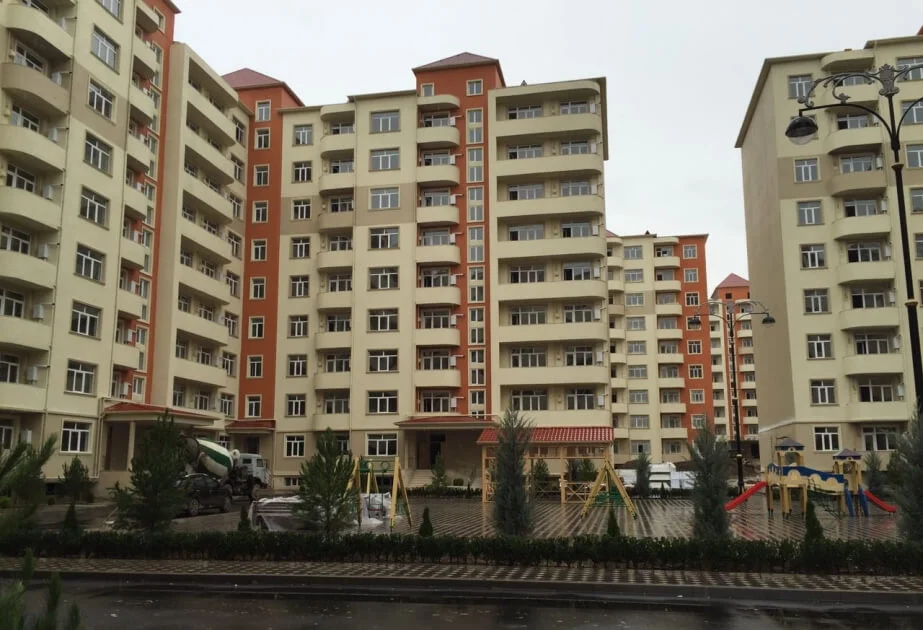
The real estate market in Azerbaijan continues to surge, and economists say it’s no coincidence.
Prices in Baku have doubled over the past decade, and while global trends play a role, much of the phenomenon is rooted in local realities – from limited land supply to deep-seated cultural attitudes toward ownership and security.
Economist Emin Garibli, speaking in an interview with Baku.Tv journalist Javid Osmanov, described housing as a “mirror of both the economy and the national psyche.”
A decade ago, he noted, an apartment bought for 60,000 manats could easily sell for 120,000 today. The reasons, he said, are a blend of global financial shifts, local market behavior, and geography.
Global Forces, Local Mentality
According to Garibli, the preference for real estate investment began worldwide in the early 2000s, after stock markets proved too volatile. “People lost trust in paper assets and turned back to something tangible,” he explained.
“That trend reached Azerbaijan too – where the market for securities is still underdeveloped. So those with savings, including members of the diaspora, choose to invest in apartments or houses.”
Another factor is cultural. For many Azerbaijanis, owning property isn’t just a financial decision but a social symbol of stability and independence.
“If you have extra money, you buy land or build a house,” Garibli said. “That mindset drives demand even when the economy slows down.”
At the same time, Baku’s rapid urban expansion has created a scarcity of land, especially in the city center. “The city is practically built out,” Garibli noted. “Developers are now running out of space, and that naturally pushes prices up.”
Mortgages, Money, and the Middle Class
Despite popular belief, Garibli cautioned that mortgages are not a social policy tool but a financial instrument shaped by market laws.
“In Azerbaijan, the supply of credit is still limited, so interest rates remain higher than in developed economies,” he said. “But for people with stable income, a mortgage remains one of the few viable paths to ownership.”
He added that any significant drop in interest rates will depend on the overall expansion of the money supply – and on broader economic diversification.
Amnesty and Active Capital
The government’s recent decision to legalize thousands of homes built without formal ownership documents – a kind of “housing amnesty” – has sparked wide debate. Garibli considers the move economically justified. “It’s not just a social gesture,” he said.
“It turns passive capital into active capital. When a property is legalized, it can be mortgaged, rented, or insured. That creates liquidity in the economy.”
However, he warned against misinterpreting the policy as a green light for unregulated construction. “Amnesty should not become a tradition,” he said. “It’s a one-time correction, not an invitation to chaos.”
The Suburbs Are Next
While urban living remains a status marker, Garibli believes the next decade will bring gradual decentralization. Projects like the new suburban rail system – expected to cover much of the Absheron Peninsula by 2030 – could make commuting from outlying districts faster than crossing Baku by car.
“Urban congestion reduces competitiveness,” he noted. “If transportation improves, people will naturally move outward – to areas like Mardakan, Mashtaga, or Vishnevka. Those are the future growth zones.”
Private developers are already betting on that shift, buying small plots, building compact houses, and reselling them.
Garibli sees this as a healthy trend: “Real estate remains the most liquid asset, but the focus is changing. It’s no longer about prestige; it’s about practicality.”
Beyond Baku
To truly unlock the country’s potential, Garibli argues, Azerbaijan needs to extend its development beyond the capital. He points to examples like Antalya, Batumi, and Sharm el-Sheikh – cities that flourished after governments granted tax incentives and created special economic zones. “Why not do the same in Nabran, Astara, or Lankaran?” he asked. “They already have natural appeal. All that’s missing is infrastructure.”
The Future of Investment
Asked where investors should look next, Garibli smiled: “Real estate has always been Azerbaijan’s true currency – something solid you can touch. Technology changes, economies shift, but people will always believe in stone and concrete.”
In other words, for all the talk of digital finance and virtual assets, in Azerbaijan one investment still rules them all: land.

