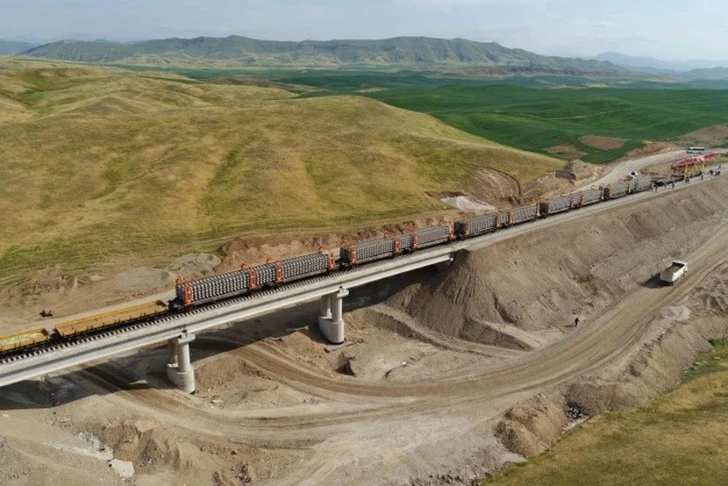
The TRIPP initiative – short for Trump Route for International Peace and Prosperity – has become a central topic in regional transport and investment discussions.
According to political analyst and Doctor of Philosophy in Economics Ilgar Velizade, the project is not only a strategic extension of the Zangezur Corridor but also a prerequisite for implementing large-scale investment projects across Eurasia.
The TRIPP project envisions a 42-kilometer segment of the Zangezur Corridor running through southern Armenia, connecting Azerbaijan’s western regions with Nakhchivan and onward to Turkey. Velizade emphasized that without the opening of communications between Azerbaijan and Armenia, TRIPP cannot materialize.
“Azerbaijan aims to build a sustainable transport network linking its western territories with Nakhchivan and Turkey. In this context, U.S. assistance in ensuring uninterrupted connectivity between the two parts of Azerbaijan logically fits into the Zangezur concept,” the expert said.
Integration Into Eurasian Corridors
Velizade noted that TRIPP aligns naturally with two of the region’s most strategic routes – the Middle Corridor (Trans-Caspian International Transport Route) and the North–South Corridor.
“Such projects always have geopolitical significance because they connect the interests of multiple states – especially those in Central Asia. The recent C5+1 Summit in Washington and President Donald Trump’s statement on TRIPP confirm that this initiative will form part of a broader transport network linking Central Asia, the South Caucasus, and the Near East,” he explained.
He added that TRIPP complements the emerging unified economic space in the region. “Now everything depends on practical steps – it’s important not to delay implementation. The U.S., Central Asia, and Azerbaijan all have vested interests. Armenia, too, should recognize its benefits and take a more constructive approach,” he noted.
Geopolitical and Economic Potential
According to Velizade, Azerbaijan is the key link in this growing chain of regional connectivity:
“TRIPP is part of a larger process uniting the Eurasian transport and economic space. The alignment of interests among key regional players elevates Azerbaijan’s geopolitical importance as a stable and reliable connector, even between rival powers.”
He highlighted that TRIPP is viewed as essential for realizing large investment projects involving not only regional states but also the United States and the European Union.
“In recent years, the EU has become more active in the South Caucasus and Central Asia, supporting infrastructure, trade, and investment projects – including those involving rare earth materials. TRIPP, as part of the East-West and Middle Corridor systems, provides a solid foundation for such initiatives,” he said.
Implementation Challenges
Despite the project’s promise, Velizade pointed out that no physical progress has been made on the Armenian section:
“As of today, not a single stake has been driven into the ground in Armenia. While Yerevan claims active consultations with the U.S. and Azerbaijan, no concrete steps have followed. The U.S. has pledged $145 million to support the initiative, but it’s still unclear how and to whom this funding will be allocated.”
Meanwhile, Azerbaijan continues upgrading its Baku–Tbilisi–Kars railway, whose capacity has already increased fivefold to 5 million tons per year. The Zangezur Corridor, currently under construction on Azerbaijani territory, is designed to handle up to 10 million tons of cargo annually.
Velizade also highlighted ongoing efforts to eliminate logistical bottlenecks in the ports of Azerbaijan, Kazakhstan, and Turkmenistan, as part of broader Middle Corridor modernization efforts. The three countries have agreed to establish a single railway operator and unified tariffs, which he called “a major step toward improving transport efficiency.”
Linking Central Asia and the Mediterranean
Velizade emphasized that Central Asian countries – particularly Kazakhstan and Turkmenistan – view TRIPP as a vital export route for their energy resources toward Turkey and the Mediterranean.
“The project allows these countries to diversify their export channels and access global markets more directly. Just as the Baku–Tbilisi–Kars railway opened a route for Central Asian energy to reach Europe, TRIPP will provide an even shorter and more efficient path,” he concluded.

