By Azerbaijan.US Editorial Board
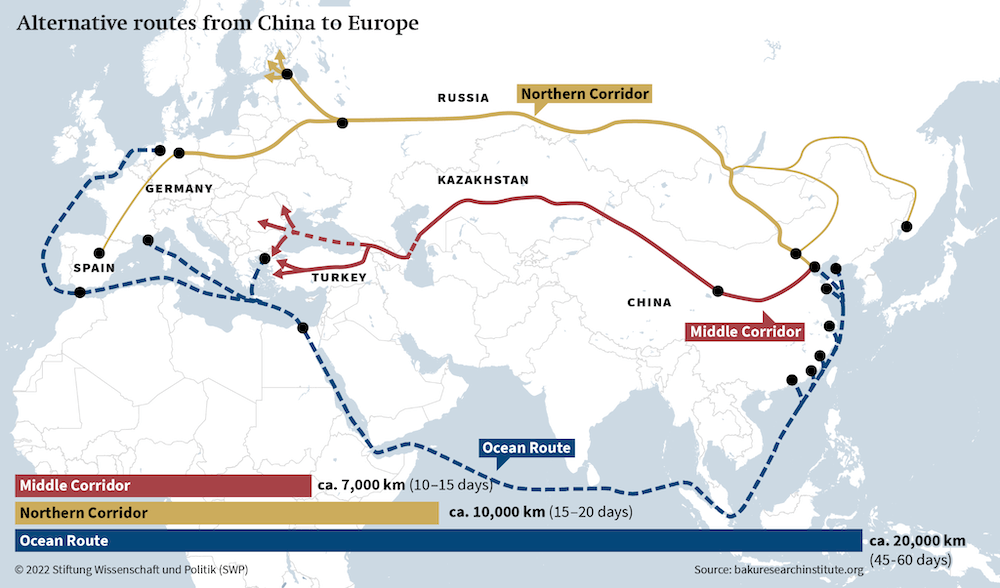
For years, Western policymakers treated the “Middle Corridor” – the route connecting Europe and Asia through the South Caucasus and Central Asia – as an exotic contingency plan.
That era has ended. The geopolitical shocks of the past three years have turned this corridor from a policy concept into a strategic necessity. And no country sits more centrally on this map than Azerbaijan.
Washington and Brussels know the arithmetic. With Russia’s war in Ukraine closing northern routes and Iran’s regional behavior complicating southern ones, the West is left with a simple question: which corridor remains viable, politically stable, and economically scalable? The answer leads through the South Caucasus – and especially through Baku.
This is not only about rails, roads, and ports. It is about political geography. Azerbaijan has positioned itself as the linchpin of a new Eurasian alignment: a country that maintained working relations with all sides while modernizing its ports, expanding pipeline systems, and investing in digital and transit infrastructure long before the West recognized it needed alternatives.
The evidence is already visible. Cargo volumes along the Trans-Caspian route have increased sharply, and the Port of Alat – now one of the most advanced logistics hubs on the Caspian Sea – is expanding faster than many analysts predicted. Regional partners, including Kazakhstan and Georgia, are accelerating their own investments. What remains missing is political seriousness from Washington and Brussels.
Europe, despite its rhetoric, still hesitates to acknowledge a basic fact: part of its energy transition depends on Azerbaijan. Whether through additional gas during winter stress, green energy exports from the Caspian basin, or the planned Black Sea cable linking Azerbaijan to Romania and onward to the EU grid, Baku has become indispensable.
But the real bottleneck is not technology or financing – it is Western indecision.
The United States in particular must stop treating the South Caucasus as an afterthought. Washington talks about diversifying energy sources, securing supply chains, and reducing dependence on China, yet it consistently overlooks the one region capable of delivering progress on all three fronts. This contradiction is no longer sustainable.
The Middle Corridor is not a theory. It is a functioning strategic artery – and the countries that commit to it early will shape Eurasian trade, energy security, and political influence in the decade ahead. Those that delay, especially the United States, risk watching from the sidelines as others define the map.
Azerbaijan saw this future early. Europe is beginning to understand it now. Washington cannot afford to be the last to act.