By Azerbaijan.US Editorial Board
At first glance, Gaza Strip and Syria appear to belong to entirely different political universes.
Gaza is locked in a cycle of violence rooted in the Israeli-Palestinian conflict, defined by decades of unresolved status, intermittent wars, and humanitarian collapse. Syria, by contrast, has emerged from a long civil war into what many now describe as a “post-conflict” phase – exhausted, fragmented, but moving toward a new political equilibrium.
Yet beneath the surface, these two cases are increasingly shaped by the same strategic logic.
The Decline of Proxy Politics
For much of the past two decades, regional and global powers relied on proxy forces to manage conflicts in the Middle East. Armed groups, informal militias, and semi-autonomous actors were treated as flexible tools – cheaper than direct intervention and politically deniable.
That model is now breaking down.
Proxy warfare has become expensive, unstable, and strategically counterproductive. It produces endless escalation without delivering durable outcomes. Gaza represents the clearest example of this dead end: repeated rounds of fighting have failed to create either security or political resolution.
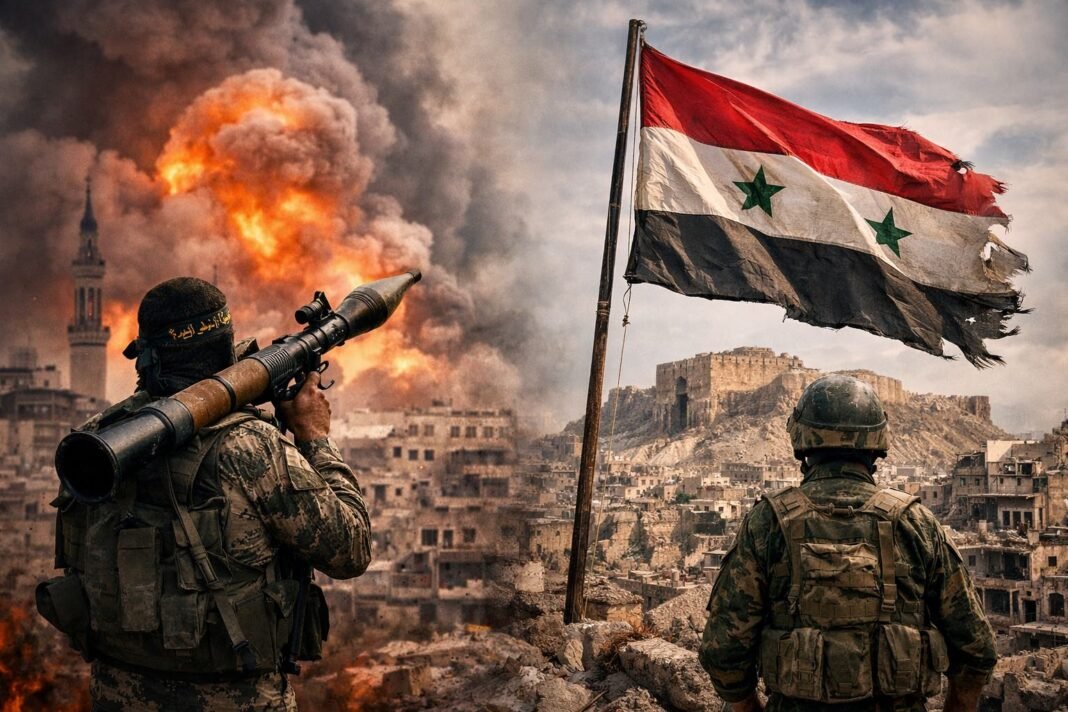
Syria points in the opposite direction. The emerging consensus around a unitary Syrian state – rather than a federation of armed zones or ethnic enclaves – reflects a broader shift away from fragmentation toward centralized authority, however imperfect.
This is not about idealism. It is about control.
Why a Unitary Syria Matters
A consolidated Syrian state serves several strategic purposes at once. It reduces the risk of permanent low-intensity conflict, limits the space for non-state armed actors, and transforms the conflict from a military problem into a political and economic one.
Crucially, it also simplifies diplomacy. Negotiations with a government – even a contested one – are easier than managing a battlefield crowded with militias, sponsors, and overlapping chains of command.
That is why actors with otherwise conflicting interests have, quietly and pragmatically, aligned around Syria’s territorial integrity. Not out of shared values, but out of shared fatigue with chaos.
Gaza Through the Same Lens
Current discussions around Gaza’s future – including temporary administrations, international oversight mechanisms, and new governance formats – follow the same logic.
The goal is not to reward one side or punish another. It is to remove armed movements from the role of political sovereigns and replace perpetual confrontation with administrable order.
This explains why traditional institutions appear sidelined and why ad-hoc formats are gaining traction. The international system is not being dismantled; it is being bypassed where it has proven unable to act.
Realism Over Rhetoric
What connects Gaza and Syria today is a broader regional recalibration. Major players are shifting away from ideology-driven intervention and toward outcome-based realism: stable borders, predictable authorities, and manageable risks.
This approach is morally uncomfortable and politically imperfect. But it reflects the realities of a region where slogans have failed and exhaustion has set in.
Syria has already become a testing ground for this new logic. Gaza may be next.
The central question is no longer who wins rhetorically, but who can function in a Middle East where chaos is no longer subsidized – and where survival increasingly depends on governability rather than resistance.

