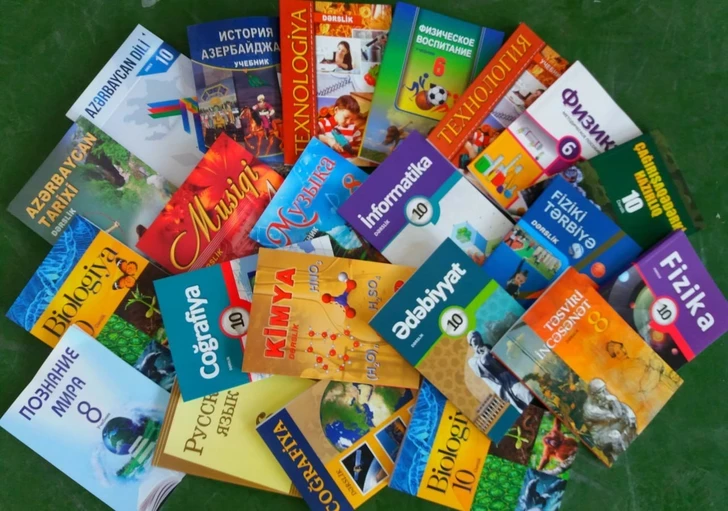
Recent remarks by Azerbaijan’s Minister of Science and Education, Emin Amrullayev, criticizing the quality of school textbooks, have ignited widespread public debate across the country.
Speaking at a recent forum, Amrullayev said that “the language of Azerbaijani history textbooks does not match the students’ age level” and called for the complete overhaul of history and biology textbooks.
“Most history textbooks are just a list of facts. That has to change,” he stated. “Our biology books also fail to meet international standards. We need to sit down and write proper textbooks for children.”
Stay Ahead with Azerbaijan.usGet exclusive translations, top stories, and analysis — straight to your inbox.
The statement sparked intense discussion on social media. Some commentators pointed out the irony that the Ministry itself oversees textbook development, suggesting the minister’s criticism effectively targeted his own institution. Others defended Amrullayev, saying he was acknowledging long-standing systemic flaws and pushing for long-overdue reform in how educational materials are written and approved.
How Textbooks Are Made
According to information provided by the Ministry of Science and Education to Modern.az, the textbook preparation process is governed by detailed regulations.
All materials are developed in accordance with the “Rules for the Preparation of Textbooks and Educational Materials for General Education Institutions”, approved by Cabinet Resolution No. 67 of February 25, 2020.
Each textbook is based on national educational standards and curricula defining the competencies and values students must acquire. The regulations require that textbooks be scientifically accurate, age-appropriate, pedagogically sound, and value-oriented, while also complying with Azerbaijan’s legislation.
Content is evaluated on a 100-point scale:
Alignment with curriculum – 30 points
Scientific accuracy and educational value – 40 points
Pedagogical and methodological quality – 20 points
Design and layout – 10 points
A balanced performance across these criteria is required for a textbook to be approved.
Before official adoption, every textbook is reviewed by at least three experts with over 10 years of teaching experience or a relevant academic degree. The Ministry also collects public feedback via the website www.trims.edu.az, where draft materials are published for open discussion. Comments and suggestions can be submitted directly online or via email at derslik@edu.gov.az.
Feedback from teachers, academics, and state bodies is compiled and forwarded to publishing houses for consideration before the final approval of each textbook. Additional pre-publication monitoring is carried out by the State Examination Center, which assesses scientific and methodological quality prior to printing.