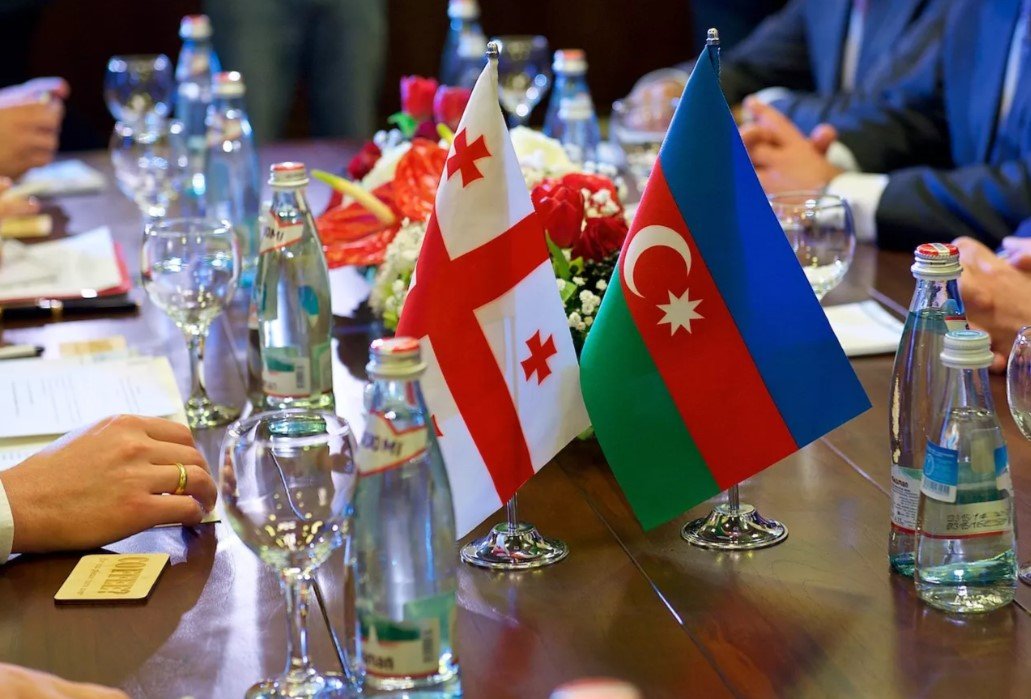
Tensions between Azerbaijan and Georgia have grown noticeably in recent months – not because of isolated bureaucratic issues, but due to a series of decisions in Tbilisi that suggest a shift in Georgia’s political calculus.
The situation at the Georgia–Azerbaijan border remains strained. According to Minval Politika, since September, Azerbaijani truck drivers have faced systematic delays, with some vehicles stuck for weeks. Georgian authorities have offered assurances but little meaningful action, fueling concerns in Baku about the country’s reliability as a transit partner.
Against this backdrop, a new development has intensified debate over Georgia’s regional role. On November 28, the 12th meeting of the Azerbaijan–Armenia border delimitation commissions took place in Gabala under the chairmanship of deputy prime ministers Shahin Mustafayev and Mher Grigoryan. Alongside technical issues, the sides also discussed potential avenues for economic cooperation.
According to sources familiar with the talks, one of the topics was the possibility of exporting Azerbaijani oil and petroleum products to Armenia – a move that could bring mutual economic benefits and strengthen the emerging space for peaceful regional development. Because Azerbaijan and Armenia currently lack a direct railway connection, the only possible transit route is through Georgia. For this reason, Baku requested a tariff quote for the Gardabani–Sadakhlo railway segment.
The response from Tbilisi was revealing. Georgia reportedly proposed a tariff of $92 per ton for the 111-kilometer route – roughly $0.82 per ton per kilometer. While the number may appear routine at first glance, comparative analysis paints a different picture.
In Azerbaijan, identical cargo travels 680 kilometers from Yalama to Boyuk-Kesik for $17 per ton, or $0.02 per ton per kilometer – making Georgia’s proposed rate 40 times higher. Such a disparity raises questions not about commercial logic but about intentions.
Even within Georgia, similar cargo is transported to the ports of Batumi, Poti and Kulevi for $17 over distances of 360–396 kilometers – $0.04-$0.05 per kilometer. When the transit benefits Georgia, tariffs are twenty times lower than those proposed for the Armenia-bound route. Economics alone does not explain the difference.
This approach inevitably raises concerns. Georgia – a country that relied heavily on Azerbaijan’s support during some of the most challenging periods of its modern history – is adopting decisions that undermine the trust of one of its key partners. Equally important, Georgia’s current monopoly over regional transit routes is no longer guaranteed. With new connectivity projects accelerating, attempts to leverage old chokepoints risk backfiring.
At a moment when the South Caucasus has a rare opportunity to transition from decades of conflict to economic integration, Georgia’s recent steps appear misaligned with wider regional interests. Instead of contributing to a sustainable architecture of peace and connectivity, Tbilisi risks slowing that process down.
Georgia must recognize that policies creating artificial barriers inevitably lead to consequences. Azerbaijan has invested consistently in Georgia’s economy and supported the country during critical periods. It cannot be expected to indefinitely overlook decisions that harm its interests.
History also matters. During Georgia’s most difficult years – including periods of heightened confrontation with Russia – Azerbaijan did not exploit Tbilisi’s vulnerabilities, nor did it impose inflated tariffs when Georgia was at its weakest. Baku acted as a partner, not a beneficiary of crisis.
This is why today’s situation raises a fundamental question:
Will Tbilisi acknowledge the problem and move toward constructive cooperation, or continue with the current approach at the expense of regional stability and its own long-term interests?