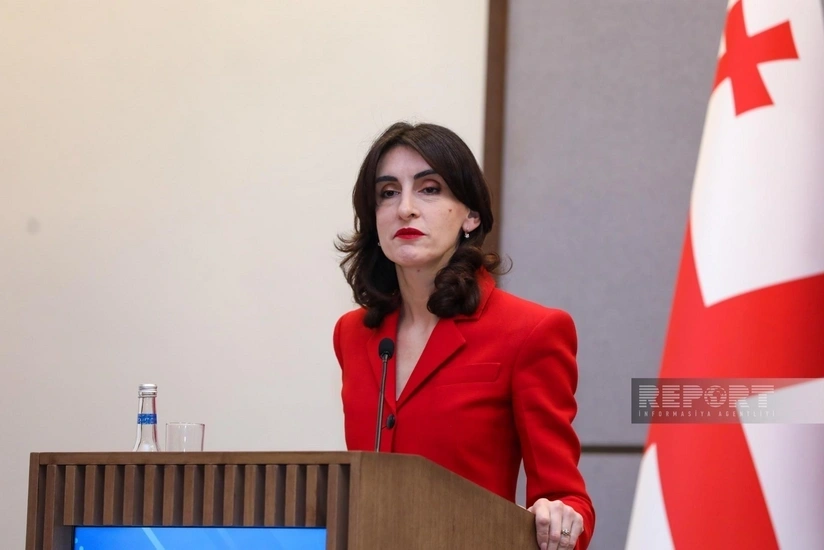
Georgia’s Foreign Minister Maka Bochorishvili sharply criticized the European Union, saying Brussels has “backed itself into a dead end” by cutting political contacts with Tbilisi over legislation adopted by the Georgian parliament.
Speaking to Georgia’s Imedi TV, Bochorishvili said the EU’s refusal to engage with the government was the result of its own miscalculations.
.
“Brussels trapped itself with its own decisions when it declared that all negotiations and relations with Georgia were suspended because the parliament passed laws based on the interests of the country and society,” she said. “Once a law is passed by parliament, asking to reverse it is not something that happens in democratic states.”
According to the minister, Prime Minister Irakli Kobakhidze repeatedly invited EU leaders to resume dialogue, but the invitations were ignored.
Visa Liberalization Debate: “Responsibility Lies with Brussels”
Asked about growing EU discussions on suspending visa-free travel for Georgian citizens, Bochorishvili said any such decision would be a purely political step by Brussels – and the responsibility would rest entirely with the EU.
“If Brussels takes the difficult decision to punish the Georgian people for their democratic choice, the responsibility will lie fully with Brussels,” she said on Imedi LIVE. “I hope this approach will not prevail.”
Bochorishvili added that for years, European integration has been used as a political tool in EU–Georgia relations, including during debates over Georgia’s candidate status.
“Ukraine and Moldova Did Not Overtake Georgia”
The foreign minister also dismissed claims that Ukraine and Moldova have advanced further in European integration, arguing that such narratives are artificially constructed by political groups.
“These claims are false. Georgia is significantly ahead of Ukraine and Moldova in key development indicators,” she said. “But the portrayal of Georgia as a ‘backward country’ has long been artificially created by certain circles.”
Bochorishvili stressed that for many years Georgia had been considered one of the EU’s most reliable and advanced partners – implying that current tensions stem from political pressure rather than issues of performance or democratic standards.

