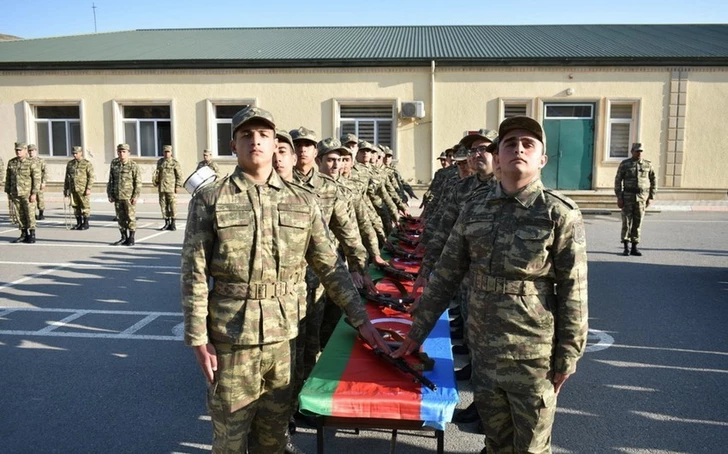
Elman Mammadov, a member of Azerbaijan’s Milli Majlis Committee on Defense, Security, and Anti-Corruption, has weighed in on growing discussions around increasing the military draft age from 18 to 20.
Speaking to local media, Mammadov emphasized that, like in many modern and developed countries, Azerbaijan is placing greater emphasis on building a professional, contract-based military force.
He pointed out that the current draft age of 18 is a legacy from the Soviet era. The idea of changing it is actively being discussed among defense policy circles.
But how necessary is such a change—and what would the impact be? More broadly, is it time for Azerbaijan to shift entirely to a professional military model?
Military expert and former official with Azerbaijan’s Ministry of Defense, Azad Isazade, shared his perspective with Media.Az.
“There are a few ways to look at this. At 18, people can vote, drive, get married—and serve in the military. Legally, they are full citizens,” he noted. “That said, the difference between 18 and 20 is significant. A 20-year-old is usually either in college, working, or has gained social and team-oriented experience. That makes adapting to army life easier.”
He added that students who join the army after graduating with a bachelor’s degree—usually around age 21—often find service less challenging than 18-year-olds do.
From a purely military standpoint, Isazade said the war in Ukraine has underscored the importance of having a population with basic military training.
“Even if the law remains the same, we could consider drafting 18-year-olds for a shorter term—say, one year—to give them essential skills, without engaging them in combat or high-risk operations,” he said.
According to Isazade, a professional (contract-based) army is essential for absorbing the first strike in a conflict—buying time for the country to mobilize reserves and trained former conscripts.
“This has been proven in modern wars, including the 2020 Second Karabakh War and the ongoing Russia-Ukraine conflict. In our own war, the initial breakthroughs were made by professional special forces. Still, losses were comparable between conscripts and professionals—highlighting the training gap. A conscript might serve 1–1.5 years, while a contract soldier serves at least two or more,” he explained.
Isazade noted that even a well-trained professional force can only go so far without adequate reserves.
“In 2022, Russia launched its invasion of Ukraine with a professional army of around 300,000 troops. It wasn’t enough—they had to announce mass mobilization by September. That’s a clear strategic miscalculation. Today, they’re plugging battlefield gaps with poorly trained recruits under the label of ‘contract soldiers’.”
As for legislative reform, Isazade said conscription should remain in place for the purpose of basic training and reserve force development, while the active-duty core should consist of professionals.
He also floated the idea of increasing the number of draft cycles from two to four per year, though acknowledged that the current spring and autumn drafts are timed for milder weather to ease new recruits through initial training.
Before raising the draft age, Isazade believes demographic trends must be considered.
“We need data on how many boys are born over the last 10–15 years to understand what kind of manpower we’ll have at 18 or 20. If projections show sufficient numbers at 20, then increasing the age makes sense. But we must also factor in geopolitical risks and the possibility of future conflicts.”
In conclusion, Isazade warned against rushing reforms.
“Right now, I wouldn’t recommend changing the system. Any reform takes at least 2–3 years to implement, and transitions are always painful for the military. The priority should be to look at long-term demographic and strategic trends—and plan accordingly.”

