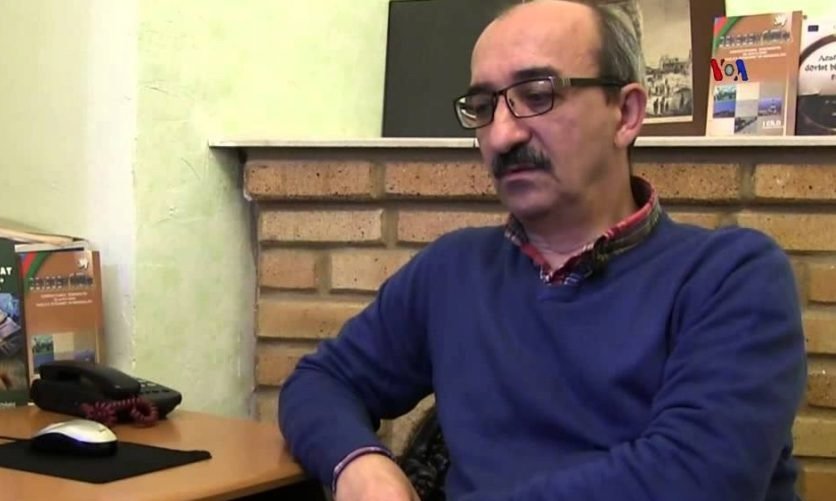
The idea of returning Azerbaijanis to Armenia and Armenians to Azerbaijan remains deeply risky and potentially destabilizing under current conditions, analyst Azad Isazade warned in a new episode of the Echo Baku project, hosted by Movsun Hajiyev.
The discussion ranged from the recent Kazakh wheat transit to Armenia to Moscow’s reaction, and the unresolved challenges within the Armenia–Azerbaijan peace process.
Kazakh Wheat Transit: A Step Toward Peace, Kremlin Anxiety
Isazade began by clarifying that Azerbaijan had not “lifted a blockade,” but had allowed transit of Kazakh wheat – which travels by rail through Georgia, not directly from Azerbaijan into Armenia.
He called the move “a colossal step toward peace,” though reactions have varied widely in Baku, Yerevan and Moscow.
The most unexpected reaction came from Russia’s Foreign Intelligence Service (SVR), which issued a statement about the commercial shipment.
“For the SVR to comment on a grain delivery is entirely off-topic,” Isazade said, noting that the cargo passes through multiple customs checks, leaving no room for covert transfers.
He suggested the real reason for irritation is that Armenia – which previously relied on Russia for up to 90% of its wheat – is becoming less dependent on Moscow.
Peace Negotiations: Guarantees and Distrust
Addressing Armenian claims that Azerbaijan is making “inadequate” demands, Isazade argued that Baku’s concerns stem from decades of conflict.
“Azerbaijan has more than 30 years of negative experience. No one can guarantee that a future leadership in Armenia won’t return to aggression,” he said. “That’s why guarantees are needed.”
These may include constitutional amendments in Armenia, he added, though even the best treaty is no absolute safeguard.
Peace, Isazade stressed, also requires dismantling the entrenched enemy images in both societies: “In war, the enemy image helps; in peace, it prevents reconciliation.”
Mutual Return of Communities: A Dangerous Scenario
At this point in the interview, host Movsun Hajiyev raised the idea – discussed in some analytical circles – of returning Azerbaijanis to Armenia and Armenians to Azerbaijan as a mutual guarantee or lever of stability.
Isazade rejected this outright.
“If, for example, 10,000 Azerbaijanis settle in Armenia, we are essentially turning them into hostages,” he said. “Armenia pledges territory; we pledge our people.”
He emphasized that humanitarian issues (like long-term return of displaced persons) should not be weaponized as political tools.
Isazade also recalled that Armenian intellectuals in the late 2000s openly said they viewed the return of Azerbaijanis as an existential threat – a stance that, he argued, is even stronger today.
Hajiyev summarized the risks bluntly:
“In today’s circumstances, returning Armenians to Azerbaijan and Azerbaijanis to Armenia would be like placing a loaded gun on the table – aimed at both Baku and Yerevan.”
Isazade agreed.
Memory Politics: A New Tension Point?
The analyst also commented on a proposal in the Armenian parliament to establish a national Memorial Day for soldiers killed in conflicts with Azerbaijan.
Honoring the dead is legitimate, Isazade said, but framing those who fought on occupied territories as national heroes inevitably sends a political signal and risks complicating peace efforts.
“You cannot imagine Germany establishing a memorial day for Wehrmacht soldiers who died in the USSR or France,” he said.
The Realistic Path: Dialogue Without Artificial Triggers
Both Isazade and Hajiyev concluded that neither society is psychologically ready for intermingled populations, given the scale of trauma on both sides.
“For now, the safest formula is simple,” Isazade said.
“Azerbaijanis live in Azerbaijan, Armenians live in Armenia – and we build relations through dialogue, cooperation and communication, not through mutual points of vulnerability.”
Hajiyev ended the discussion with a wish for “peaceful skies over the heads of both Armenians and Azerbaijanis,” to which Isazade answered: “Amin.”