Baku, September 20, 2025
By Azerbaijan.US Editorial Board
[Editor’s note: Arman Abovyan, “Бумажный ‘щит’…”, Sputnik Armenia, Sept 15, 2025 — link]
A recent Armenian opposition column casts the world as pure lawlessness and derides Washington’s peace text as a “paper shield.” It’s a striking piece of rhetoric. It’s also a blueprint for permanent paralysis.
Call it what it is: non-constructivism. Instead of proposing safeguards, timelines, or enforcement tools, the argument reduces policy to a single instruction – don’t sign.
Everything is collapse: international law is gone; diplomacy is theater; any agreement equals capitulation. When politics becomes apocalyptic prophecy, there’s no room left for practical steps that actually protect people.
That worldview has three problems.
First, it’s selectively factual. The essay leans on sweeping claims to argue that rules mean nothing anywhere. Yet even in a messy world, rules and mechanisms still shape outcomes: monitoring missions change behavior at borders, escrowed payments condition infrastructure projects, and legal clauses – however imperfect – give governments levers when partners slip. “Nothing works” is not analysis; it’s an alibi for inaction.
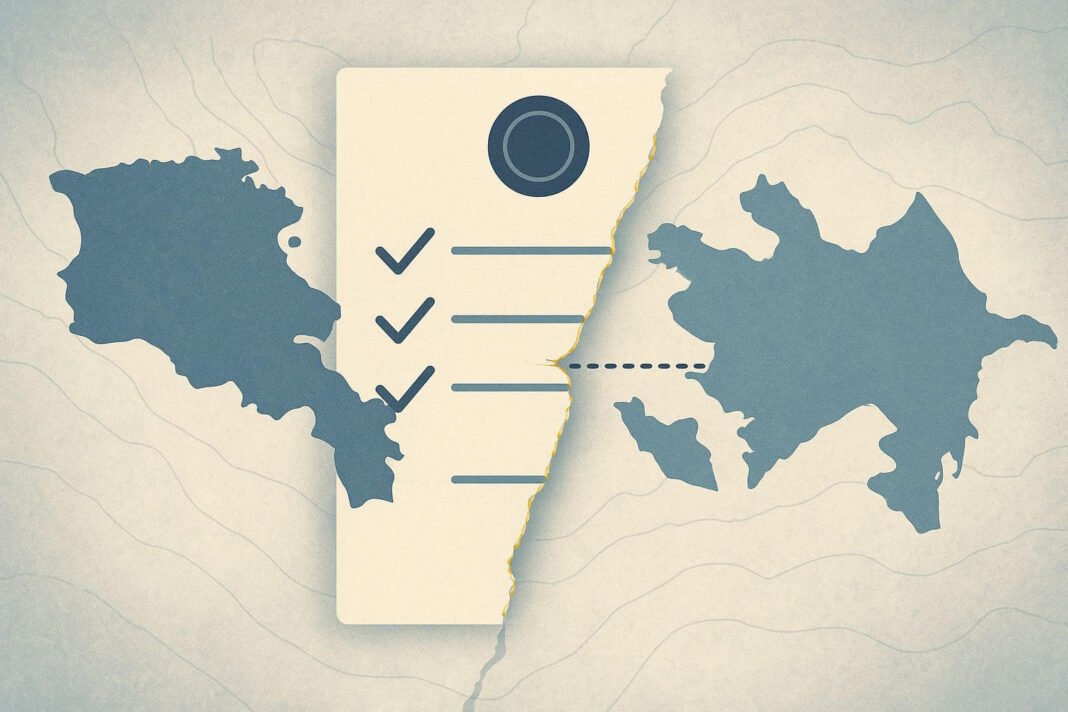
Second, it substitutes maximalism for strategy. If your baseline is “no deal unless it guarantees everything,” you’ve pre-written the headline: “No deal.” That might energize a rally; it does not solve corridor management, demarcation, trade, or the return and rights of civilians. Politics is what you do after the photo op: the checklists, inspections, and snapback provisions you insist on when cameras are gone.
Third, it misreads leverage. Declaring that only raw power matters while refusing frameworks that structure power relations cedes the field to whoever can impose facts on the ground. Armenia’s opposition says it wants deterrence; its playbook ensures drift.
Constructive opposition is not submission. It is conditionality – backed by detail. If the objective is a durable peace with verifiable security, here is what a constructive platform would demand instead of tearing up the page:
Clause – by – clause enforceability. Insist on measurable milestones (border pillars by date X; customs/immigration posts by date Y) and attach automatic remedies for missed targets – fee adjustments, paused transit quotas, or third-party arbitration within 30 days.
Independent monitoring you can escalate. Embed a neutral observer mechanism (mutually acceptable format) with public monthly reports and an incident hotline. Monitoring without publication is theater; publication creates pressure.
Human-security benchmarks. Tie each infrastructural opening to civilian protections: safe-passage protocols, humanitarian access, property claims processing, and language/cultural safeguards – reviewed quarterly with boringly specific metrics.
Economic conditionality that cuts both ways. Use escrow for big cross-border projects and snapback for violations. If either side breaches, funds pause automatically until an adjudicator says otherwise.
A real dispute ladder. Start with joint commissions and end with time – boxed arbitration by a pre-selected panel. No open-ended “talks about talks.”
Will such mechanisms solve everything? No. But they convert slogans into systems – and systems, however imperfect, are how small states survive in hard neighborhoods. If you believe the world respects only leverage, build it into the text: verifiable timelines, automatic triggers, outside eyes, money that moves (or doesn’t) on performance.
There is also a democratic point. Opposition’s job is not to burn every bridge the government tries to cross; it is to weight-test the bridge. That means publishing an alternative treaty checklist, not just a YouTube rant. It means proposing amendments that raise the cost of non-compliance, not the volume of outrage. It means telling voters what would make a deal acceptable – and how you would enforce it if you were in charge tomorrow morning.
Armenia and Azerbaijan are closer to a comprehensive settlement than at any time in decades. That does not make peace inevitable. It makes details decisive.
The choice facing Armenia’s opposition is not between romantic defiance and naïve compromise; it is between catastrophism and conditional engagement. One keeps you pure and powerless. The other lets you rewrite the fine print that will govern lives long after this news cycle ends.
Fear can fill a square. It cannot staff a checkpoint, run a corridor, or safeguard a family moving back to a village. If the opposition truly believes strength is what counts, it should act like it: stop railing against paper and start drafting terms that have teeth.

