By Eldar S., Special to Azerbaijan.US
By singling out Sergei Markov — a former State Duma deputy, longtime Kremlin loyalist, and once even a trusted representative of Vladimir Putin — Moscow has made clear that no level of loyalty protects those who misstep in today’s political climate. Markov’s recent inclusion on the Justice Ministry’s registry of “foreign agents” was not just about paperwork or legal technicalities. It was punishment — and punishment with geopolitical undertones.
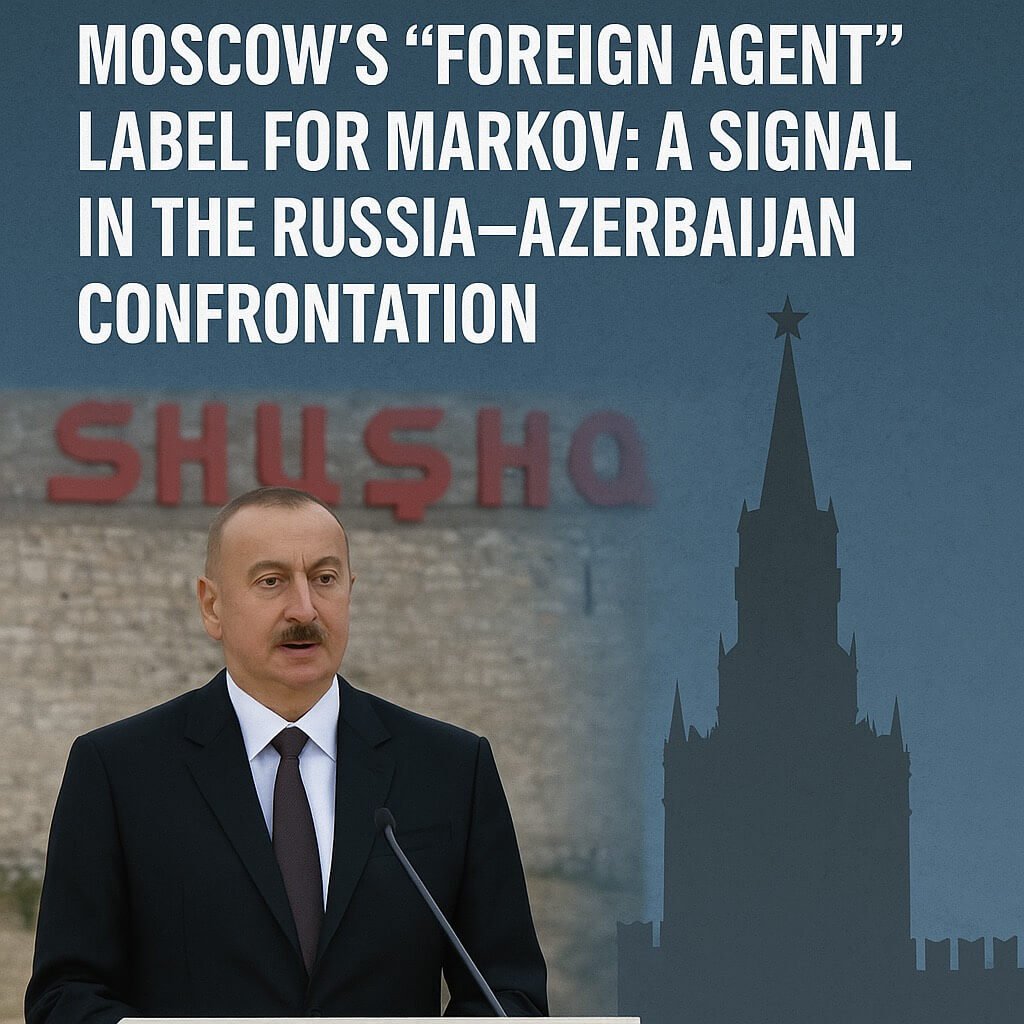
Markov’s career has hardly been that of a dissident. For decades he has endorsed Putin’s policies, defended Moscow’s narratives abroad, and served as a reliable figure in Russia’s propaganda machinery. Yet his visit to Shusha for the July media forum, where Azerbaijani President Ilham Aliyev publicly voiced support for Ukraine’s territorial integrity, became the breaking point. Markov did not protest, did not challenge Aliyev’s words — and that silence, in the Kremlin’s logic, was unforgivable.
He was not alone. Mikhail Gusman, the influential deputy director of TASS and another participant of the Shusha event, was swiftly removed from his post. The Kremlin’s message is blunt: any Russian public figure who fails to counter Aliyev’s rhetoric, or who appears too close to Baku’s position, risks professional ruin.
The irony is glaring. Russia brands Markov a “foreign agent” — a man who has been one of Putin’s most loyal foot soldiers, sanctioned not for cozying up to the West, but for being caught in the crossfire of Moscow’s growing confrontation with Azerbaijan.
What these moves reveal is a Kremlin shaken by its shrinking influence in the South Caucasus. Aliyev’s assertiveness — from peace agreements in Washington to open statements on Ukraine — has left Moscow humiliated. Unable to punish Baku directly, the Kremlin is turning inward, targeting its own commentators for failing to perform the ritual of objection.
Markov’s case is not about foreign money or hostile propaganda. It is about disciplining loyalty, drawing red lines in the Russia–Azerbaijan rivalry, and sending a chilling signal: silence in the wrong place can be as damning as dissent.

