By Azerbaijan.US Editorial Board
Why this op-ed was written
Earlier this week, a local Azerbaijani media outlet published an article portraying young women who visit bars and nightclubs as a moral problem. The piece triggered a strong public reaction – not because of nightlife itself, but because many readers saw it as another example of selective moral outrage.
Instead of addressing corruption, abuse of power, or the erosion of trust in key institutions, the debate once again focused on women’s personal choices.
The op-ed below responds to that discussion. It argues that societies often target the most visible – and least powerful – while ignoring the behavior that causes real damage.
This is not a text about bars.
It is a text about where societies choose to look when they talk about “morality.”
OP-ED
Bars, Women, and the Comfort of Moral Hypocrisy
There is a strange hierarchy of moral panic in many societies. Some issues provoke outrage instantly, loudly, and with moral certainty. Others – far more damaging – are quietly tolerated, rationalized, or ignored altogether.
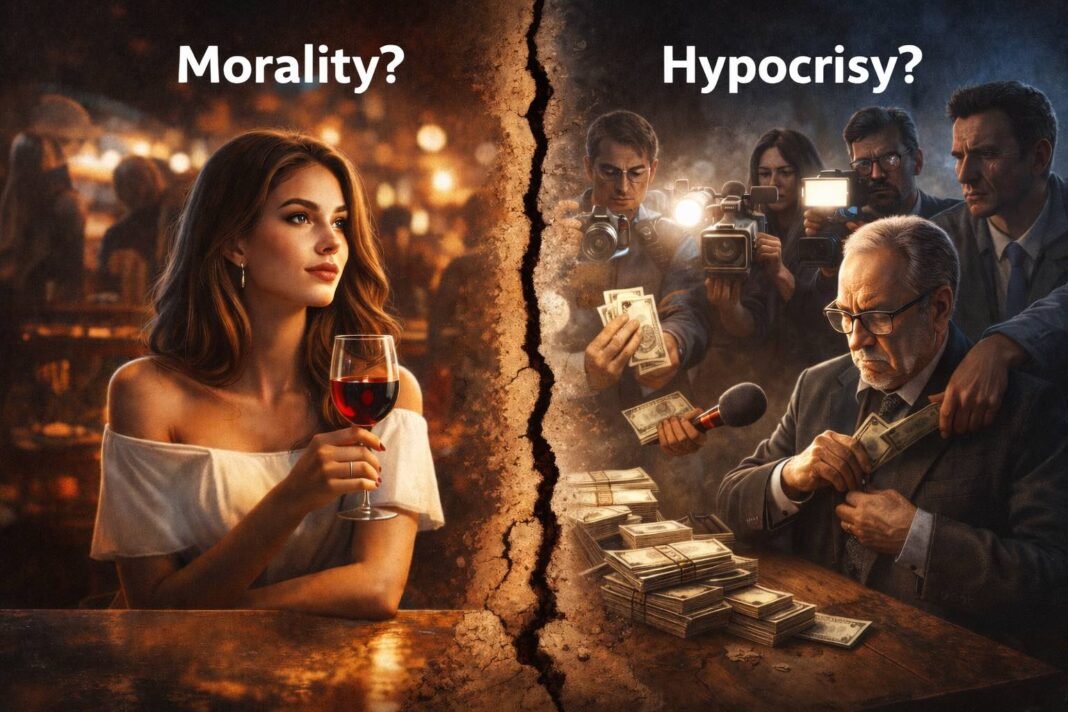
For some commentators, the greatest social threat appears to be a young woman sitting in a bar in the evening. A woman who chooses how to live, how to socialize, and how to spend her free time. Her presence becomes a symbol – not of harm, but of anxiety.
Yet the same moral energy is rarely directed at issues that shape everyday reality in far more destructive ways.
It is apparently not scandalous when a journalist distorts facts for money. It is not alarming when corruption quietly decides grades, careers, or court rulings. It is not urgent when institutions lose credibility, when trust collapses, when dishonesty becomes routine.
Those problems are complex.
They require confrontation.
They demand courage.
Judging women does not.
Focusing on lifestyle choices is easy. It is emotionally satisfying and politically safe. The woman in the bar has no institutional power, no influence over budgets or policies, no legal shield. She is a convenient target – visible, defenseless, and easy to label.
This is why moral debates so often drift toward clothing, behavior, and “proper conduct,” instead of accountability, ethics, and abuse of power.
But morality is not measured by where someone spends an evening. Morality is measured by choices that affect others.
Do you take what is not yours?
Do you lie when truth is inconvenient?
Do you use power against those who cannot resist it?
These are moral questions.
Bars are not.
When societies obsess over women’s behavior, it is rarely about tradition or values. It is about control. A woman who is free to choose is also free to question. And a questioning individual is harder to manage than a silent one.
That is why narratives shift. Labels appear. Stereotypes multiply. Attention is redirected – away from systems, toward individuals. Away from responsibility, toward appearances.
Meanwhile, the real damage continues quietly: education erodes, media credibility weakens, ethical standards fade.
And then the same society asks, with apparent surprise: How did things get this way?
Perhaps the answer is simple. We searched for morality in the wrong places. We chose the easy target over the powerful one. We mistook visibility for danger.
A woman in a bar does not threaten society. A society that confuses control with ethics does.