Azerbaijan.US
Discussions about deeper security and defense cooperation among Turkic states have gained renewed attention amid shifting geopolitical dynamics involving Russia, China, NATO, and the broader Eurasian region.
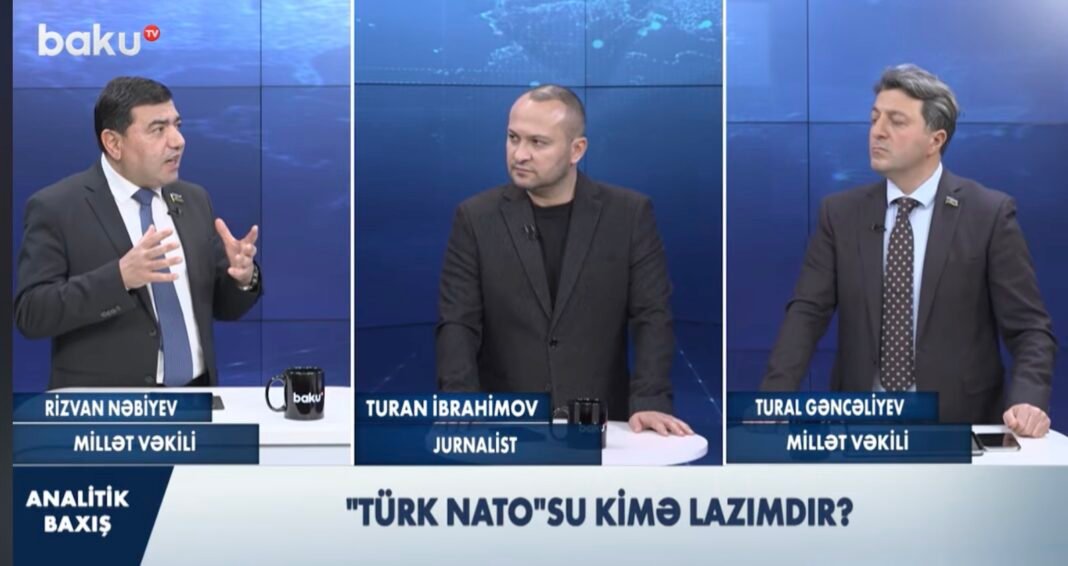
The topic was at the center of a recent analytical political talk show aired on Baku TV, where experts examined whether the Organization of Turkic States could eventually develop a stronger security or defense coordination mechanism.
Participants stressed that the often-used label “Turkic NATO” is misleading and does not reflect the current reality or official intentions of the organization.
Rather than forming a military bloc, Turkic states are gradually expanding cooperation in areas such as defense industries, military training, strategic coordination, and broader security issues.
Analysts noted that the Organization of Turkic States already cooperates across more than 30 fields, including trade, transport, energy, digitalization, education, and culture.
Security, they argued, is a natural extension of this cooperation-especially as modern security challenges now extend beyond traditional military threats to include energy security, logistics routes, hybrid threats, and economic resilience.
A key point raised during the discussion was the diverse geopolitical positioning of member states.
Turkey is a member of NATO, some Central Asian countries participate in other regional security frameworks, while Azerbaijan follows a non-aligned security policy, relying primarily on bilateral and multilateral partnerships rather than formal military blocs.
Experts emphasized that closer security coordination among Turkic states is not aimed against any third country. Instead, it reflects an effort to protect national interests and regional stability in a rapidly changing global environment.
The discussion also referenced the strategic document “Vision of the Turkic World – 2040”, which outlines long-term goals for institutional development and cooperation within the organization.
While the document includes security-related elements, panelists underlined that any progress in this area would be gradual, pragmatic, and based on political consensus and legal frameworks.
According to analysts, growing coordination among Turkic states has naturally drawn international attention, but such processes are consistent with global trends, as regions seek greater self-reliance and strategic autonomy.
The debate concluded that Turkic integration is entering a more mature phase-focused less on symbolism and more on practical cooperation-where security is viewed as a multidimensional concept shaped by economics, infrastructure, technology, and diplomacy, rather than purely military power.

