By Azerbaijan.US Editorial Board
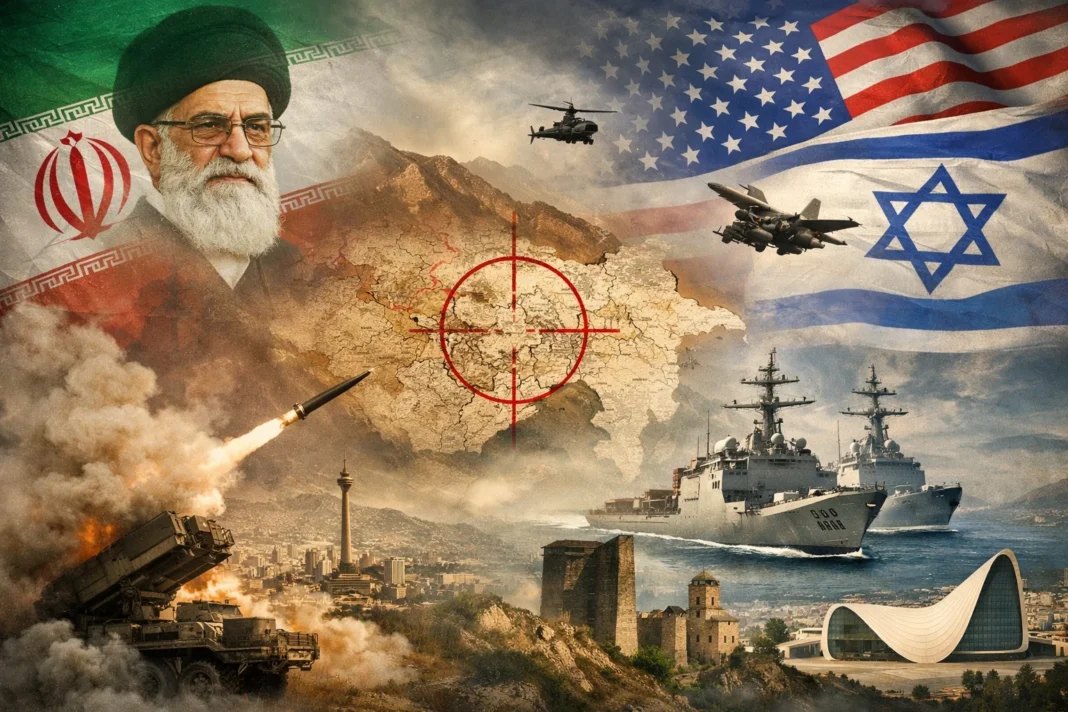
The latest escalation around Iran is unfolding less like a sudden crisis and more like the slow tightening of a strategic vise. Military signaling from the United States and Israel, paired with Tehran’s calibrated rhetoric about deterrence and readiness, suggests that the confrontation has entered a new psychological phase – one where preparation matters as much as action.
For the South Caucasus, this is not abstract geopolitics. Geography alone ensures involvement. Any sustained confrontation involving Iran inevitably redraws logistical routes, intelligence priorities, and security assumptions across Azerbaijan, Armenia, and Georgia. What once looked like a regional balance now resembles the outer ring of a much larger strategic theater.
Washington’s posture appears designed to combine pressure with ambiguity. Naval deployments and security consultations signal capability without committing to immediacy. Israel’s messaging, by contrast, remains sharper – focused on prevention rather than containment. Tehran, meanwhile, walks a narrow line between projecting strength and avoiding a trigger that could justify direct confrontation.
In this triangular tension, the South Caucasus quietly gains importance.
Energy corridors running westward from the Caspian become more valuable in any scenario where Gulf instability threatens supply chains. Transport routes linking Central Asia to Europe acquire new security meaning. Even airspace management and intelligence cooperation shift from routine coordination to strategic necessity.
None of this requires open war.
Prolonged uncertainty alone is enough to transform the region.
Azerbaijan, in particular, sits at the intersection of opportunity and risk. Stability enhances its role as an energy and transit hub for Europe. Instability, however, could pull the country into security calculations not of its choosing. The challenge for Baku is to remain indispensable without becoming exposed – a delicate balance that defines small-to-mid powers during major-power rivalry.
Armenia faces a different equation. Reduced reliance on traditional security partners has already pushed Yerevan toward cautious diversification. A wider Iran crisis would accelerate that search for external guarantees while simultaneously narrowing room for maneuver.
Georgia, long positioned as a transit and diplomatic bridge, would again find itself managing pressure from multiple directions – economic, political, and security-related – even without direct involvement.
The broader pattern is clear.
The Middle East and the South Caucasus are no longer separate strategic spaces. They are merging into a single corridor of competition stretching from the Eastern Mediterranean to the Caspian Sea.
Whether a strike on Iran ultimately happens may matter less than the environment created in anticipation of it. Markets react early. Militaries reposition early. Alliances quietly adapt early. By the time the world speaks of crisis openly, the geopolitical map is often already redrawn.
That process is now underway.
And in this emerging landscape, the South Caucasus is no longer watching events from the sidelines. It is already part of the board on which the next phase of great-power tension will be played.