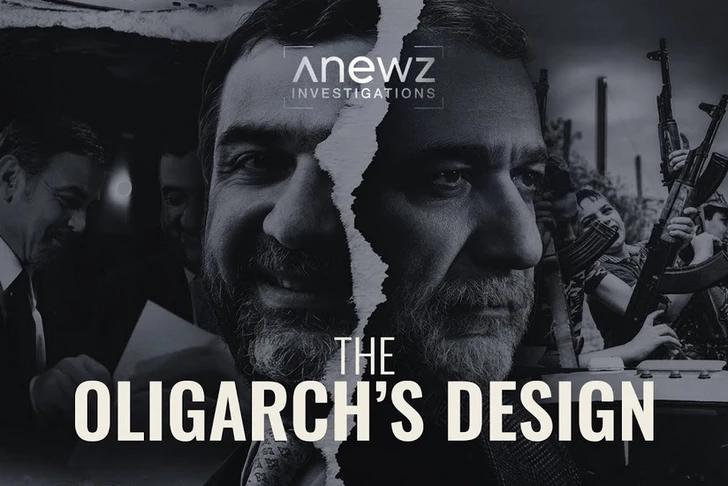
Azerbaijani media has released a new investigative documentary examining the financial power, political influence, and public-narrative role of Ruben Vardanyan, an Armenian citizen accused of serious crimes against Azerbaijan.
The film, titled The Oligarch’s Design, was produced by AnewZ and focuses on how financial resources, political positioning, and coordinated messaging can shape conflicts and public perception.
According to the filmmakers, the documentary is based on international investigative journalism, open-source intelligence, and materials related to the large offshore financial network known as the Troika Laundromat, which was previously exposed by international media and reportedly linked to Russian corporate and political interests.
From Moscow’s Financial Elite to Karabakh Politics
The documentary traces Vardanyan’s transition from Moscow’s financial circles to political involvement in Karabakh. It highlights his renunciation of Russian citizenship in 2022 and his subsequent role among separatist structures in the region.
Video footage used in the film includes commentary describing his arrival in Karabakh in late summer 2022:
“They arrived in Karabakh in late August, early September 2022.”
Other excerpts in the documentary reflect how his actions were perceived internationally:
“He is a criminal for Europe, for NATO countries, and for Ukraine. That’s why we need to arrest him.”
Another segment underscores a narrative attributed to Vardanyan’s stance during that period:
“I will stay with my people here. Whatever they will face, he will face together.”
The film presents these statements as part of a broader examination of how messaging and positioning were used during a sensitive geopolitical period.
Financial Networks and Narrative Power
The Oligarch’s Design explores how offshore financial structures and political messaging can operate simultaneously, often outside public scrutiny. The documentary situates Vardanyan’s activities within a wider geopolitical and financial framework, arguing that individuals with significant resources can influence regional stability without holding formal state positions.
According to AnewZ, the purpose of the film is not advocacy, but documentation.
The project aims to analyze mechanisms of power, influence, and narrative formation, and to inform the public about how financial and political tools intersect in conflict environments.
The documentary has been released as part of Azerbaijan’s broader media focus on transparency, accountability, and the international dimensions of regional conflicts.