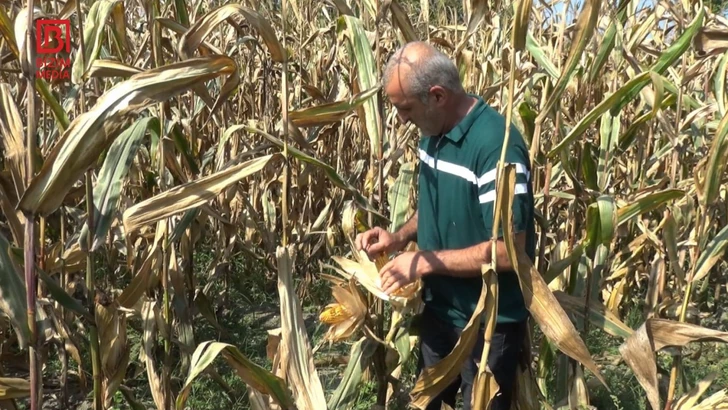
In Azerbaijan’s northwestern Balakan district, vast golden fields of corn stand ready for harvest – but farmers are in no hurry to collect their crops.
This year, about 8,000 hectares of grain corn were planted, marking one of the region’s strongest yields in recent years. Yet, despite the healthy harvest, the fields remain largely untouched.
The reason is simple – and harshly economic. Procurement prices have collapsed, dropping almost by half compared to the previous decade.
Between 2013 and 2022, Balakan farmers consistently sold their grain for 40–45 gapiks per kilogram, Bizim.media report. In 2025, processing companies are offering barely 28 gapiks, a price that farmers say makes harvesting financially senseless.
“The cost of renting land is around 2,500–3,000 manats, and our yield is good – about 8 to 11 tons per hectare,” says Musa Sheikhov, a farmer from the village of Khanifa who cultivates 20 hectares of cornfields, much of it leased from the municipality. “But at 28 gapiks per kilo, there’s no profit at all.”
The Balakan district uses a land classification system that adjusts rent according to soil fertility – from 500 to 800 manats per hectare. Sheikhov, who expanded his fields to 30 hectares this season, argues that the pricing mechanism for corn must be revised, or many local farms will simply stop production next year.
Rising Costs, Falling Returns
Modern corn production is an expensive venture. “Land rent, high-quality seeds, fertilizers, and machinery services – all of that adds up,” says Shadnus Mammadov, another local farmer. “At current prices, we can’t recover even the basic costs.”
Fellow producer Faig Rasulov describes the situation more bluntly:
“We used to get 40-45, sometimes 50 gapiks per kilogram. Now they’re offering 28. It doesn’t even cover the cost of production.”
Rasulov notes that over the past decade, fertilizer prices have increased by 20–30 manats per bag, while the cost of seeds and harvesting services has also surged. “Everything went up – except what we earn,” he adds.
No State Leverage — Only Negotiation
Under Azerbaijan’s market-based agricultural system, the Ministry of Agriculture has no direct authority over grain prices. Purchases are made by private processors and traders who set their own rates based on global market trends and domestic demand.
Even so, talks have begun. Procurement companies recently met with farmers from Balakan, Zagatala, and Gakh districts to discuss potential price adjustments. According to local sources, both sides have agreed to continue negotiations in hopes of reaching a compromise that would at least make harvesting economically viable.
Between Policy and Survival
The crisis underscores a broader challenge facing Azerbaijan’s rural economy: the gap between agricultural productivity and profit. Farmers may be producing record harvests – but without fair prices or state support mechanisms, their success risks turning into loss.
As Sheikhov puts it, “We can grow corn. That’s not the problem. The problem is whether it’s worth harvesting at all.”

