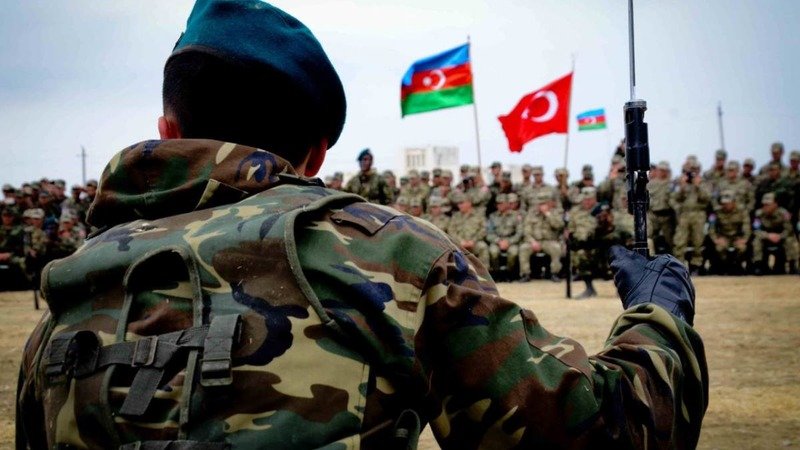
Amid growing tensions with Moscow, former presidential chief of staff Eldar Namazov has publicly called for the establishment of a Turkish military base in Azerbaijan — a provocative proposal that signals shifting dynamics in the South Caucasus and intensifies the strategic recalibration underway in Baku.
Namazov argued that Azerbaijan is under mounting pressure from both Russia and Iran, countries he labeled direct threats to national sovereignty. His remarks came just hours after Russia’s Foreign Ministry issued a strongly worded statement warning against actions it said could undermine “strategically important” ties with Baku.
The rhetorical escalation follows the June 27 killing of two Azerbaijani citizens during a Russian police raid in Yekaterinburg — an incident Azerbaijan has condemned as an ethnically motivated act of violence. Moscow denies any wrongdoing, but the fallout has been swift: Baku has detained Russian nationals, suspended bilateral cultural programs, and shut down Russian media outlets operating in the country.
While officials in Moscow attempt damage control, the deepening diplomatic rift is bringing long-shelved debates over foreign military infrastructure back into public discourse.
Calls for a Turkish military base have surfaced periodically over the past decade, only to be publicly dismissed — most recently by President Ilham Aliyev, who six months ago branded such talk as “unnecessary and politically driven.” However, as relations between Baku and Moscow reach a new low, what was once dismissed as rumor is now resurfacing with symbolic weight.
“A major Turkish military base must be established in Azerbaijan in the near future,” Namazov declared. “It would send a clear message to hostile neighbors — and could even be shared with our other ally, Pakistan’s nuclear-capable air force.”
While Namazov’s proposal does not reflect official Azerbaijani policy, it underscores a growing strategic consensus in Baku that favors deeper Turkish involvement in regional security. Since the 2020 Nagorno-Karabakh war, Turkey’s military, political, and technological support has become foundational to Azerbaijan’s postwar defense posture.
Still, President Aliyev has reiterated his opposition to a permanent foreign base, citing the 2021 Shusha Declaration signed with Turkey, which includes mutual defense provisions.
“That clause alone is sufficient. It renders the creation of permanent infrastructure unnecessary,” Aliyev stated, adding that in today’s surveillance-driven world, concealing such a facility would be virtually impossible.
Despite Azerbaijan’s denials, Moscow remains uneasy. The Kremlin has long regarded any potential NATO-linked presence in the South Caucasus as a “red line.” In 2021, Kremlin spokesperson Dmitry Peskov warned that a Turkish base in Azerbaijan would provoke “serious concern” and trigger national security countermeasures.
Analysts point to Turkey’s expanding military footprint in regions like Syria, Iraq, Libya, and now the Caucasus, as reasons for Russia’s growing unease.
“If this proposal is ever formalized, it could completely redraw the security architecture of the region — and escalate tensions with Russia to a new level,” one European diplomat familiar with regional security dynamics told us.
Turkey’s influence in Azerbaijan is already substantial. Since 2020, Turkish military advisors have worked closely with Azerbaijani forces, and joint exercises have become routine. Ankara’s defense industry — especially drone technology and arms exports — plays a central role in Azerbaijan’s modernization drive.
Diplomatically, President Recep Tayyip Erdoğan has positioned Turkey as a quiet but active mediator between Baku and Yerevan. His recent meeting with Armenian Prime Minister Nikol Pashinyan in Istanbul — the first such visit since the Cold War — signaled Turkey’s ambition to become the region’s leading political broker, a role once dominated by Moscow.
While the prospect of a Turkish base remains speculative, it reflects broader shifts in Azerbaijan’s foreign policy orientation, particularly as Russia’s war in Ukraine continues to isolate Moscow.
Though Azerbaijan has stopped short of joining Western sanctions or openly aligning with anti-Russian platforms, it has deepened ties with Turkey, Pakistan, Israel, and more recently, China — all part of what observers see as a deliberate strategy to diversify away from Russia’s orbit.
Andrew D’Anieri, a resident fellow at the Atlantic Council’s Eurasia Center, sees a pragmatic calculation at play:
“President Aliyev won’t allow this episode to unravel the foundation of Baku-Moscow ties. While cultural and educational ties may suffer, energy exports and strategic cooperation are likely to endure,” he said.
For now, Russia appears to need Azerbaijan more than Azerbaijan needs Russia, giving Baku increased leverage as tensions rise.
The idea of a Turkish base may remain unfulfilled — but in the current climate, even its mention sends a signal: Azerbaijan has options, and it is not afraid to explore them.
Whether or not a base materializes, the geopolitical center of gravity in the South Caucasus is clearly shifting — and Ankara and Baku appear determined to shape that future on their own terms.

