Azerbaijan.US
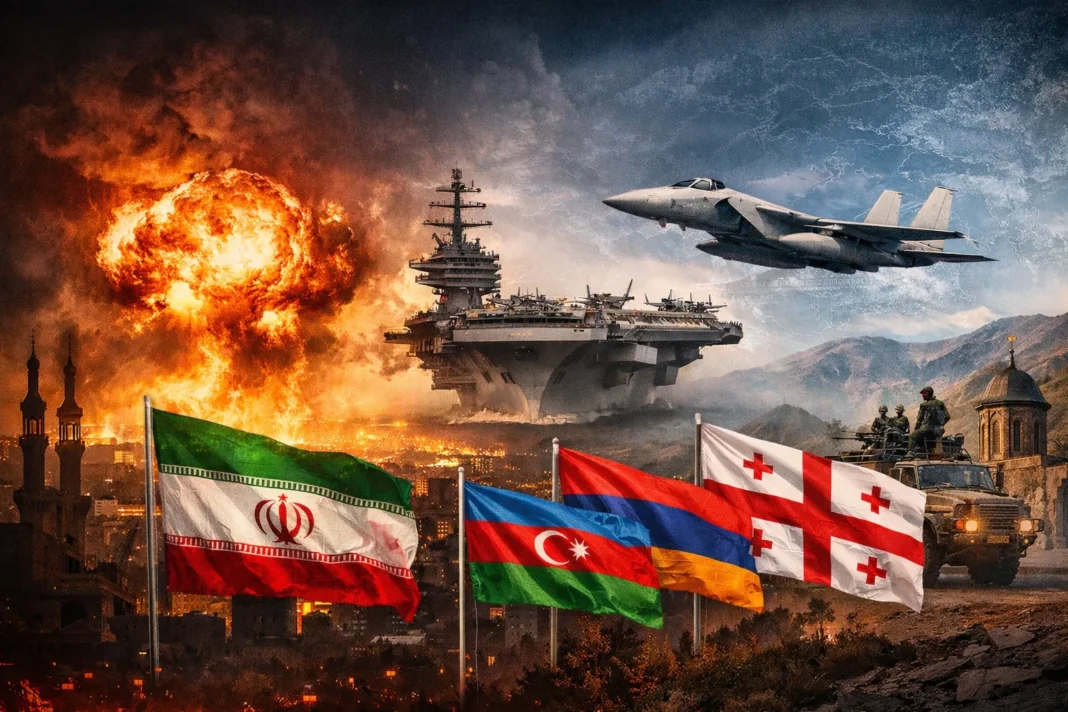
Recent explosions inside Iran have once again raised questions about stability across the wider South Caucasus – a region increasingly caught between collapsing security guarantees and an unfinished new order.
Speaking during a live broadcast on the Novosti Kavkaza YouTube channel, political analyst Rizvan Guseynov outlined why current developments should be seen not as isolated incidents, but as part of a broader geopolitical transition.
According to Guseynov, the situation around Iran reflects a familiar pattern in U.S. foreign policy under President Donald Trump: initial pressure and escalation, followed by tactical de-escalation and negotiations. The presence of aircraft carrier strike groups and sharp rhetoric, he argues, is aimed at raising the stakes before talks – not necessarily triggering a full-scale conflict.
At the same time, Tehran is pursuing a cautious internal recalibration. Guseynov notes visible signs of limited liberalization and reform, designed to reduce internal pressure and avoid giving external actors a pretext for direct intervention. In his view, tightening domestic controls at this stage would be counterproductive for Iranian authorities.
Iran As A Historical Trigger
Placing current events in historical context, Guseynov argues that Iran has repeatedly acted as a catalyst for major regional shifts. From the collapse of the Safavid Empire to the Iranian Revolution of 1979, periods of Iranian turbulence have often coincided with broader geopolitical realignments – including in the South Caucasus.
Today, he suggests, Iran’s internal transformation is unfolding amid the erosion of the post–World War II international system. This makes Tehran’s trajectory especially consequential for neighboring regions.
South Caucasus: Between North And South
Despite growing tensions to the south and an ongoing war to the north, Guseynov does not see an imminent risk of direct military conflict in the South Caucasus. Instead, he describes the region as a strategic “rear area” for both Iran and Russia – a zone both sides currently prefer to keep stable.
Security, in his assessment, is increasingly shaped by a pragmatic regional axis linking Azerbaijan, Georgia, and Turkey. This framework prioritizes transit security, energy routes, and economic connectivity over traditional military alliances.
Armenia, he adds, is gradually being drawn into regional economic projects – a process that could reduce conflict risks and limit external interference, even amid internal political tensions ahead of elections.
Key Uncertainties Ahead
Guseynov identifies two unresolved variables that will define the region’s near future:
the outcome of negotiations around the Russia–Ukraine war, and
the direction of Iran’s internal and external policy choices.
Until these questions are answered, the South Caucasus will remain in a state of strategic alert – navigating instability around it while attempting to preserve its own fragile balance.
For now, the analyst concludes, the region is not heading toward immediate war – but it is entering a period where old rules no longer apply, and new ones are still being written.