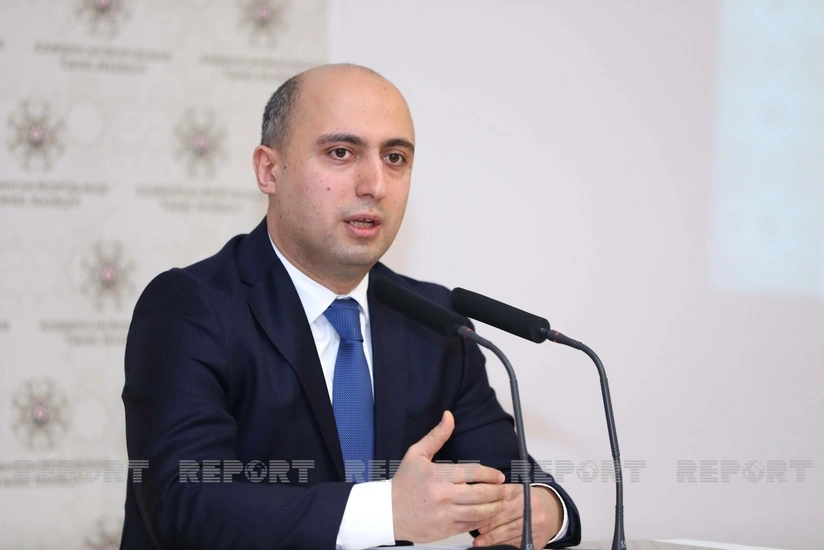
Azerbaijan’s Education Minister Emin Amrullayev has said that the problem of heavy school backpacks is caused not only by textbooks, but also by non-academic items students carry with them.
Speaking in an interview with Real TV, Amrullayev stressed that the issue should not be placed solely on the Ministry of Science and Education.
“The backpack is not filled by the ministry,” he said. “We have already taken steps on our side. Previously, textbooks were printed for an entire academic year; now they are issued for one semester. In primary grades, the weight of a single textbook ranges from 270 to 300 grams. If this is a problem that affects everyone, then it must be solved collectively.”
Stay Ahead with Azerbaijan.usGet exclusive translations, top stories, and analysis — straight to your inbox.
Nearly 3,000 Students Study in Liberated Territories
Amrullayev also said that the number of students studying in educational institutions in Azerbaijan’s liberated territories is approaching 3,000.
According to him, more than 300 teachers are currently employed in general education institutions in these areas, where around 30 facilities are operating, including schools and kindergartens.
Construction of the Karabakh University campus is ongoing, alongside the development of new academic programs. The minister said the university plans to admit between 1,200 and 1,500 students next year.
“New specialties and faculties will be introduced, particularly in the natural sciences. There may also be an expansion of teacher training programs related to information technology and economics,” he noted.
Amrullayev added that a vocational school in Shusha is also expected to begin operations.
Preschool Education: Progress and Financial Limits
The minister emphasized that at least one year of preschool education is critically important. He said more than 85 percent of the issue has already been addressed, but financial and quality constraints remain.
“More than 100,000 children are enrolled in state-run preschool education. One child costs the state budget about 4,500 manats. If you multiply that figure by the total number of children, the amount exceeds 2 billion manats. From a logical standpoint, this is not realistic,” Amrullayev said.
He noted that in leading countries worldwide, preschool education is not funded exclusively by the state.
“We have proposed several solutions, including community-based preschool education and public–private partnerships,” the minister added.
High Spending, Low Results in Small Rural Schools
Amrullayev also pointed to inefficiencies in education spending in some regions. In certain rural areas, he said, the cost per student exceeds tuition fees at private schools in central Baku.
“In hundreds of rural schools, the average annual cost per child – and the total spending over 11 years – is comparable to educating several students in private schools in central Baku,” he said. “But we do not see corresponding results.”
According to the minister, small-capacity schools face serious quality issues.
“Imagine being a teacher with only three students in a class. How can a full educational process be built with three children?” he asked.
Amrullayev concluded that class size plays a key role in education quality and said this is why the ministry continues its school optimization policy.

