Azerbaijan is entering a new phase of economic transformation, focusing on diversification, sustainable energy, and regional connectivity.
The European Bank for Reconstruction and Development (EBRD) has become a key partner in this transition, supporting projects that link the country’s economic vision with global environmental goals.
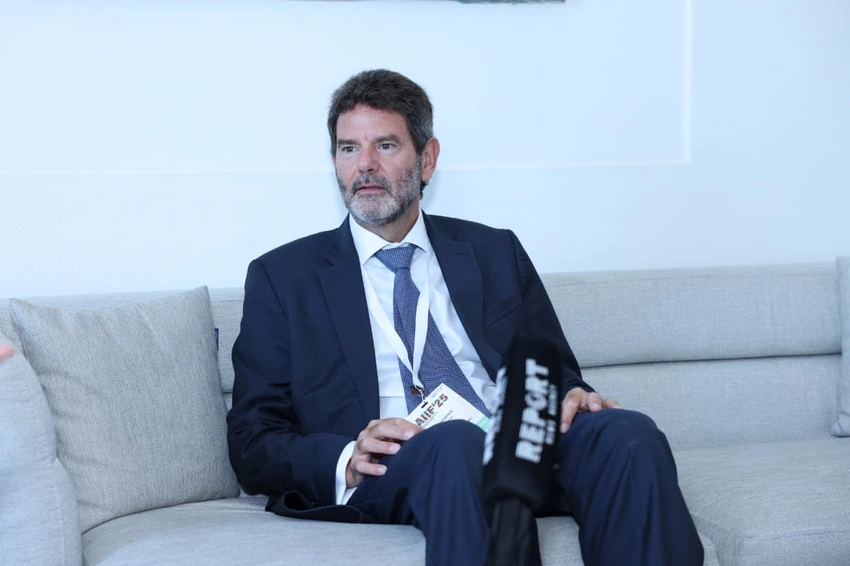
In an interview with Report, Alkis Drakinos, EBRD Regional Director for the Caucasus, said the Bank’s five-year strategy for Azerbaijan aligns closely with the nation’s ambitions to expand its renewable capacity, modernize infrastructure, and strengthen its position as a strategic bridge between Europe and Asia.
“Our priorities are clear – economic diversification, the green transition, and enhancing Azerbaijan’s role as a connectivity hub,” Drakinos said. “These directions fully align with the country’s goals and with the EBRD’s mandate.”
Renewables at the Core of the Partnership
The EBRD is currently the only international financial institution involved in every large-scale renewable energy project in Azerbaijan. Together, these developments will deliver over 1 gigawatt of clean power, marking the beginning of what the Bank sees as a long-term transformation.
“We’re proud to be part of all industrial-scale renewable projects in the country,” Drakinos noted. “The momentum is strong – and this is only the start.”
He emphasized that supporting private-sector innovation remains a top priority, from advisory programs for startups to technical and financial assistance for small and medium enterprises.
Green Corridors Across the Caspian
Drakinos highlighted Azerbaijan’s geographic advantage at the heart of the Middle Corridor – the Trans-Caspian route linking Europe and Asia. The EBRD, he said, is eager to support “green corridor” initiatives that combine logistics efficiency with lower carbon footprints.
“We can co-finance infrastructure modernization, bring in donor funding for sustainable components, and conduct technical, environmental, and social assessments to ensure that every project delivers measurable results,” he said.
The Bank has already partnered with railway authorities in Azerbaijan and Georgia to develop a rolling-road project – transporting trucks by rail between Baku and Batumi to reduce congestion and emissions.
“Green corridors are not just about moving goods faster,” Drakinos added. “They represent smarter, cleaner connectivity – an ecosystem of cooperation between economic actors.”
Hydrogen and the Next Frontier
The EBRD also supports Azerbaijan’s first National Hydrogen Strategy, introduced at COP29, and is assisting in the transition from planning to implementation.
“We’re helping develop the regulatory framework and exploring pilot projects that integrate hydrogen with renewable capacity, industry, and export routes,” Drakinos said. “Economic feasibility and measurable decarbonization are key for us.”
The Bank views hydrogen as a cornerstone of Azerbaijan’s long-term energy diversification, enabling new export opportunities and deeper regional integration.
Transport and Port Development
The EBRD is closely monitoring the second phase of the Baku International Sea Port expansion and is open to participation if terms meet its standards of sustainability and transparency.
“Our focus is on financial viability, environmental safety, and regional impact,” Drakinos said. “We already work on Kazakhstan’s eastern Caspian coast, including the port of Aktau, so we see strong potential for integrated cooperation.”
Zangezur Corridor and Peace Dividend
Commenting on the U.S.-brokered peace framework and the reopening of regional routes, Drakinos said such initiatives could reshape trade and investment across the South Caucasus.
“We welcome steps that strengthen regional connectivity and long-term peace,” he said. “Progress like this builds investor confidence and opens new trade paths between Asia and Europe.”
The EBRD is ready to support cross-border infrastructure, including in Nakhchivan, through long-term financing and technical assistance.
Toward a Sustainable Future
At COP29, the EBRD also backed Azerbaijan’s move to introduce competitive renewable energy auctions, ensuring transparency and cost efficiency for investors.
“The first auction laid the foundation for future rounds,” Drakinos concluded. “We’re optimistic that this mechanism will attract more international participation and accelerate the supply of clean, affordable energy.”
With the EBRD’s involvement, Azerbaijan’s “green turn” is no longer just a policy aspiration – it is becoming a tangible pillar of the country’s economic future.

