Azerbaijan.US
More than three decades after Black January, the question still resurfaces: could the tragedy of January 20, 1990, have been avoided?
In a wide-ranging interview on Daily Europe Online, Azerbaijani political analyst and former presidential communications official Chingiz Mamedov argues that the events were not an accident, nor merely the result of tactical mistakes. They were, he says, the outcome of long-accumulating historical forces.
Not an accident, but an inevitability
Mamedov’s answer is unequivocal: the tragedy was predetermined.
While its scale and form could have differed – with fewer or more victims – a violent confrontation, in his view, was unavoidable. The roots lay far deeper than the late-Soviet crisis of authority.
They stretched back to the imperial era, when Azerbaijani Turks on the South Caucasus consistently resisted external domination, unlike other regional elites that at times sought accommodation with imperial power.
This tradition of resistance, Mamedov argues, shaped the political consciousness that ultimately collided with Moscow’s late attempt to preserve control by force.
The myth of Soviet “equality”
A central theme of the interview is the gap between Soviet ideology and practice. Officially, the USSR promoted internationalism and equality among peoples. In reality, Mamedov notes, an informal hierarchy existed. Certain regions and ethnic groups were treated as more “reliable” than others, especially in moments of crisis.
Within this framework, he places the Nagorno-Karabakh issue, territorial adjustments at Azerbaijan’s expense, and the deportations of Azerbaijanis from Armenia. By the late 1980s, he contends, elements of the Soviet leadership were already exploring scenarios that would fundamentally alter Azerbaijan’s territorial integrity – and January 20 was meant to intimidate society into submission.
Information blackout – and its failure
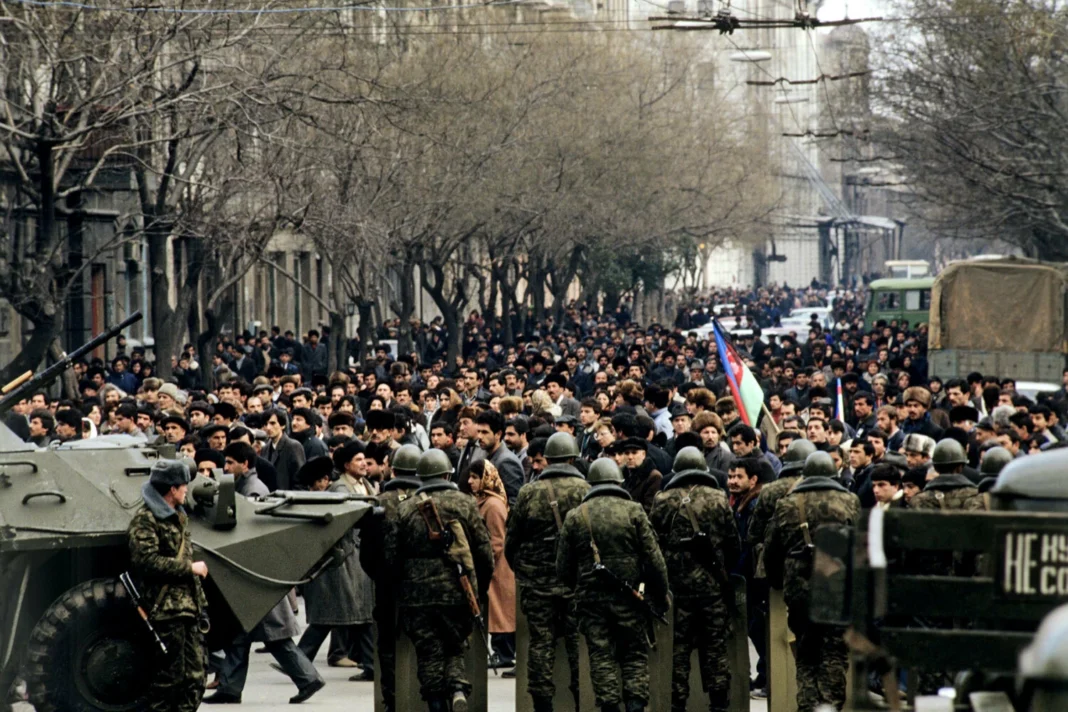
The night of January 19–20 was not only marked by tanks on the streets of Baku, but also by a deliberate information blackout. Television transmitters were blown up, radio silenced, newspapers shut down. The goal, Mamedov says, was to control the narrative – to portray the military intervention as a response to chaos and extremism.
That effort, however, failed. With Baku isolated, the city of Ganja became an alternative information hub. Newspapers and statements produced there were distributed across the Soviet Union, undermining the official version of events and exposing the scale of the violence.
For Mamedov, this information resistance was as important as the physical resistance in the streets.
A break with illusions
January 20, he argues, marked the end of illusions.
Many Azerbaijanis still believed in the possibility of reform, fairness, or solidarity within the Soviet system – or hoped that external audiences, once informed, would intervene morally or politically. Black January shattered those assumptions.
From that moment, Mamedov says, Azerbaijani society understood that survival and dignity required self-determination, not appeals to distant centers of power.
From Black January to later history
Mamedov draws a direct line from 1990 to later milestones in Azerbaijan’s modern history. The willingness of unarmed civilians to confront tanks demonstrated a level of societal resolve that, in his view, prevented irreversible decisions against Azerbaijan during the Soviet collapse. That same resolve, he argues, did not disappear – it accumulated.
Decades later, it manifested itself again, most clearly during the Second Karabakh War, when state and society acted with a unity that had its psychological origins in January 1990.
Why January 20 still matters
For international readers, Black January is often framed as one episode among many during the Soviet Union’s violent disintegration. Mamedov insists this view misses its deeper meaning. For Azerbaijan, January 20 was not merely a tragedy to be mourned, but a historical threshold – the moment when the cost of dependency became undeniable.
In that sense, the question of whether the tragedy could have been avoided becomes secondary. What matters, he concludes, is what Azerbaijani society learned from it – and how that lesson continues to shape the country’s political instincts today.