Azerbaijan.US
The water level of the Caspian Sea continues to fall at an alarming pace and reached a historic low in January 2026, marking the deepest level recorded over millions of years.
According to science journalist Said Huseynov, the world’s largest enclosed body of water has dropped below –29 meters relative to global ocean level, setting an absolute anti-record. The paradox is striking: while global ocean levels are rising due to climate change, the Caspian is moving in the opposite direction – and accelerating.
A crisis entering a new phase
In the first two decades of the 21st century, the Caspian’s level declined by an average of 7 centimeters per year. Over the past five years, that figure has surged to 30 centimeters annually, signaling a shift into a much more dangerous phase.
A sea trapped by geology
The Caspian is a geological captive. Millions of years ago, it was part of the vast Paratethys Ocean, connected to the Atlantic, Indian, and Pacific oceans. Around two million years ago, it lost all outlets and became a closed basin. Since then, it has had no natural drainage, losing water only through evaporation – a vulnerability that makes it extremely sensitive to climate and river inflows.
Two eras of dramatic decline
Scientists identify two especially critical periods:
1948-1978
1996-2026
Between them was an 18-year rise that peaked in the mid-1990s, when the sea climbed to nearly –25 meters, flooding coastal infrastructure and repeatedly submerging Baku’s seaside boulevard. That phase triggered major coastal reconstruction projects.
The current decline, however, has lasted longer and is unfolding much faster.
The North Caspian is vanishing
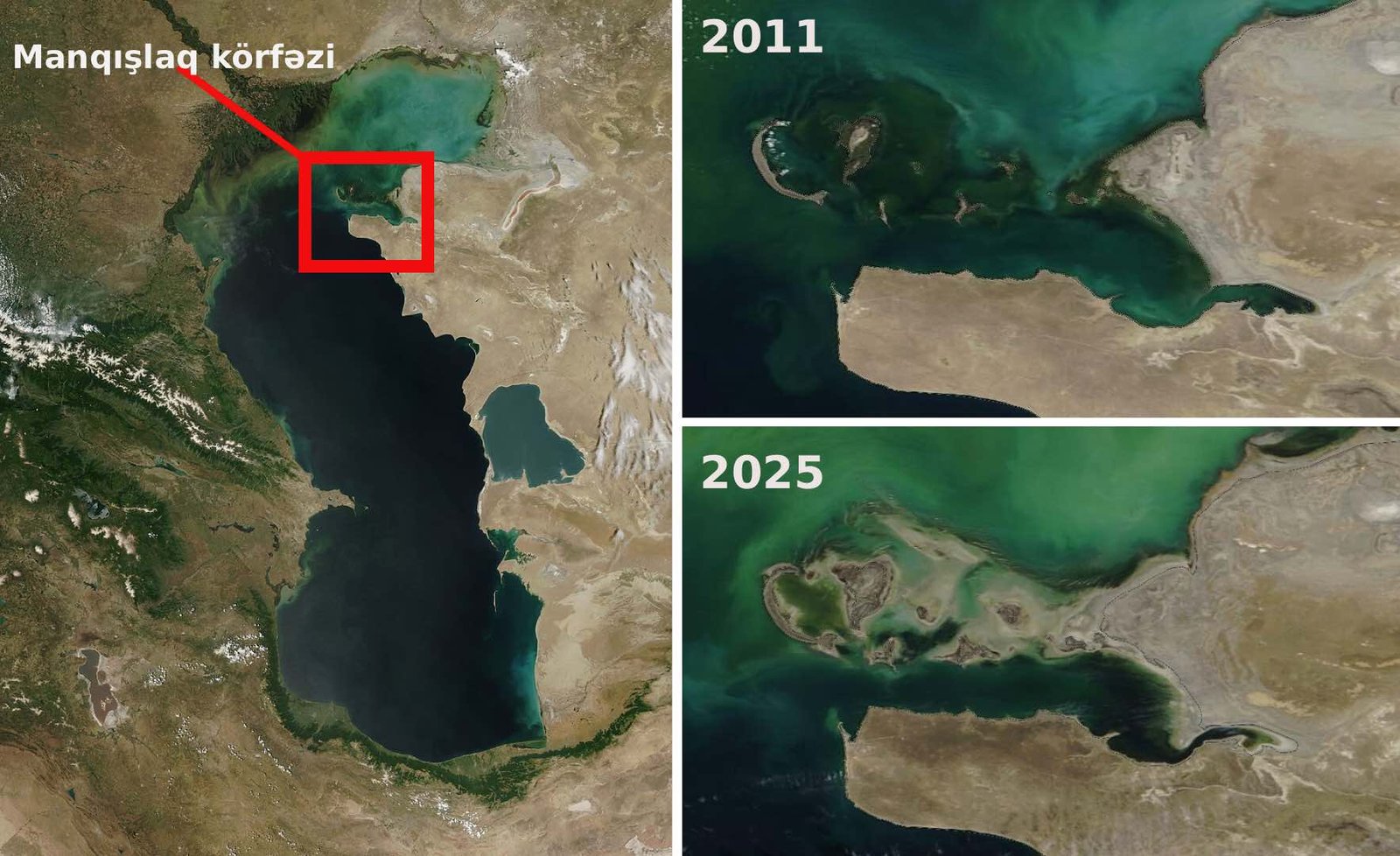
The most dramatic changes are occurring in the shallow northern basin, along the coasts of Russia and Kazakhstan. Over the past 15 years, shorelines there have retreated by 8–10 kilometers in some areas.

Key developments include:
The Dead Kultuk Bay drying up completely
Severe shrinkage of the Mangystau Bay
In Kara-Bogaz-Gol, the eastern shoreline has retreated 26 kilometers
New islands are emerging, vast salt layers are being exposed, and the region’s physical geography is visibly transforming.
The Absheron Peninsula has been less affected due to greater depths, but retreat is evident there as well. In some locations, the shoreline has shifted by 15–20 meters, and the Zigh sandy island has already merged with the mainland.
Why the sea is shrinking
Researchers point to several core factors:
Rising temperatures linked to global warming
Intensified evaporation
Reduced river inflow
Thousands of dams retaining water upstream
About 50% of the decline is attributed to evaporation alone. The remainder stems from lower precipitation and reduced river discharge.
The Volga River – responsible for more than 80% of total inflow – plays a decisive role. Its average annual discharge has fallen from the long-term norm of 250 km³ to roughly 207 km³. Experts stress that only a stable inflow of at least 270 km³ per year could halt the decline.
Atmospheric circulation also matters. Falling-level periods are dominated by dry eastern air masses from the Pacific Ocean, while rising phases coincide with moist Northern Atlantic systems. Why this circulation shifts remains an open scientific question.
An ecosystem under severe stress
Lower water levels are triggering a cascade of ecological damage:
Thickening algae layers
Declining oxygen levels
Disrupted natural self-purification
Breakdown of food chains
The most alarming indicator is the Caspian seal. Once numbering over 100,000, its population has collapsed to critically low levels. Mass die-offs have been recorded along the coasts of Kazakhstan and Dagestan, driven by pollution, disease, and food shortages.
Sturgeon species are also at risk. Nearly 90% of global sturgeon stocks are native to the Caspian, yet pollution and dam construction have pushed them into the “critically endangered” category.
What the forecasts say
Projections are increasingly grim:
-3 meters: sharp contraction of northern waters
-5 meters: loss of up to 20% of the sea’s surface area
-18 meters: desertification of 143,000 km², or 37% of the Caspian
Previously, scientists estimated the northern basin could dry up in about 75 years. But the growing speed of the decline makes the action four times faster for 15 to 20 years, and even shorter in the next decade if it keeps the upgoing stream.
Can the process be stopped?
Completely – unlikely. The Caspian’s long-term fate is governed by geological processes that predate human civilization. But human activity is clearly accelerating the crisis.
Improved wastewater treatment, coordinated basin-wide environmental policies, dam management, and regional cooperation could soften the impact – even if they cannot reverse the trend.
The central dilemma
Caspian history is cyclical. Sharp declines have been followed by recoveries before, and some climatologists cautiously suggest this could happen again.
The difference today is scale. Millions of people now live along the shores. Cities, ports, energy infrastructure, and ecosystems depend on stability. What were once natural fluctuations are now socioeconomic shocks.
The Caspian remains the same sea, Huseynov concludes. What has changed is humanity’s exposure – and vulnerability – to its movements.