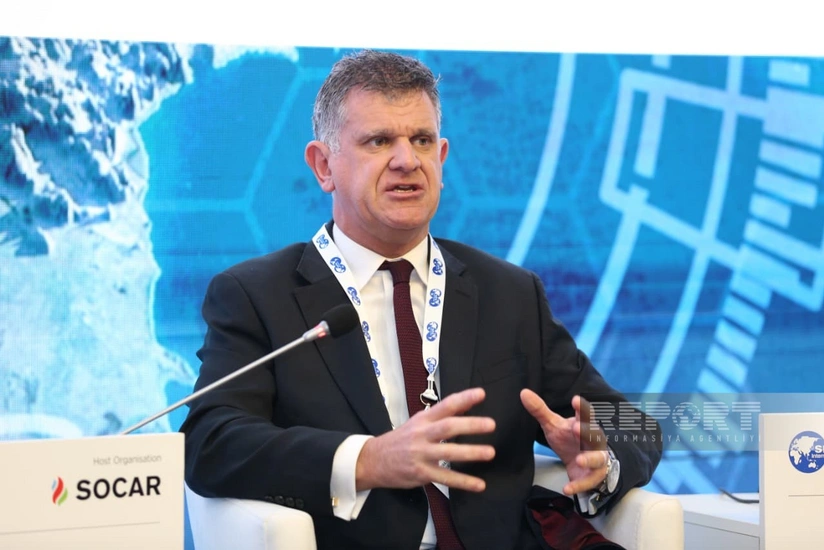
At this year’s SPE Caspian Technical Conference in Baku, the world’s leading energy companies delivered an unusually frank assessment of the challenges – and opportunities – shaping the future of the Caspian basin.
From aging offshore assets and sand-control failures to artificial-intelligence-driven drilling and a looming global investment shortfall, the message was clear: the region sits at the center of a decades-long energy transition that still needs oil and gas.
BP: “The Caspian must remain an energy hub for decades to come”
BP’s Regional President for Azerbaijan, Georgia and Turkey, Giovanni Christofoli, put it bluntly: global demand for hydrocarbons will stay high well into mid-century.
“By 2050 the world will need around 10 percent more energy than today, and roughly half of that will come from oil and gas,” he said. “Even in a 2-degree scenario, hydrocarbons will meet one-third of global energy needs.”
Christofoli pointed to the Caspian’s mature but strategically vital infrastructure:
the pipeline network that feeds Europe, the Sangachal terminal, offshore platforms, and a deep engineering talent pool.
But he also warned that legacy fields such as Azeri-Chirag-Gunashli (ACG) are reaching a technological ceiling.
“We need longer horizontal wells, new drilling technology, and solutions for sand-control failures. Without that, as much as 8,000 barrels a day could be left underground next year.”
SOCAR: a full transition to digital field management
SOCAR is preparing one of the most ambitious digital transformations in its history.
Reservoir development manager Murad Seidov announced that every SOCAR-operated field will be moved onto integrated digital models – structural mapping, static/dynamic simulations, and unified data platforms.
“Our decisions must rely on real data. After building a trustworthy foundation, we will move toward advanced analytics and artificial intelligence.”
Most of SOCAR’s portfolio consists of century-old mature fields, which still underpin Azerbaijan’s energy security. The company manages over 10,000 wells across 30+ assets – and is restructuring its strategy around long-term value rather than short-term output spikes.
Halliburton: “AI is already drilling at 16 kilometers – autonomously”
In one of the conference’s most striking remarks, Halliburton’s President for the Eastern Hemisphere Shannon Slocum described how automation has transformed subsurface operations:
autonomous drilling to depths of more than 16 km;
3D/4D reservoir models updating in real time;
downhole tools “seeing” 100 feet ahead;
algorithms analyzing load, vibration and ROE to make real-time decisions.
“Traditional methods simply cannot deliver today. The speed and accuracy of AI-driven systems redefine what’s possible in drilling and reservoir evaluation.”
Baker Hughes: mature fields are 15% cheaper – and deliver results within months
Baker Hughes integration lead Owen O’Donnell explained why global companies are refocusing on mature assets:
developing existing fields is 15% more cost-efficient than new discoveries;
well-intervention cycles have dropped from 15 days (2007) to about 8 days today;
production response arrives in months, not years.
This accelerated turnaround makes older assets a strategic pillar for energy security worldwide.
BCG: the world needs $350 billion a year – or risks a supply deficit
Boston Consulting Group partner Vladimir Rogov warned that the global industry is underinvesting:
“Proven and probable reserves are insufficient in almost every realistic scenario. The world needs around $350 billion in annual upstream investment over the next 25 years.”
However, capital flowing into the Caspian has fallen sharply:
investment levels are 50% below the previous decade;
major Azerbaijani and Kazakh projects moved from capex to production phases;
competition for capital is intensifying as global investors demand faster, higher returns.
Even so, the Caspian retains enormous potential:
2% of global oil production
10% of global proven gas reserves
A new strategic landscape for Azerbaijan
The discussions in Baku suggest several long-term trends:
1. Europe will rely on Caspian gas for years to come
Brussels now openly acknowledges it needs stable supplies beyond 2030.
2. Technology will determine the region’s production ceiling
Without AI-driven drilling, advanced sand-management and seismic imaging, major volumes will remain inaccessible.
3. SOCAR is evolving into a regional tech leader
Digital modeling and integrated data systems will reshape how the company manages mature fields.
4. BP’s vision for the Caspian extends decades beyond “energy transition” timelines
ACG Phase Next and Absheron Phase 2 are central to this strategy.
5. The investment race is accelerating
To attract capital, the region must demonstrate low risk, high efficiency, and rapid returns.

