By Azerbaijan.US Editorial Board
For years, analysts have tried to fit Azerbaijan into familiar political science frameworks – “competitive authoritarianism,” “democratic backsliding,” “shrinking civic space.” These labels once captured the country’s hybrid reality: formal elections existed, opposition parties functioned on paper, independent voices survived at the margins, and public debate, though constrained, had not disappeared entirely.
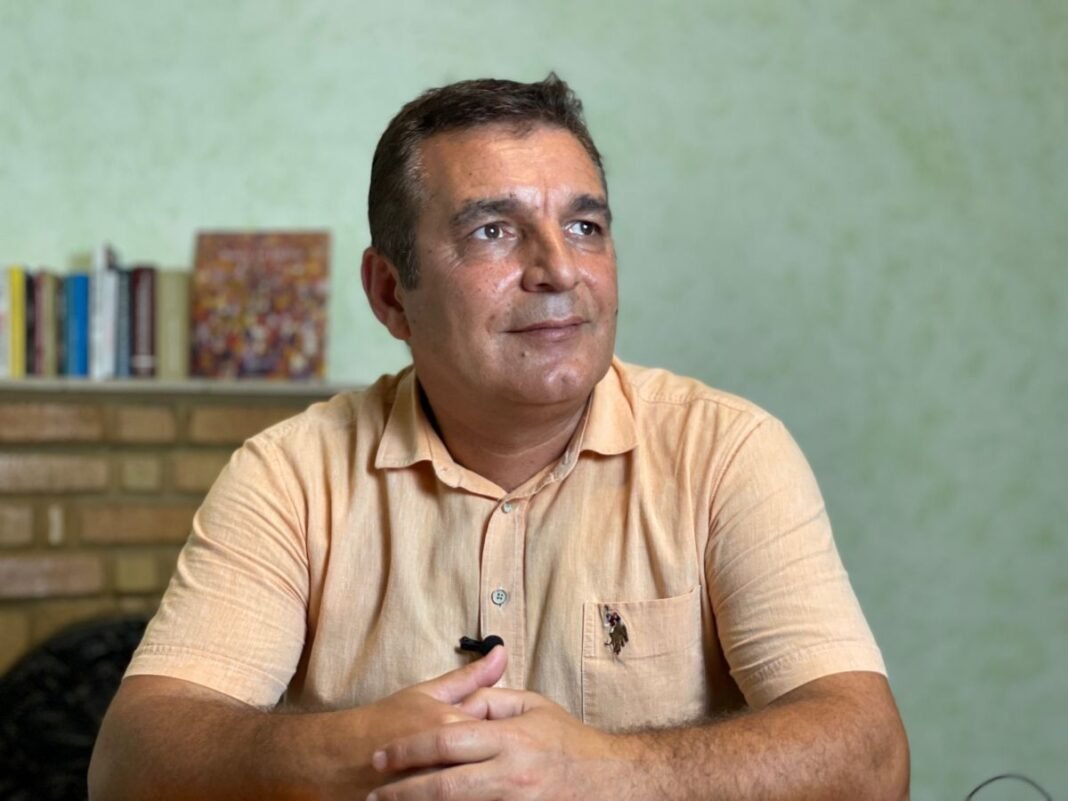
But the arrest of Ali Karimli, the long-time leader of the Azerbaijan Popular Front Party, signals a deeper structural turn-one that classical terminology can no longer adequately explain.
Azerbaijan is moving beyond authoritarian consolidation. It is entering a post-political phase, where politics itself is treated as an anomaly to be removed, not a system to be controlled.
The End of the Post-Soviet Political Era
For more than three decades, Azerbaijan lived in a strange duality: the ruling elite exercised near-total control, but the political energy of the late 1980s and early 1990s-mass mobilization, pluralistic debate, rival visions of the future-never fully vanished. Karimli embodied that residue. He did not possess the institutional power to challenge the state; his significance came from something subtler: he preserved the idea that politics, in the classical sense, was still possible.
His arrest is not simply another wave of repression. It marks the closure of an entire epoch.
What remained of competitive politics-however distorted-has now been purposefully dismantled.
From Authoritarianism to a Post-Political System
Traditional authoritarian regimes seek to dominate political life while still acknowledging that politics exists. Azerbaijan is evolving into something else. The emerging system demands:
no rivals, because rivalry implies plurality;
no debate, because debate implies legitimacy;
no ideological competition, because ideology requires a political arena.
This is not merely about eliminating opposition figures. It is about eliminating the very function they perform.
In Elman Fattah’s formulation, Azerbaijan is undergoing a transformation analogous to Karl Polanyi’s “Great Transformation”-but inverted. Where Polanyi described markets detaching from society, Azerbaijan is witnessing the eradication of politics from public life, replaced by a technocratic structure focused on administration, coercive security, and transactional resource distribution.
Elections continue, but as ritual. Civil society exists, but largely as formality. Freedoms appear in legal codes, but not in practice. The system no longer competes with alternative visions-it simply denies their existence.
Why Now? The Coming Post-Oil Stress Test
This shift is not occurring in a vacuum. Azerbaijan is approaching a decisive structural challenge: the beginning of the post-oil era, expected to intensify between 2027 and 2035. The country will face:
declining hydrocarbon revenues,
rising budgetary pressures,
demographic and social strains,
a shifting regional security landscape, and
the need for rapid technological and economic adaptation.
Political systems respond differently to such pressures. Democracies open space for new actors. Classical autocracies cautiously loosen controls to absorb discontent. Petro-authoritarian regimes, by contrast, often choose sterilization-pre-emptively neutralizing not only today’s opposition but the potential political coalitions of tomorrow.
The dismantling of independent media, the collapse of the NGO sector, transnational pressure on activists abroad, the criminalization of bloggers and online dissent, and finally the arrest of the last major opposition leader form a coherent pattern. This is not drift. It is design.
What Azerbaijan Loses in a Post-Political System
A system without politics may produce short-term stability. But it sacrifices the essential safety mechanisms that prevent crises from becoming existential.
Without political actors, there are no mediators.
Without public debate, there are no pressure valves.
Without credible institutions, there is no legitimate channel for reform.
Without competition, the system cannot renew itself.
As Azerbaijan enters the post-oil period with no political intermediaries, no structured dialogue, and no institutional memory of compromise, the risks become structural rather than tactical. The state is removing politics today but may desperately need it tomorrow.
Ali Karimli’s Arrest as a Symbolic Break
Karimli was never a direct threat to the existing order. His influence did not stem from the capacity to mobilize tens of thousands but from being the last living repository of a political culture that once existed. He carried:
the memory of the 1988–1993 national awakening,
the country’s brief parliamentary pluralism,
the logic of competitive elections,
and the principle that political alternatives matter.
Eliminating that final remnant completes the transition. Azerbaijan is not merely restricting politics; it is moving beyond it, into a post-political model where the state remains, the bureaucracy remains, and security structures remain-but the political sphere itself ceases to function.
A New Category of Regime?
Western academia lacks a vocabulary for systems in which politics has been deliberately dissolved. The familiar typologies-authoritarianism, hybrid regimes, electoral autocracy-presume the continued existence of political competition, however shallow.
Azerbaijan no longer fits this spectrum.
It is becoming a post-opposition, post-pluralist, post-political state.
For three decades, analysts described Azerbaijan in the language of democratic decline. Today, that frame is obsolete. This is not decline. It is replacement-the construction of an order in which politics is not suppressed but structurally unnecessary.
Whether such a system can withstand the turbulence of the post-oil transition remains an open question. But one thing is clear: the era inaugurated in 1991 has now definitively ended.