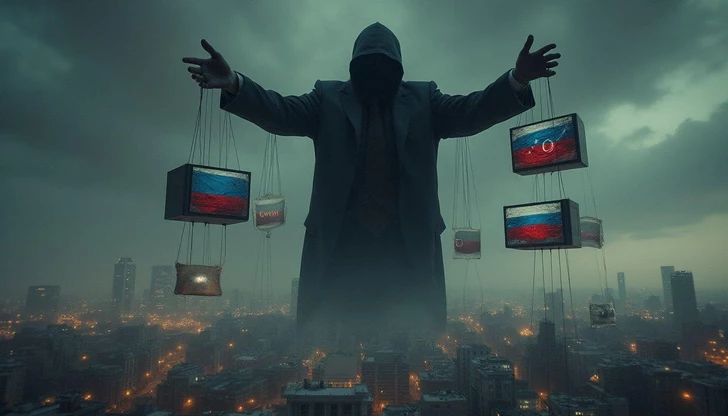
BAKU — The Azerbaijani Press Council has issued a strong rebuttal to an open letter circulated by the Russian Union of Journalists, which condemned the arrest of two staff members from Sputnik Azerbaijan. The Council’s statement, released on Tuesday, accuses Sputnik of acting as an arm of the Russian intelligence services and rejects the notion that the detainees were performing legitimate journalistic work.
“Contrary to what is claimed in the Russian letter, the arrests of Sputnik Azerbaijan’s head Igor Kartavykh and chief editor Yevgeny Belousov are not related to journalistic activity,” the statement reads. “These individuals were operating under the direction of Russia’s Federal Security Service (FSB), and their presence in Azerbaijan had nothing to do with media reporting.”
The Azerbaijani side asserts that Sputnik’s local operations are part of a larger pattern of foreign interference masquerading as journalism. They point out that the agency has a documented history of using its platform for political destabilization and propaganda under the cover of media freedom.
The statement also singles out Vitaly Denisov, a former head of Sputnik Azerbaijan and a known Russian intelligence operative, who previously ran Sputnik branches in South Ossetia and Moldova before being expelled from both countries — and later from Azerbaijan — for espionage-related activity.
“This is not journalism — this is covert influence. Using media as a tool of hybrid warfare is a direct threat to national security,” the Council said.
The Press Council’s remarks come amid growing international scrutiny of Sputnik’s role in Russia’s global disinformation network, a concern echoed in numerous reports by the EU Parliament, Council of Europe, EUvsDisinfo, and other watchdogs. Sputnik has already been banned or blocked in 32 countries, including all 27 EU member states, the UK, Canada, Switzerland, Ukraine, and Australia.
“Don’t Lecture on Press Freedom While Silencing Your Own”
The Azerbaijani Press Council also criticized the Russian Union of Journalists for what it described as “selective outrage.” While the Union is quick to defend suspected agents under the guise of press freedom, it remains silent on the systematic crackdown on independent media inside Russia.
“Where is the same outrage for the more than 50 journalists killed in Russia since 1992, or the 26 arrested between 2019 and 2024?” the statement asks. “Why not protest the disappearance of independent media, which experts say has shrunk by as much as 70%?”
The statement cites the unresolved murders of Anna Politkovskaya, Yuri Shchekochikhin, Paul Klebnikov, and Pavel Sheremet as evidence of the chronic impunity and political motives behind the suppression of critical journalism in Russia.
Since the full-scale invasion of Ukraine in 2022, Russian media has been subjected to sweeping censorship, with independent outlets shuttered and journalists prosecuted under so-called “foreign agent” and “extremism” laws.
“Instead of confronting these glaring violations at home, the Russian Union of Journalists chooses to shield individuals who are credibly accused of espionage,” the Council stated. “This reveals the dangerous blurring of lines between journalism and intelligence operations.”
“Time to Call Out Media Weaponization”
The Azerbaijani Press Council concluded its statement with a call to international journalist associations and human rights organizations to recognize the weaponization of media by authoritarian regimes, and to firmly reject attempts to manipulate press freedom as a cover for political interference.
“It’s time to stop pretending that Sputnik is just another news agency,” the Council emphasized. “It is a coordinated influence operation operating under journalistic camouflage — and its exposure must be met with a firm global response.”

