Azerbaijan.US
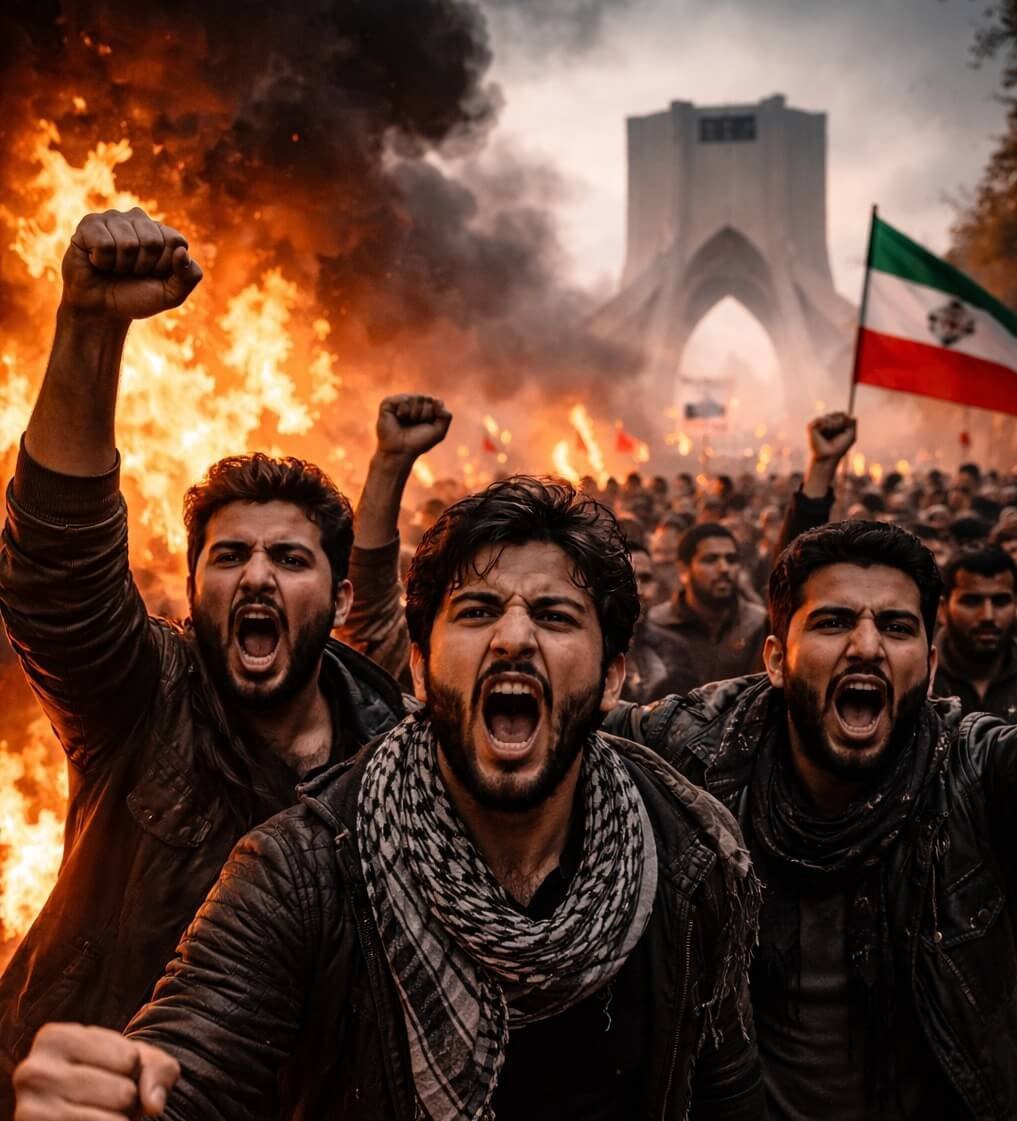
The ongoing protests in Iran are the result of a deep systemic crisis, marked by an existential struggle within the country’s power structure. The Iranian authorities have responded with extreme force, seeking to suppress the unrest through violent repression.
This assessment was outlined by Farhad Mammadov, Chairman of the Center of South Caucasus Studies, in a commentary published on his Telegram channel.
According to Mammadov, a systemic crisis differs fundamentally from other forms of political instability because key actors perceive the confrontation as a fight for survival. In Iran’s case, this struggle directly involves Supreme Leader Ali Khamenei and the leadership of the Islamic Revolutionary Guard Corps (IRGC).
While Iran’s president remains the country’s formally legitimate executive authority, he does not belong to this existential power bloc. Nevertheless, he is compelled to operate within the political framework imposed by the Supreme Leader. President Masoud Pezeshkian has attempted to channel public discontent into institutional mechanisms, but his recent public remarks suggested that these efforts have so far failed.
Internal Dynamics
The protest movement has already passed its initial phase of heightened activity, followed by a harsh crackdown from the authorities. The key unanswered questions now are whether a second wave of protests will emerge, whether the movement can sustain itself over time, and whether it will produce a recognizable leadership beyond symbolic figures abroad.
At present, Mammadov argues, the protests have not reached a decisive or irreversible stage. This limits their immediate capacity to transform Iran’s political system.
External Factors
Alongside internal dynamics, external actors may influence how the situation evolves. At this stage, the most frequently mentioned external players are the United States and Israel, whose objectives range from minimal to maximal.
U.S. objectives, according to the analysis, include:
Neutralizing Iran’s missile program;
Weakening Iran’s strategic alignment with China;
Transforming Iran into a more predictable regional actor.
Israel’s objectives include:
Taking advantage of a rare strategic window – including freer airspace over Syria and Iraq – to significantly reduce Iran’s missile capabilities;
Containing Iran internally in the event of civil conflict, though this scenario is considered highly unpredictable;
Ultimately turning Iran into a predictable state in regional security terms.
Mammadov notes that the United States and Israel share a common strategic interest in dismantling Iran’s missile program. From this perspective, external moderation of Iran’s internal unrest would only become realistic through the removal of the Supreme Leader and the IRGC leadership – a step that a future U.S. administration might consider only if a second, more sustained wave of protests emerges.
Turkey’s Position
Turkey, according to the analysis, has no interest in the collapse of Iran or its transformation into a failed state. Ankara is expected to wait and engage with Iran’s internationally recognized authorities – the president and the government. However, in the event of civil war or state failure, Turkey would be unable to remain passive due to border security and humanitarian concerns.
Azerbaijan’s Position
Azerbaijan’s position closely mirrors that of Turkey. While developments in Iran evoke strong emotional reactions within Azerbaijani society, Baku adheres to a principle of non-interference. Given the nature of Azerbaijani-Iranian relations, Azerbaijan cannot intervene in Iran’s internal affairs without undermining its own demand that Tehran refrain from interference in Azerbaijan’s domestic matters.
Participation by Azerbaijan in military operations against Iran, or in mechanisms aimed at influencing the protest movement, is therefore excluded under current conditions.
Azerbaijan remains interested in a stable and predictable Iran. Despite Baku’s close relations with Israel and its evolving partnership with the United States, military action against Iran has never been – and should not become – part of that agenda.
Possible Outcomes
Much depends on how Iran emerges from the current crisis. Azerbaijan’s future posture will be shaped by the outcome rather than by attempts to influence events.
If protests subside, interaction with Iran’s legitimate authorities is expected to continue. If, however, Iran descends into civil conflict or state failure, the issue of ethnic Azerbaijanis in Iran would take on an entirely different dimension. In such a scenario, Azerbaijan could consider measures to support its compatriots strictly within the framework of its own national security.
Mammadov concludes that the current situation in Iran carries more risks than opportunities for the region. In periods of heightened uncertainty, safeguarding national security becomes paramount. Against this backdrop, the beginning of 2026 may see intensified Azerbaijani-Turkish military coordination, potentially including joint air force exercises.