By Azerbaijan.US Editorial Board
For more than three decades, Armenian politics revolved around a single illusion — that holding on to the occupied territories of Azerbaijan was both sustainable and strategically wise.
It was never either. But the myth was too convenient for the political elites who ruled Yerevan from the early 1990s through 2018. They built their legitimacy not on state-building, but on the promise that “Karabakh is forever.”
Today, that myth is collapsing. And the people most unsettled by its collapse are not the Armenian public – which increasingly sees peace as a path out of isolation – but the very leaders who constructed the illusion in the first place.
With elections approaching in 2026, they have returned to the last weapon they still possess: the accusation that Prime Minister Nikol Pashinyan “betrayed Karabakh.” But this time, Pashinyan hasn’t retreated. Instead, he has forced Armenia to confront the history it was never allowed to see.
The publication of the negotiation archives was not a diplomatic misstep – it was a domestic reckoning
When Pashinyan released the previously confidential documents on the Karabakh negotiations, critics rushed to accuse him of breaching protocol. But diplomacy was never the target. His audience was Armenia itself – a society that still struggles to understand how it lost a war its leaders insisted it could never lose.
The documents reveal something uncomfortable, but undeniable:
Armenia’s previous governments were not guardians of national interests; they were architects of national self-deception.
They entertained territorial exchanges.
They negotiated from a position of weakness while pretending otherwise.
They promised victory while privately acknowledging military decline.
And they let an entire generation believe that geopolitical realities could be suspended indefinitely.
The “Karabakh card” was always a political instrument – never a strategic plan
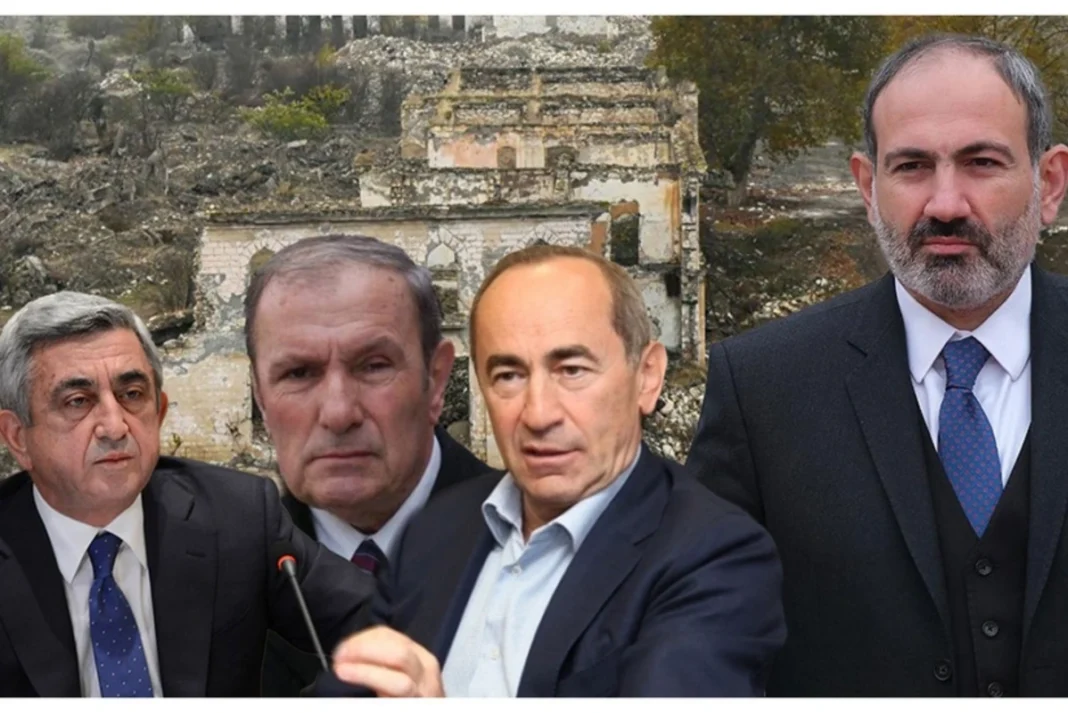
The old elites accuse Pashinyan of capitulating. But the documents show that capitulation was baked into the system long before 2018. It is no coincidence that Robert Kocharyan abruptly abandoned talks in Rambouillet or that Serzh Sargsyan begged Moscow for help after the April 2016 clashes. These episodes were not diplomatic accidents; they were moments when political mythology collided with hard reality.
Most revealing is Sargsyan’s letter to Vladimir Putin after the 2016 fighting. In it, he admits what Armenian leaders never dared to tell their public:
Armenia could no longer confront Azerbaijan militarily or diplomatically.
Even more striking is his acknowledgment that negotiations had shifted entirely to Baku’s terms: “first the territories – then everything else.”
This was not a Pashinyan policy.
This was the truth Armenian leaders hid from their own population for decades.
Why the revanchists are panicking
Pashinyan’s opponents understand what the publication of these documents means. It ends their last argument. They cannot claim moral superiority when the documents show they pursued the same concessions – and often deeper ones – behind closed doors.
Their political brand depended on the belief that victory was only a matter of will.
Now it is clear that victory was never an option at all.
In this light, their rage makes sense. They are not defending national dignity; they are defending their reputations.
A new political narrative is emerging – and the old guard has no place in it
Armenia today faces a strategic choice: rebuild itself as a functioning state integrated into a peaceful region, or remain hostage to a frozen narrative that died in 2020. Pashinyan’s critics demand a return to the past because the past is the only territory they have left.
But the political map has changed.
Azerbaijan reclaimed its territories through force and diplomacy backed by economic strength.
The Minsk Group vanished into irrelevance.
Regional power balances shifted irreversibly.
And most importantly, Armenian society is beginning to recognize that perpetual conflict is a dead end.
The bottom line – which Pashinyan’s opponents cannot say aloud
The publication of the Karabakh archives is more than a political tactic. It is a confrontation with the central lie of Armenia’s post-Soviet politics: that the country could build a national identity around holding someone else’s land.
That illusion is finished.
The question for Armenia now is whether its political class can accept the reality its people already see – or whether it will continue clinging to a mythology that has already been erased by history.