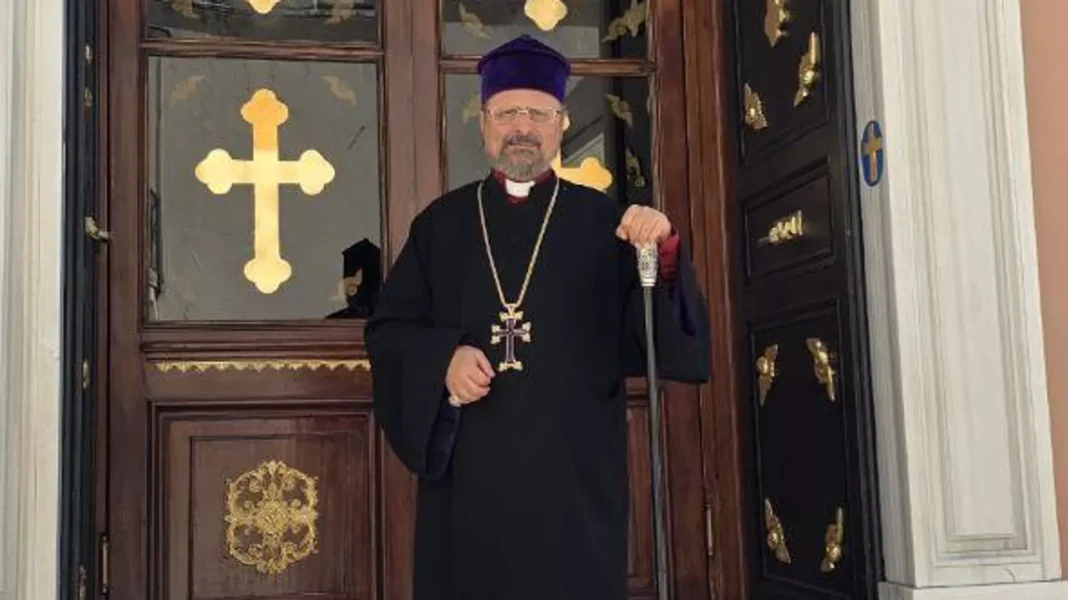
ISTANBUL, Oct. 1, 2025
The Armenian community of Istanbul has long been viewed as a unique part of the Armenian nation – a community that rebuilt its life in Turkey after the genocide, preserved its language and churches, and learned to coexist with its surroundings.
Today, many of its members advocate normalization of relations between Armenia and Turkey and the eventual opening of borders, says Archbishop Sahak Maşalyan, Patriarch of the Armenian Apostolic Church (AAC) in Constantinople.
On Normalization Between Armenia and Turkey
“Turkish Armenians have always supported normalization. We are not from Artsakh (Karabakh in Armenian), Armenia, or the diaspora. We are the ones who remained here after the genocide, who kept our schools, churches, and national structures while integrating with Turkish society,” Maşalyan told Sputnik Armenia.
He argued that history must serve as a lesson, not an obstacle.
“Armenians and Turks today are not those of a century ago. Dialogue itself – about peace, open borders, and diplomatic ties – is already a major step. There is no alternative to peace. Both sides lose from hostility and both gain from friendship.”
Public attitudes in Turkey are also shifting, he noted, with growing interest in books on the Armenian Question and a willingness to engage. Over the past 30 years, more than 200,000 Armenians have visited Turkey for business or tourism, forging new personal contacts.
“It takes decades of good neighborliness to break stereotypes. This must reach schools, education, and civic life.”
On the Armenian Apostolic Church and State Tensions in Armenia
Asked about the conflict between Armenia’s government and the Church, Maşalyan compared the country’s post-war turmoil to a shaken vessel of ants: “Chaos began, with state, church, media, and parties blaming each other. The problem lies in unclear rights and boundaries. Perhaps the constitution needs clearer separation of church and state.”
He stressed that the Church remains a spiritual anchor. “We have only two sanctities – the Church and Armenia. Healing will come when both sides define their roles.”
On the Role of the Church in Istanbul’s Armenian Community
“In the diaspora, the Church has always been the heart of Armenian identity. Around it form schools, choirs, and cultural structures,” Maşalyan said.
The Patriarchate of Constantinople dates back to 1461 under Sultan Mehmed II, with patriarchs serving as both religious and national leaders.
Today, Istanbul remains the only city in the world with about 50 functioning Armenian churches – 33 Apostolic, 12 Catholic, and 4 Evangelical. The community also maintains 17 schools educating around 3,000 students. Financial difficulties persist, but the Patriarch described the community as resilient and still one of the most important Armenian centers worldwide.
On Demographics and Language
The Armenian population of Turkey is estimated at 40,000–50,000, though shrinking: three deaths for every birth, with projections that the community may lose 10,000 members by 2050. Of the 50 schools once operating, only 17 remain. Migration trends affect Armenians and Turks alike, as many young people leave the country in search of a better future.
Around 3,000 students currently attend Armenian schools in Istanbul, while another 1,500 learn the language outside the community.
“We cannot oblige families, but many still choose to preserve the language despite economic challenges,” the Patriarch said.
On Relations With Turkish Authorities
Relations with the state have improved under President Erdoğan, according to Maşalyan. Property once confiscated from Armenian foundations has been returned, strengthening the community’s finances. State and municipal authorities support cultural life, such as the annual Navasard Games, which draw around 10,000 participants.
“The last two decades have been the most favorable for Armenians in Turkey since the founding of the republic,” Maşalyan concluded.
The views expressed by the interviewee do not necessarily reflect the position of the editorial board

