Jeyranchol Plain, Azerbaijan — Archaeologists have uncovered a 3,800-year-old burial mound in the Keshikchidagh State Historical and Cultural Reserve, shedding new light on life during the Middle Bronze Age in the South Caucasus.
According to Azerbaijan’s Ministry of Culture and the Institute of Archaeology and Anthropology of the National Academy of Sciences, the discovery was made in an area known locally as “Yovshanlydere” during a joint excavation effort.
Led by Dr. Shamil Najafov, a senior researcher and Ph.D. in history, the team unearthed a 28-meter-wide, 2-meter-high kurgan believed to be the tomb of a Bronze Age military leader. Inside the 2×6-meter burial chamber—divided into sections for the body, weaponry, ceramic vessels, and an empty space—archaeologists found remarkable artifacts.
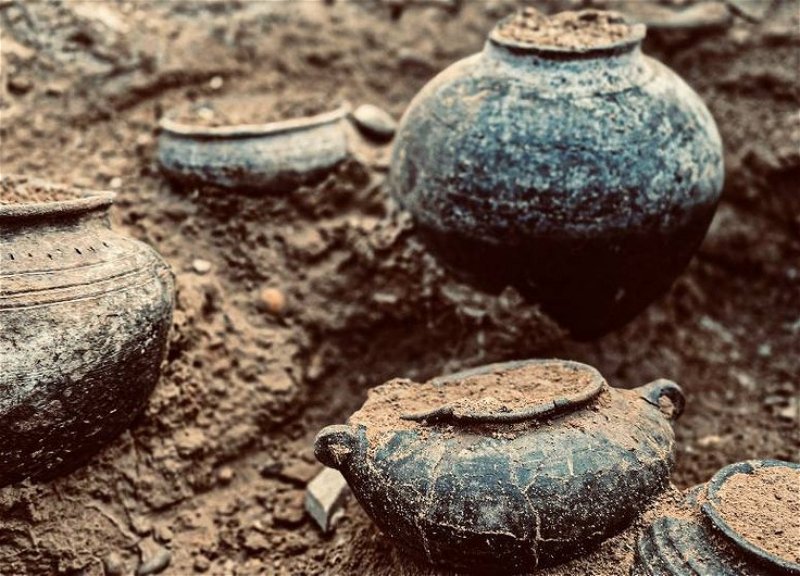
The skeleton, identified as a man over 2 meters tall, was buried in a semi-flexed position with a finely crafted bronze spearhead in hand. Adorned with a bronze ankle ornament, obsidian tools, beads, and twelve intricately designed clay jugs, the burial suggests a person of high rank and ceremonial importance. The vessels, featuring detailed punch and stamped motifs, reflect a sophisticated artisan culture.
Atop the mound, beneath half a meter of soil, researchers uncovered 14 one-ton “galtan” stones—each about 2 meters long and 0.6 meters wide—arranged in a symmetrical pattern, alongside a bull-shaped stone idol, hinting at religious or symbolic practices.
This major archaeological find offers a rare glimpse into the funerary rituals, material culture, and social hierarchy of the region’s Bronze Age inhabitants. Further study is expected to deepen understanding of early Azerbaijani civilization and its connections to broader regional cultures.