Azerbaijan.US
President Ilham Aliyev said that U.S. President Donald Trump has lifted the long-standing Section 907 amendment, calling the move a symbolic but historic breakthrough in Azerbaijan–U.S. relations after decades of political restrictions.
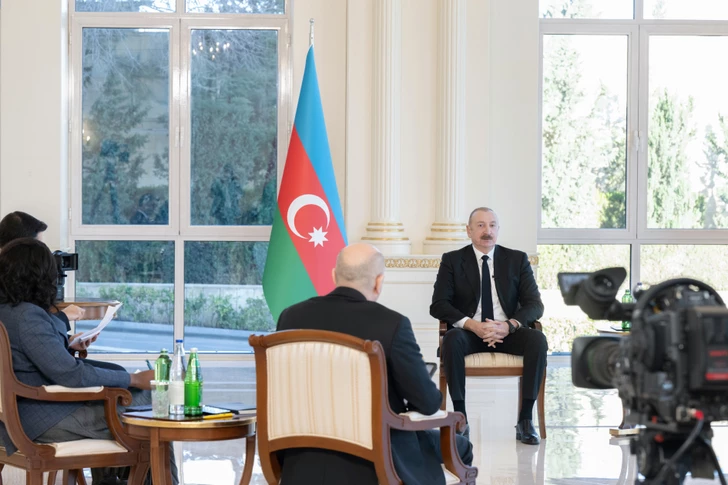
Speaking in an extensive interview with local television channels, Aliyev said the decision was announced during a White House ceremony attended by him personally, underscoring what he described as a turning point in bilateral ties. The interview was reported by Vesti Baku, citing AZERTAC.
According to Aliyev, although Congress has not yet formally repealed the amendment, President Trump’s decision carries strong political and symbolic weight, signaling Washington’s readiness to reset relations with Baku after years of strain.
“A cloud hanging over relations for decades”
Aliyev recalled that Section 907, adopted in 1992, had long overshadowed Azerbaijan–U.S. relations, limiting assistance and cooperation at a time when Azerbaijan was facing occupation, economic hardship, and a massive humanitarian crisis.
“This was a grave injustice,” Aliyev said, arguing that the amendment was the result of lobbying by Armenian groups in the U.S. and weak Azerbaijani diplomacy in the early years of independence.
He stressed that the original justification for the amendment – claims of a blockade of Armenia – was unfounded both then and now. “There was no blockade. Armenia’s borders with Georgia and Iran were open, and even today goods transit through Azerbaijan to Armenia,” he said.
Trump administration seen as decisive shift
Aliyev sharply contrasted the Trump administration with previous U.S. governments, saying relations under the Obama-Biden and later Biden-Blinken administrations had deteriorated, culminating in what he described as a political crisis.
“With President Trump’s return to power, the situation changed radically,” Aliyev said, calling the current U.S. leadership “pragmatic and professional” and focused on national interests.
He added that Azerbaijan now expects Congress to fully repeal the amendment, describing it as outdated and “absurd” in today’s geopolitical reality.
Strategic partnership and regional connectivity
Aliyev said 2025 marked a historic year not only because the Armenia–Azerbaijan conflict was politically concluded, but also because Azerbaijan consolidated its battlefield victory diplomatically – including in Washington.
He highlighted the creation of a U.S.–Azerbaijan Strategic Working Group tasked with drafting a Strategic Partnership Charter, as well as U.S. confirmation of regional connectivity projects, including the opening of a transport link between mainland Azerbaijan and the Nakhchivan Autonomous Republic.
“The name may differ, but the essence remains the same,” Aliyev said, referring to the Zangezur corridor, adding that public confidence in its opening is now firm.
Broader foreign policy gains
Beyond relations with Washington, Aliyev pointed to several major diplomatic achievements in 2025, including:
The signing of a Comprehensive Strategic Partnership with China;
Azerbaijan’s admission as the only new member of the D-8 Organization;
Its election as a full member of the Central Asian states’ consultative council;
Growing importance of Azerbaijan as a key East–West and North–South transport hub.
He said freight volumes through Azerbaijan have surged, with more than 100,000 containers transiting the country for the first time, and major investments underway to expand ports, railways, and energy infrastructure.
“Peace dividends already visible”
Aliyev emphasized that five months of peace have already brought tangible political and economic benefits, boosting public confidence and regional stability.
“We are learning what it means to live in peace,” he said, adding that Azerbaijan, after decades shaped by war, is now entering a fundamentally new phase of development.

