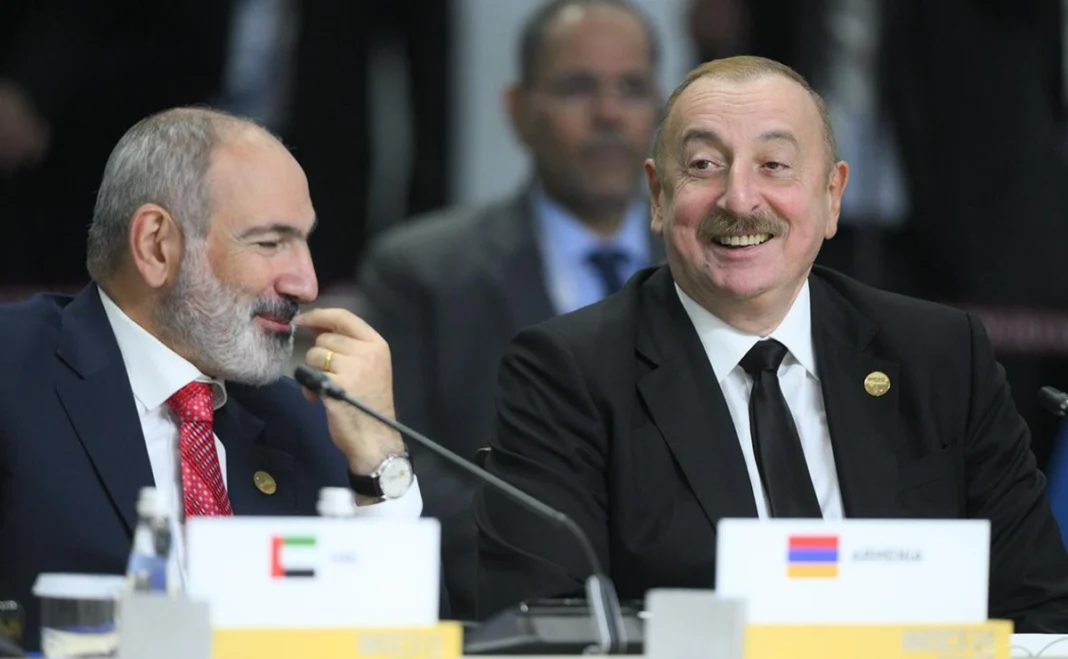
By Rustam Garakhanli
A long-anticipated meeting between Azerbaijani President Ilham Aliyev and Armenian Prime Minister Nikol Pashinyan has been officially confirmed and is set to take place tomorrow in Abu Dhabi, the capital of the United Arab Emirates. Both leaders have already arrived on working visits for what could be a pivotal round of negotiations.
Initial reports about the potential summit surfaced in Western media last week, during Pashinyan’s visit to Turkey and his meeting with President Recep Tayyip Erdoğan. Sources indicated that the Abu Dhabi meeting would focus heavily on the possible opening of the Zangezur Corridor, a key transit route linking Azerbaijan to its exclave Nakhchivan and Turkey.
A Peace Deal on the Horizon?
While tomorrow’s meeting has fueled speculation that a final peace agreement may be within reach, sources close to the talks suggest the session will primarily tackle the most sensitive and unresolved aspects of the deal. Both sides have publicly stated that the text of the agreement is fully negotiated, and officials in Yerevan—Pashinyan included—have declared readiness to sign it at any moment.
Baku, however, maintains a position of measured optimism, noting that certain obstacles remain. These include the abolition of the OSCE Minsk Group and, more significantly, constitutional amendments in Armenia to remove territorial claims against Azerbaijan. While the former may be addressed alongside the signing ceremony, the latter is a more complex process that could take months.
Talks Amid Regional Upheaval
The Abu Dhabi summit comes at a time of considerable regional turbulence. The Israel–Iran war, though currently paused, has left a volatile geopolitical residue. Israeli officials have hinted that the 12-day conflict may have only been the first stage of a larger confrontation—further weakening Iran’s regional standing.
Meanwhile, the Russia–Ukraine war appears to be entering a new, more entrenched phase. Despite U.S. pressure, the European Union continues to back Kyiv, and even within Donald Trump’s orbit, there is a growing recognition that concessions from Russia may be unattainable.
Turmoil in Yerevan
In Armenia, recent weeks have been marked by the resurgence of hardline nationalist forces. Amid escalating tensions between the government and the Armenian Apostolic Church, oligarch Samvel Karapetyan—a Russia-based businessman—publicly challenged Pashinyan’s leadership. The government viewed the move as a coup attempt, arresting Karapetyan and two high-profile clergymen.
This internal unrest is widely seen as an effort to undermine the peace process and derail regional integration projects like the Zangezur Corridor. Armenia is expected to hold parliamentary elections within a year, and the opposition, sensing an opportunity, may be using church-led agitation to destabilize the government ahead of the vote.
Strategic Stakes for the Region
The outcome of the Abu Dhabi talks could have implications far beyond Armenia and Azerbaijan. A breakthrough on the peace agreement—particularly one that includes opening the Zangezur Corridor—would pave the way for deeper transnational trade across the South Caucasus, linking Central Asia, the Middle East, and Europe. Armenia, a small landlocked country, would stand to benefit significantly—if it chooses to cooperate.
A lasting peace would also weaken foreign actors’ ability to manipulate the region through historical conflicts. In particular, opening Armenia’s border with Turkey would present a rare chance to address centuries-old hostilities and normalize relations between the two nations.
Abu Dhabi: Not Just a Peace Deal, But a Regional Reset
The stakes in Abu Dhabi extend beyond a bilateral treaty. What’s on the table is nothing less than the future of the South Caucasus. A positive outcome could bring Armenia out of economic crisis and regional isolation. In the West—especially in European capitals previously skeptical of regional developments—there is now growing consensus that no alternative to peace exists.
If Yerevan takes a constructive stance and resists pressure from nationalist and clerical hardliners, Prime Minister Pashinyan may finally be positioned to put a decisive end to decades of conflict—and secure a future that generations of Armenians and Azerbaijanis have never known: one shaped not by war, but by cooperation.

