BALAKEN/ZAGATALA, Azerbaijan — September 3, 2025.
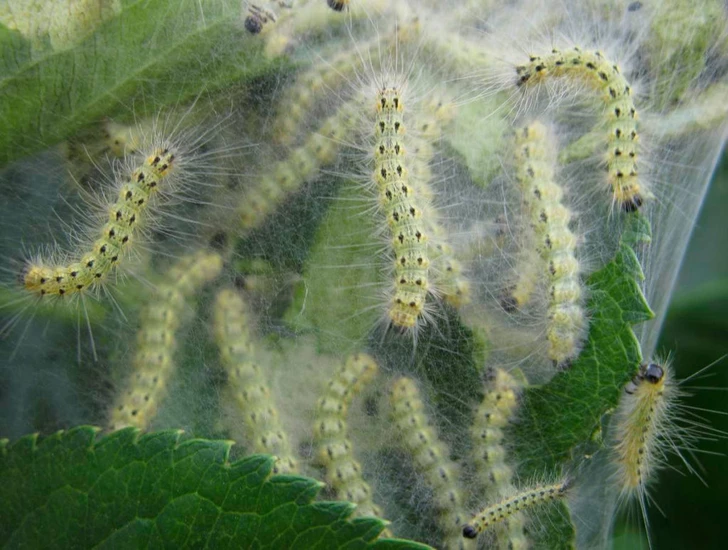
An invasive quarantine pest—the American white moth (Hyphantria cunea)—has surged across forest belts in the Balaken and Zagatala districts since early August, residents and local officials say. Caterpillars are spreading from woodlands into orchards and fields and, increasingly, into homes where they seek sheltered spots to overwinter.

Farmers warn the timing is ominous. For three years the northwest has wrestled with the brown marmorated stink bug (Halyomorpha halys). Now a different invader is chewing through foliage and threatening nuts, mulberries and silkworm feed, melons, and vegetable plots. Growers report that larvae are present “in most holdings,” and worry that unchecked egg-laying in the coming days will multiply the population.
“We saw very few last year and didn’t take it seriously,” said a resident of Kortala village, who recalled sparse sightings in 2024. “It turned out to be a probe—this season they’ve hatched in force.” Another villager said forests and edge-of-woodland orchards are “under constant attack,” adding that weakened trees could die if defoliation continues.

Officials say response teams have been on the ground for two weeks. Fumigation and chemical treatments are underway in orchards and adjoining forest strips, with coordination between the Ministry of Ecology and Natural Resources and the Agrarian Services Agency. Turaj Safarli, who heads the Balaken regional Plant Protection and Fumigation Center, said the agency has deployed supplies and equipment for a broader push. Elshad Balaev, who chairs the Kortala municipal union, said infestations are still rising despite early measures.
Specialists advise timing treatments to the mass emergence of young caterpillars, when they are most susceptible to insecticides. In autumn, they recommend plowing or loosening soil around trunks and between rows to disrupt overwintering stages. Longer term, agronomists urge a systematic, combined approach—quarantine controls, agronomic and mechanical steps, biological agents, and, where needed, chemical control—to slow the moth’s spread and protect next season’s harvest.
Bizim.Media

