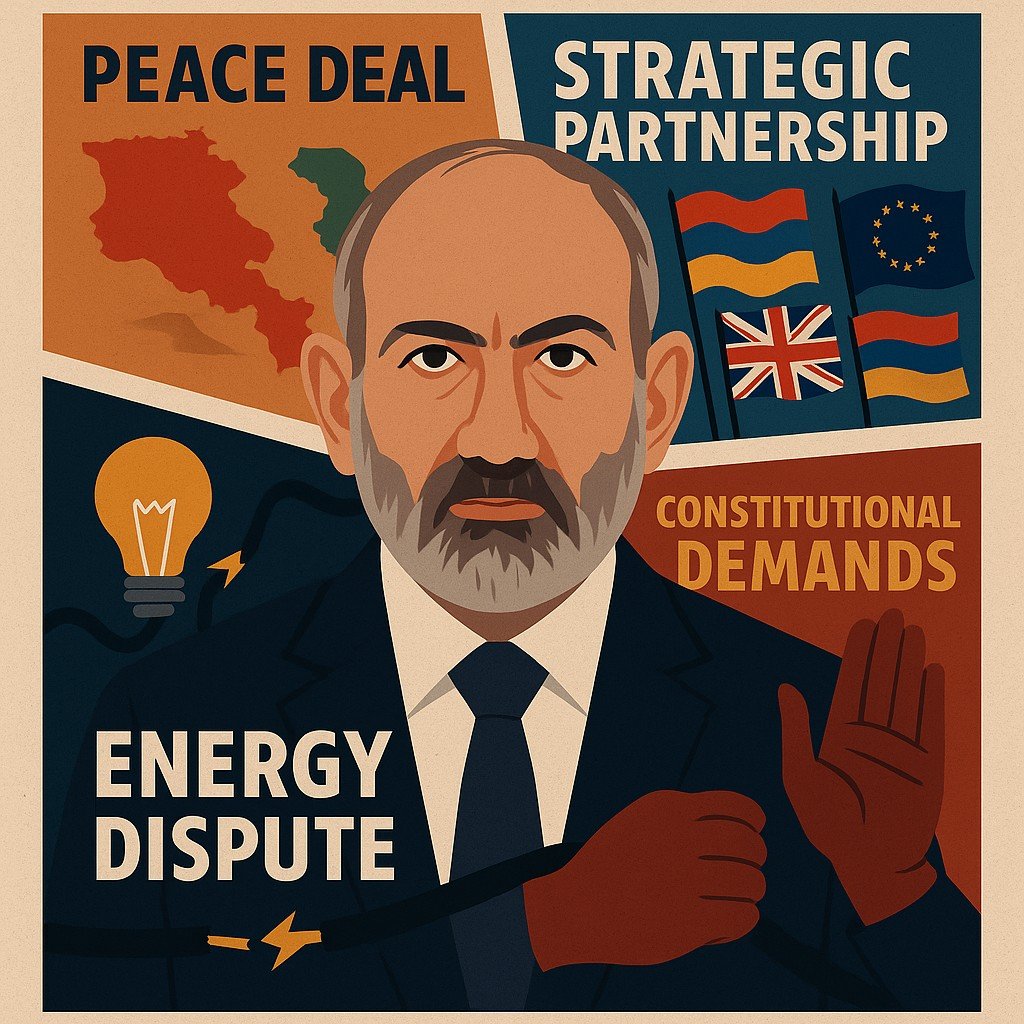
YEREVAN, August 31 — The past week in Armenia was marked by a series of strategic moves abroad and turbulent developments at home, underscoring how rapidly the country’s political landscape is changing.
On August 26, Yerevan hosted the second stage of the Armenia–UK Strategic Dialogue. Deputy Foreign Minister Vahan Kostanyan and UK Minister for Europe Stephen Doughty reaffirmed their commitment to democracy, the rule of law, and human rights. British officials also met Prime Minister Nikol Pashinyan, with both sides stressing the importance of the Washington agreements of August 8, which laid the groundwork for peace with Azerbaijan.
This came as part of a broader diplomatic realignment: Armenia has already signed strategic partnership charters with the United States and Georgia, and recently elevated ties with Iran.
Washington Agreements and the “Peace Process”
Foreign Minister Ararat Mirzoyan, speaking on August 27, declared that peace between Armenia and Azerbaijan is “already a fact,” even if the treaty has not yet been ratified. He said the Washington document enshrines mutual recognition of territorial integrity under the Almaty Declaration, inviolability of borders, and non-interference in internal affairs.
Mirzoyan emphasized that unblocking regional transport is the second major achievement, with Armenia emerging from three decades of blockade. He dismissed Baku’s long-standing demand for an extraterritorial “corridor” through southern Armenia, insisting that all routes will remain under Armenian sovereignty and jurisdiction.
Pashinyan reinforced this line on August 28, announcing that negotiations on unblocking roads will resume in September under five principles: sovereignty, territorial integrity, jurisdiction, reciprocity, and inviolability of borders.
Azerbaijan’s Position
Baku, for its part, hailed the Washington agreements as a breakthrough. Foreign Minister Jeyhun Bayramov confirmed that on September 1 the OSCE Minsk Group will be officially dissolved — a demand long pressed by Azerbaijan. He also renewed calls for Armenia to amend its constitution to remove what he called “territorial claims.”
Prime Minister Ali Asadov welcomed what he described as guaranteed, unhindered connectivity between Azerbaijan and its Nakhchivan exclave, presenting this as a major regional transport achievement.
Domestic Turmoil: The Power Grid Dispute
While Armenia projected new alliances abroad, internal controversies deepened. The government moved to take control of the Electric Networks of Armenia (ENA), despite an interim ruling by the Stockholm Arbitration Court prohibiting changes in management.
Pashinyan responded defiantly, declaring on August 28: “The government is me. Anyone who says the arbitration decision is binding should resign.” The next day, senior legal officials linked to the case, including Leparit Darmeyan, were dismissed.
The dispute has also become political. Former President Serzh Sargsyan publicly defended detained businessman Samvel Karapetyan, who once acquired ENA at his request. Critics warn that the standoff with international arbitration could damage Armenia’s legal credibility, but Pashinyan insists “no one will defeat the Republic of Armenia” in this dispute.
International Reactions
EU envoy Magdalena Grono visited Baku on August 28, voicing European support for the Washington framework and new communication routes. She is expected in Yerevan in mid-September. Russia also signaled acceptance of the Minsk Group’s dissolution, with OSCE envoy Alexander Lukashevich confirming Moscow’s agreement to wind down the body by December 2025.
Netanyahu’s Remark on Armenian Genocide
One of the week’s most sensitive moments came on August 27, when Israeli Prime Minister Benjamin Netanyahu — in a podcast interview — acknowledged the Armenian, Assyrian, and Greek genocides carried out by the Ottoman Empire. While no official Knesset resolution exists, his statement drew immediate attention.
Pashinyan downplayed its significance, stressing that Armenia rejects the use of the genocide issue as a geopolitical bargaining chip. “What has the Armenian state or people gained from these recognitions?” he asked, noting that many such statements abroad were driven by domestic electioneering, not genuine concern.
This week’s developments were analyzed in depth on the CivilNet YouTube channel, where experts placed them in the wider regional context.