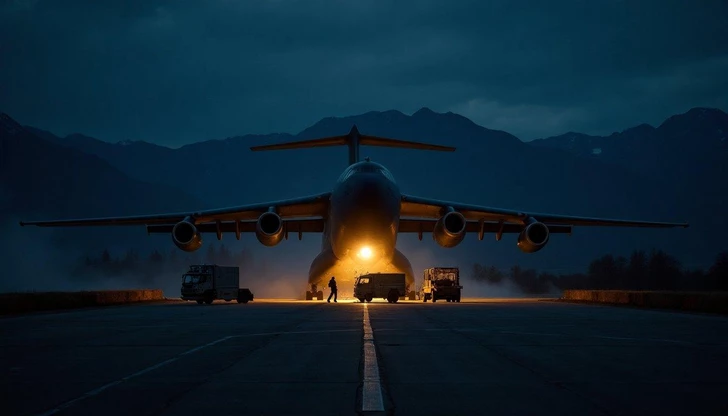
Russia has significantly enhanced its military presence in Armenia. In recent weeks, large quantities of military equipment and ammunition have been brought to the 102nd Russian base in Gyumri. Several planes carrying military cargo from Russia land daily in Armenia. Armenian media reports have raised questions about the purpose of these shipments, but various hypotheses have been put forward. One version suggests that Russia is preparing for potential changes in the region, despite its outwardly calm stance regarding its future presence in Armenia.
What does this mean, and what objectives and goals might explain Moscow’s actions? Could this be a message to Armenian Prime Minister Nikol Pashinyan?
Experts on the region provided answers to these questions for Media.Az. According to Sergey Danilov, Deputy Director of the Center for Middle Eastern Studies in Kyiv, Russia may be attempting to conceal military equipment supplies to Iran.
“It is no secret that there was an agreement between Israel and Russia: certain types of weapons were not supplied to Iran and Ukraine, based on mutual vetoes. For example, Iran did not receive Su-35 fighter jets, and military-technical cooperation between Kyiv and Tel Aviv was essentially frozen. Even humanitarian initiatives, such as providing Ukraine with early warning missile systems for civilian use, were carried out extremely slowly. However, this changed following the 12-day war. Russia adopted an unequivocally pro-Iranian stance, and after this brief conflict, Russian military transport aircraft began making regular flights to Tehran. This pro-Iranian, thus anti-Israeli, position was accompanied by a propaganda campaign in Russian media,” he explained.
Danilov further pointed out that in Tel Aviv, these actions were seen as a breach of previous agreements. As a result, Israel’s Foreign Minister visited Kyiv, and during the last Shahed missile attack, residents of Kyiv found that air raid alerts were issued much earlier than before.
“Russia heard the signal: a large group of propagandists was quickly dispatched to Israel with a task to write a series of positive articles about the country that had previously been vilified. There’s a small chance that Russia decided to hide the supplies of military equipment, using the Gyumri base as a logistics hub to secretly continue deliveries by land. But this version has a weak point: Israel seems to have exceptional capabilities for intelligence in Iran, and such camouflage is unlikely to help,” said the expert.
In his view, more traditional versions are tied to the worsening relations between Russia, Azerbaijan, and Armenia.
“Even a slight increase in Russian forces is a clear signal to the countries that Moscow might consider a military scenario, especially if it continues to lose its bets on pro-Russian forces in Armenia. The risk of a sharp escalation from Russia is actively discussed in Eastern and Northern Europe right now. No one in the region doubts Russia’s aggressive plans—the debate is only about their implementation possibilities. By the way, one of the conditions for starting a war in the Baltics might be the presence of alternative ports, such as in Iran,” he added.
Danilov also expressed skepticism about Russia’s military campaign in Ukraine: “The attack on Ukraine was illogical and counterproductive for Moscow. The likelihood of an invasion in 2022 was deemed low by many rational analysts. Now, there’s no reason to believe that Russia has changed in the past three years.”
Meanwhile, Azerbaijani security expert Ilham Ismail stated that while Russia’s war with Ukraine continues, the strengthening of the base in Gyumri might seem illogical at first.
“However, it should be noted that the military supplies to Armenia coincide with the period of tense relations with Baku. For Russia, the South Caucasus holds strategic significance as a Eurasian region with the potential to influence the North Caucasus. That is why it is demonstratively advancing the transfer of weapons and ammunition to Gyumri, considering it a deterrent factor for the regional states. At the same time, it is a message to the revisionists in Armenia, the church, and all pro-Russian political forces that Russia is still here and is still strong. It is also a move aimed at the government of Pashinyan,” said the expert.
In his opinion, Russia wants to emphasize that it will stay in Armenia until 2044, as agreed, and has no intention of leaving Gyumri.