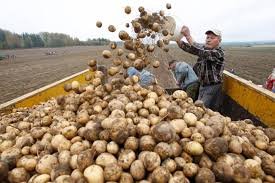
Baku, July 9 – Azerbaijan is facing a troubling decline in domestic potato production, with farmers increasingly abandoning the crop due to rising input costs and unprofitable market conditions.
In the Tovuz region, once considered a key potato-growing area, planted acreage has dropped by 1,000 hectares compared to last year. Farmers cite economic infeasibility as the main reason, pointing to the high cost of imported seed potatoes and low farmgate prices for harvested crops.
While producers are selling potatoes directly from the field at 40–45 qepiks (around $0.24–$0.27) per kilogram, retail market prices have surged to 70 qepiks up to 2 manats ($0.41–$1.18) — a markup of two to three times.
According to Akif Nasirli, Chairman of the Center for Liberal Economists, potato farming in Azerbaijan is primarily concentrated in the northern and southern regions. He highlighted that in the Jalilabad district, a key agricultural area in the south, planted potato acreage has plummeted from 60,000 hectares in 2023 to just 30,000 in 2024, and actual planting this year may be as low as 25,000 hectares.
“In regions like Gadabay, Shamkir, and Gusar, we’re seeing a year-over-year decline in potato cultivation,” Nasirli said. “We are gradually becoming import-dependent in this sector as well.”
One of the sector’s core structural issues, Nasirli emphasized, is the absence of a national seed breeding program. Azerbaijan currently lacks the infrastructure to develop and distribute new, high-yield potato varieties. As a result, farmers are increasingly forced to rely on costly imported seeds, which further reduces the profitability of growing potatoes.
“We’ve abandoned breeding entirely,” Nasirli said. “This leads to declining productivity and diminishing interest among farmers.”
The expert warned that Azerbaijan’s growing dependence on imports is also driving up prices for consumers. Unlike in previous years, when domestic supply helped stabilize prices, market dynamics are now shaped by imported goods.
“It’s highly unlikely that prices will drop back to last year’s levels this fall,” Nasirli cautioned. “On the contrary, potato prices are expected to spike significantly in the next two to three months.”