By Azerbaijan.US Editorial Board
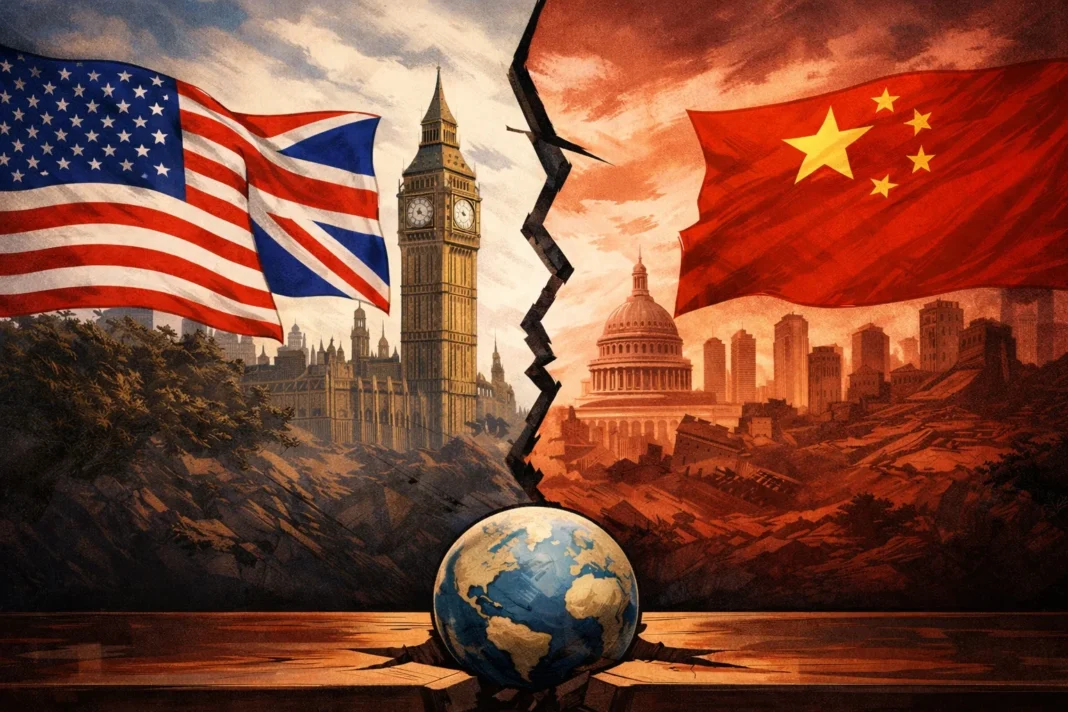
For years, the Western approach to China rested on a simple assumption: London and Washington spoke with one strategic voice. That assumption is no longer holding.
Behind the familiar language of alliance and shared values, a quiet divergence is taking shape. The United States and the United Kingdom are beginning to treat China not as a single, agreed-upon challenge – but as a problem requiring fundamentally different solutions.
Washington views Beijing in existential terms. China is framed as a systemic rival whose economic scale, technological capacity, and geopolitical reach threaten American primacy. From this perspective, confrontation is unavoidable. Tariffs, tech restrictions, pressure on allies, and containment strategies are not policy choices – they are necessities.
London, however, is moving in a different direction.
For the UK, China is not just a rival but a variable – one that can be managed, leveraged, and, in some cases, accommodated. Britain no longer has the luxury of binary thinking. Outside the EU, facing a weaker European economy and an increasingly transactional United States, London is searching for room to maneuver.
China offers exactly that: capital, markets, influence across Eurasia, and access to emerging trade and logistics corridors. This does not mean strategic trust – but it does mean pragmatism.
Recent British diplomatic signals toward Beijing have unsettled Washington precisely because they challenge the idea of a unified Western front. While the US doubles down on pressure, London appears willing to test dialogue, recalibration, and selective engagement.
The return of Donald Trump to the center of global politics accelerates this divide. Trump’s foreign policy is blunt, unilateral, and openly dismissive of traditional alliance etiquette. For Britain, that unpredictability is not theoretical – it is structural risk.
Relying exclusively on Washington now carries costs. Diversifying strategic options becomes less a choice than a necessity.
This does not signal the collapse of the US–UK alliance. Military cooperation remains intact. NATO coordination continues. On the Middle East and security architecture, London and Washington still move largely in sync.
But strategic alignment is no longer automatic.
Where Washington favors confrontation with China, London prefers calibration. Where the US demands loyalty, Britain seeks flexibility. And where America insists on pressure, the UK experiments with balance.
Some argue this is a deliberate division of labor – a “good cop, bad cop” strategy toward Beijing. That interpretation may hold in the short term. Yet even managed divergence has consequences.
The deeper reality is this: the old model of a single Western command center is fading. The West is no longer one strategic brain – it is a network of actors with overlapping but no longer identical priorities.
China did not cause this shift. It merely exposed it.
As global competition intensifies – over trade routes, technology, energy, and influence in Eurasia – London and Washington will increasingly act as allies with different endgames. Cooperation will persist, but convergence will not always follow.
The China question is not dividing the West.
It is revealing how divided it already is.