Azerbaijan.US
Political analyst Rizvan Huseynov, director of the Caucasus History Center, says current global tensions increasingly point to a struggle for control over the Arctic and its emerging transport corridors, with Greenland playing a central strategic role.
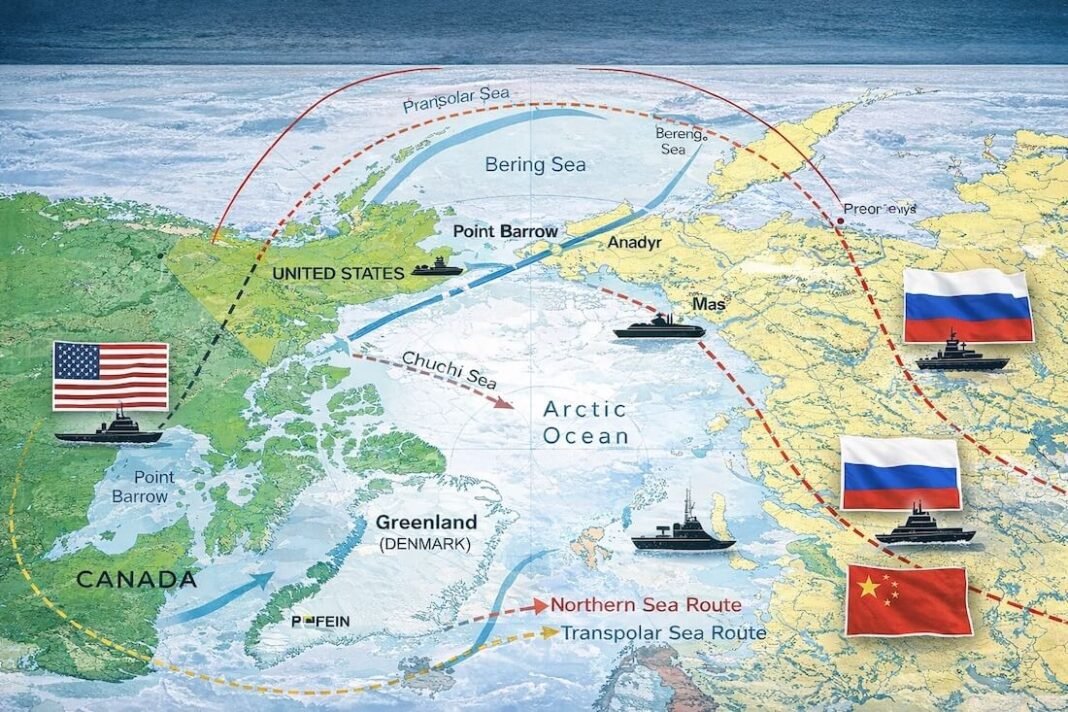
Speaking on the YouTube program “Modern Conversation” Huseynov argued that U.S. interest in Greenland should be viewed primarily through the prism of Arctic transit routes rather than territorial expansion.
According to him, control over Arctic maritime corridors would allow Washington to influence key trade flows between Northern Europe, Canada, and Asia.
Huseynov noted that the U.S. approach reflects a revived version of the Monroe Doctrine, adapted to modern geopolitical realities. Unlike Russia and China, which for years articulated Arctic ambitions largely at the doctrinal level, the current U.S. administration is acting proactively to secure dominance in the European Arctic.
He emphasized that Greenland’s geographic position makes it a natural platform for monitoring and controlling Arctic shipping routes, indirectly strengthening U.S. leverage over Canada and transatlantic logistics. In this context, Greenland is viewed not in isolation, but as part of a broader strategy to reshape the balance of power in the High North.
Europe and NATO constraints
According to Huseynov, European countries have limited real leverage to oppose U.S. plans. Despite political statements in support of Denmark, Europe lacks both the military and logistical capacity to challenge American dominance in the Arctic. This imbalance, he said, exposes internal weaknesses within NATO and limits Europe’s room for maneuver.
Turkey, the Middle East, and shifting priorities
Huseynov also argued that U.S. strategic priorities are shifting away from the Middle East toward the Arctic, Canada, and the Pacific region. This shift has reduced Washington’s direct involvement in projects traditionally aligned with Israeli interests, opening space for regional powers – particularly Turkey – to act more assertively.
He stressed that no major regional initiative, from energy to security, can advance without Turkey’s participation. Attempts to sideline Ankara, including in Gaza-related initiatives, have failed, prompting Azerbaijan to take a cautious stance on participation in missions where security guarantees are unclear.
Iran and the South Caucasus
On Iran, Huseynov said large-scale military action against Tehran is unlikely in the near term, as the U.S. is unwilling to divert attention from higher-priority theaters. He pointed to signals of openness to negotiations from Iran and a possible recalibration of Washington’s approach.
Turning to Azerbaijani-Armenian relations, Huseynov described recent developments on the peace track as positive. He linked these moves to progress on the Zangezur direction, noting that Azerbaijan is strengthening its role around strategically sensitive junctions where the borders of four states converge.
A new geopolitical phase
In conclusion, Huseynov said the world is entering a phase of intense competition over logistics, transit routes, and strategic space.
In this emerging reality, the Arctic has become one of the key arenas of global rivalry – and Greenland one of its most important geopolitical nodes.