By Azerbaijan.US Editorial Board
For more than three decades, U.S. policy toward the South Caucasus has been guided less by strategy and more by muscle memory. Washington inherited Section 907 – a punitive clause written in 1992 to freeze aid to Azerbaijan – and kept it on the books long after the geopolitical map changed beyond recognition. What began as a reaction to a war in the early post-Soviet years calcified into a doctrine.
But the world that produced Section 907 no longer exists.
Azerbaijan today is not the vulnerable post-Soviet republic of the 1990s. It is a pivotal energy hub for Europe, a rare-earth minerals partner the U.S. desperately needs, and a state that delivered what Washington had always claimed to support: the restoration of internationally recognized borders and the end of the decades-long Karabakh conflict.
And yet U.S. policy continued to operate on auto-pilot – until this year.
A turning point Washington couldn’t ignore
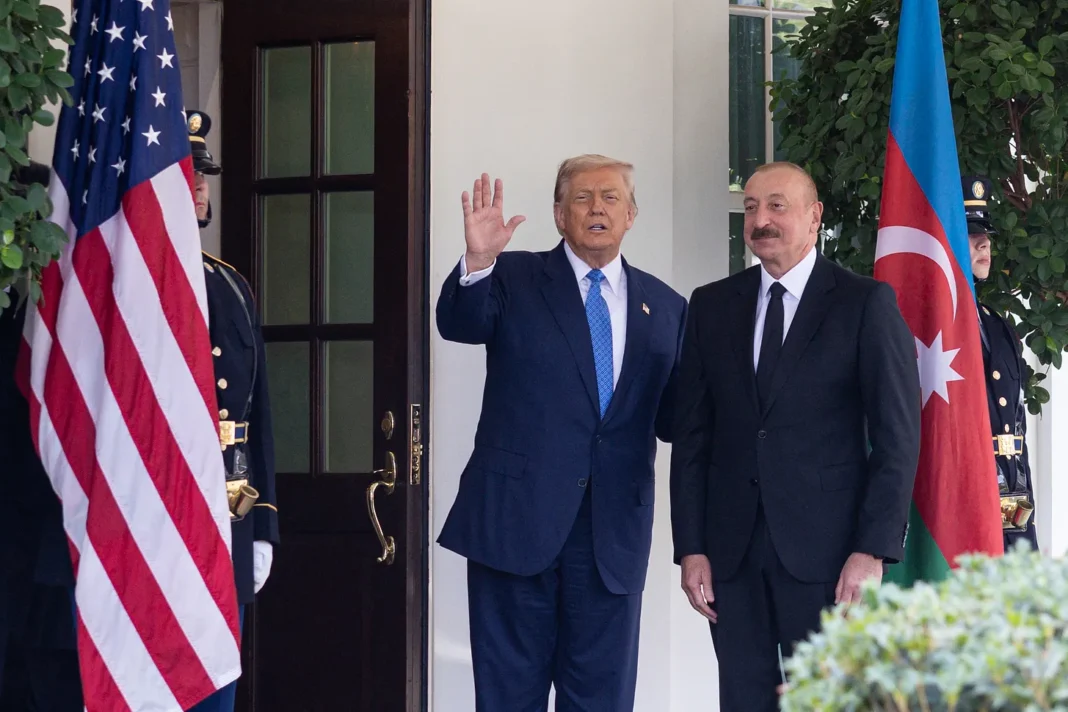
When President Donald Trump extended the waiver of Section 907 in 2025 and publicly embraced the Trump Route for International Peace and Prosperity (TRIPP), he did more than authorize another procedural exception. He acknowledged a reality that bipartisan foreign-policy professionals have quietly admitted for years:
the United States cannot be competitive in Eurasia while sidelining Azerbaijan.
The consequences were immediate and measurable.
Armenia and Azerbaijan both saw their credit outlooks improve. Western energy corridors regained momentum. Central Asian governments, watching closely, signaled interest in future integration.
Most importantly, Washington finally reinserted itself into a region where it had ceded influence to Russia by default, not design.
The uncomfortable truth for Washington’s old guard
Opposition to U.S.–Azerbaijan cooperation is rooted not in strategy but in nostalgia – a desire to maintain a narrative that collapsed the moment Armenia itself recognized Azerbaijan’s territorial integrity. The Minsk Group is defunct. The conflict it was built to manage no longer exists.
Continuing to base U.S. policy on a dissolved framework is not principled diplomacy. It is bureaucratic inertia masquerading as morality.
And it is geopolitically dangerous.
Europe relies increasingly on Azerbaijani gas to replace Russian flows. China is tightening its rare-earth monopoly. Iran is expanding its influence in every direction. For the U.S., refusing to adapt simply hands strategic advantage to competitors.
Azerbaijan’s role in a new geopolitical contest
What Azerbaijan offers is something Washington rarely finds:
Energy independence for Europe – and by extension, the U.S.
A corridor linking Europe, the Middle East, and Central Asia.
Alternatives to Chinese rare-earth dominance.
A stable, secular, Western-aligned state in a volatile region.
And unlike other regional actors, Baku has consistently demonstrated its willingness to work with the United States on counter-terrorism, energy diversification, and regional integration – even when domestic political pressure made that cooperation costly.
This is what modern American foreign policy looks like:
partnerships built on shared strategic interests, not outdated scripts.
The case for policy modernization
If Washington wants lasting influence in the South Caucasus – and a foothold in the emerging Europe-Central Asia trade architecture – it must move beyond the 1990s playbook. That means:
Formally reconsidering or repealing Section 907.
Locking in long-term cooperation on energy, logistics, and rare-earth minerals.
Fully integrating TRIPP into U.S. regional strategy.
Treating Azerbaijan as a partner, not a policy exception.
This is not about rewarding one side or punishing another. It is about adjusting American policy to the world as it is – not as it was when the U.S. was the only global superpower and Russia still looked like a rising democracy.
Washington’s moment of clarity
The United States now faces a choice. It can cling to habits formed in a different century, or it can build a strategic relationship with a country that is central to Europe’s energy security, Asia’s transit architecture, and the West’s rare-earth diversification.
Azerbaijan is not asking for favors. It is asking for realism.
If Washington truly wants influence in the South Caucasus – if it truly wants to counter Russia, China, and Iran – then treating Azerbaijan as a peripheral afterthought is no longer an option.
A new chapter in U.S.–Azerbaijan relations is overdue.
All it requires is that Washington finally turns the page.

