Azerbaijan has reaffirmed its role as one of the main initiators of the “3+3” regional consultation platform, which brings together the South Caucasus states and their neighboring powers.
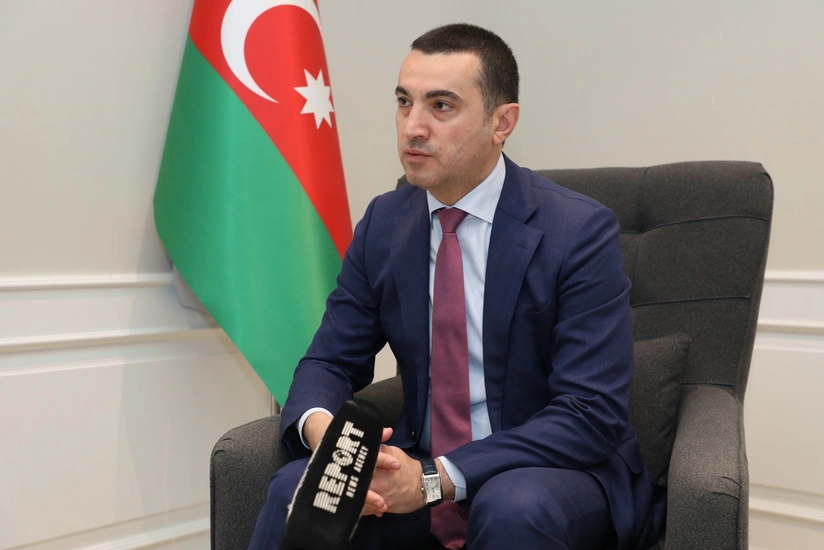
The country now seeks to host the next meeting in this format, said Aykhan Hajizade, Spokesperson for Azerbaijan’s Ministry of Foreign Affairs, in an interview with Report.
.
“Azerbaijan was the main initiator of the ‘3+3’ platform. Since its establishment on December 10, 2021, three meetings have been held – in Moscow, Tehran, and Istanbul,” Hajizade said. “At the last session in Istanbul in October 2024, we proposed including a clause in the final document that the next meetings be held in Azerbaijan and Armenia in turn. However, the Armenian side objected. We believe the next round should take place in Azerbaijan.”
He stressed that serious preparatory work and a comprehensive agenda are needed ahead of the next session. “The platform is not limited to Azerbaijani-Armenian or South Caucasus issues – it is designed to address the interests of all participating countries,” Hajizade added.
EU Mission in Armenia “Used for Anti-Azerbaijan Propaganda”
Hajizade also voiced Baku’s concern over the EU monitoring mission in Armenia, saying it contradicts previous agreements between Baku and Yerevan.
“Despite its declared goal of contributing to stability and trust, the mission has in fact been used as a tool of anti-Azerbaijan propaganda,” he said.
According to Hajizade, this was why Azerbaijan insisted on – and secured – the inclusion of a ban on third-party forces along the Azerbaijan–Armenia border in the draft peace treaty.
“By third-party forces, we also mean the EU mission,” he said. “Our position is clear and has been communicated to Armenia. We expect that, after signing the peace agreement, Armenia will fulfill its commitments in this regard.”
Talks Underway with U.S. and Armenia on TRIPP Corridor
The MFA spokesperson confirmed that the United States is holding talks with Armenia on implementing the “Trump Route for International Peace and Prosperity” (TRIPP) – a transport corridor designed to strengthen regional connectivity.
“Azerbaijan, as the initiator of the peace process, is deeply interested in sustainable peace and stability,” Hajizade said. “Following the historic Washington agreements, official meetings and informal contacts have aimed to advance our peace agenda and accelerate implementation.”
He noted that one of Azerbaijan’s key preconditions for signing a peace treaty remains amending Armenia’s Constitution, which still contains territorial claims against Azerbaijan.
Hajizade said that a major outcome of the August 8 Washington Summit was an agreement on the TRIPP route, which would ensure unhindered transit through the Zangezur Corridor and boost regional integration.
“The Joint Declaration emphasized the need to establish unhindered communication between mainland Azerbaijan and its Nakhchivan Autonomous Republic as part of regional connectivity efforts,” he said. “The U.S. is negotiating with Armenia on the project’s implementation, safety measures, and ensuring smooth passage. While construction timelines have not yet been announced, Azerbaijan has made its position clear to both the U.S. and Armenia.”
Peace Treaty Requires Preconditions
Hajizade reiterated that signing a final peace treaty between Azerbaijan and Armenia requires the creation of appropriate conditions.
“The key condition for Azerbaijan is that Armenia amends its Constitution to remove territorial claims,” he stated. “This principle is indirectly reflected in the Joint Declaration signed by the leaders of both countries in the presence of U.S. President Donald Trump.”
Only after these conditions are met, Hajizade said, can the parties begin discussing the venue for signing the peace treaty.