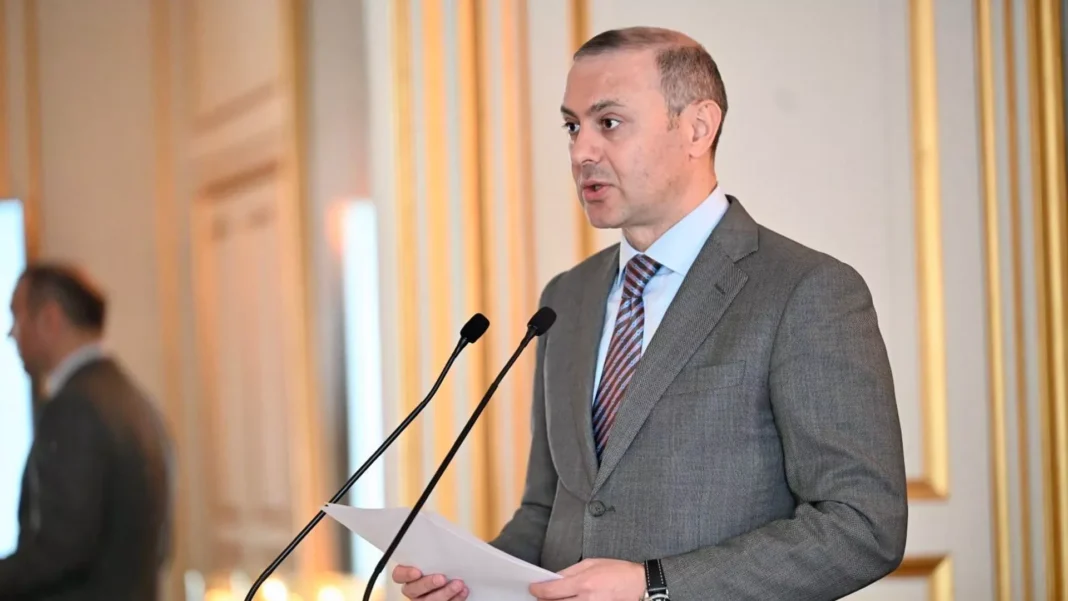
Armenia’s Secretary of the Security Council Armen Grigoryan announced that following the visit of Azerbaijani civil society representatives to Yerevan in late October, an Armenian delegation is expected to travel to Azerbaijan in the near future.
Speaking at a Brussels conference dedicated to the “Crossroads of Peace” project – organized by Rasmussen Global, the consulting firm led by former NATO Secretary General Anders Fogh Rasmussen – Grigoryan emphasized that such reciprocal visits help strengthen trust between the two societies and lay a foundation for sustainable peace.
He recalled that the October 21–22 visit of the Azerbaijani delegation marked the first direct civil society dialogue between the two nations since the signing of the Washington Declaration on August 8, when Presidents Ilham Aliyev and Nikol Pashinyan – in the presence of U.S. President Donald Trump – committed to advancing a comprehensive peace agenda.
Institutionalizing the peace process
Grigoryan said the next phase of the peace process will focus on institutional mechanisms, including the unblocking of transport, energy, and digital communications across the region.
The Crossroads of Peace project, and its key route known as TRIPP, could become a new corridor between Europe and China, potentially reducing transport distance by 5–10%, according to research from Armenia’s Amberd Center.
He added that opening the border with Turkey could lead to a threefold increase (200%) in bilateral trade, while trade routes between Armenia and Eastern Europe could shorten by 10–25%, and with Central Europe by 5–15%.
Washington Declaration and U.S. involvement
The Joint Declaration signed in Washington on August 8 elevated the U.S. role as guarantor and facilitator of the South Caucasus peace architecture. Under the agreement, Armenia granted the United States exclusive 99-year rights to develop Route No. 741, which will operate under Armenian jurisdiction.
Azerbaijan, for its part, plans to use the route to connect its mainland with Nakhchivan, establishing long-awaited land communication across Armenia. The U.S. intends to lease the section to an international consortium responsible for the construction and management of the infrastructure.
In parallel, the foreign ministers of Armenia and Azerbaijan signed a joint appeal formally closing the OSCE Minsk Group and its subsidiary structures, and initialed the text of the future peace treaty.