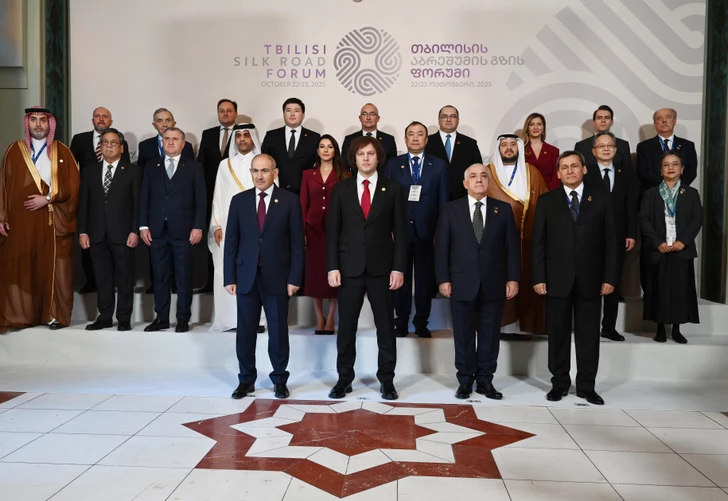
At the opening of the 5th Tbilisi Silk Road Forum, Azerbaijani Prime Minister Ali Asadov underlined Azerbaijan’s growing role as a regional transport and logistics hub – and a bridge between East and West.
Speaking before heads of government and global investors, Asadov highlighted the expanding cooperation between Azerbaijan and Georgia in trade, transport, and energy, describing the partnership as one of the key pillars of stability in the South Caucasus.
The two countries, he said, have for centuries stood at the crossroads of civilizations. “Azerbaijan and Georgia, both located along the Great Silk Road, have always connected Europe and Asia, contributing to the growth of trade and cultural exchange,” Asadov told participants.
“Today, we continue this historic mission in a new context — as leading players in regional cooperation and architects of new transport routes across Eurasia.”
A Forum of Strategic Dialogue
Launched in 2015, the Tbilisi Silk Road Forum has evolved into one of the region’s premier international platforms on connectivity and investment.
This year’s theme – “Investing in Connectivity” – reflects growing interest in the Middle Corridor, the east–west route linking China and Central Asia to Europe through the Caspian Sea, Azerbaijan, and Georgia.
Asadov praised Georgia for hosting the forum and noted the exceptional level of trust and cooperation between the two countries.
“Our relations of friendship and strategic partnership have long served as a foundation for regional development,” he said.
“Azerbaijan and Georgia are not only reliable political partners but also key players in energy and transport cooperation.”
Building the Middle Corridor
Azerbaijan’s investments in infrastructure over the past decade have transformed the country into a modern logistics hub.
According to Asadov, the Baku–Tbilisi–Kars railway, jointly built with Georgia and Turkey, has increased its capacity from 1 million to 5 million tons per year thanks to Azerbaijani funding.
He added that expansion is also underway at the Baku International Sea Trade Port in Alat, where capacity is being raised from 15 to 25 million tons annually. Azerbaijan now boasts the largest commercial fleet on the Caspian Sea and the biggest cargo airline in the region.
“In May, our country inaugurated its ninth international airport – in Lachin,” Asadov said. “A new cargo airport is also being built in the Alat Free Economic Zone. These and other projects have made Azerbaijan one of the key international transport nodes of Eurasia.”
All of these efforts, he stressed, are integral parts of the Middle Corridor, which has already proven its reliability and efficiency. Over the past three years, transit volumes along the corridor have grown by nearly 90%, while transport times have been significantly reduced. Earlier this month, Azerbaijan, Georgia, and Kazakhstan reached a landmark agreement introducing a unified long-term tariff for cargo shipments, further simplifying operations.
From Peace to Connectivity
In one of the most closely followed parts of his speech, Asadov referenced the recent peace agreements between Azerbaijan and Armenia, calling them “a historic step toward sustainable cooperation.”
“The opening of regional communications – including the connection between the main part of Azerbaijan and the Nakhchivan Autonomous Republic – will enhance the region’s transit capacity,” he said.
He also confirmed that the new regional route – dubbed the ‘Trump Route’ (TRIPP) after the Washington talks held on August 8 – will become an essential segment of the Middle Corridor.
“The transportation of Kazakh grain to Armenia through Azerbaijani territory marks the first practical step in this direction,” Asadov noted.
“As President Ilham Aliyev has said, peace between Azerbaijan and Armenia is now not only on paper but in practice.”
Asadov emphasized that Azerbaijan has lifted all restrictions on cargo transit to Armenia that had remained since the occupation period – a gesture demonstrating Baku’s commitment to reconciliation and regional confidence-building.
Energy Partnership and Green Transition
The Azerbaijani Prime Minister devoted a significant portion of his address to the energy partnership between Baku and Tbilisi, describing it as “a model of long-term, productive cooperation.”
He cited the Baku–Tbilisi–Ceyhan oil pipeline, the Baku–Tbilisi–Erzurum gas pipeline, and the Southern Gas Corridor as flagship projects that “have changed the geopolitical landscape of the region and ensured Europe’s energy security.”
“The Southern Gas Corridor, initiated by Azerbaijan and implemented with Georgia’s active participation, has become an important component of Europe’s energy architecture,” he said. “Over the past year, the number of countries receiving Azerbaijani gas has risen to 14, including 10 in Europe.”
Asadov also pointed to the growing partnership in renewable energy, particularly within the Caspian–Black Sea–Europe Green Energy Corridor initiative, which aims to transport green electricity from the Caspian basin to European markets.
“Azerbaijan will continue to work toward unlocking the region’s full transit and energy potential,” he said. “Our goal is to build sustainable logistics chains, green energy corridors, and an open, mutually beneficial space of cooperation across Eurasia.”
Regional Cooperation in Focus
At the same forum, Georgian Prime Minister Irakli Kobakhidze welcomed the participation of his counterparts from Azerbaijan and Armenia, calling it a symbolic step toward reconciliation and regional stability.
“We are pleased that our strategic partners – the prime ministers of Azerbaijan and Armenia – are present at this important event,” Kobakhidze said. “The Middle Corridor, as the modern continuation of the Silk Road, connects Europe and Asia efficiently and reliably.”
He underlined Georgia’s role as a strategic bridge between the continents and expressed hope that stronger connectivity would translate into deeper economic cooperation.
A New Chapter in the South Caucasus
With political barriers easing and infrastructure expanding, the South Caucasus is entering a new phase of integration. The combination of peace diplomacy, joint infrastructure projects, and green transition initiatives is reshaping the region’s image – from one of historic rivalries to one of emerging opportunities.
As the Tbilisi Silk Road Forum concluded its first day, Asadov’s message was clear: Azerbaijan is positioning itself not just as a transit country, but as a central connector of Europe and Asia – and a driver of peace and prosperity in the South Caucasus.