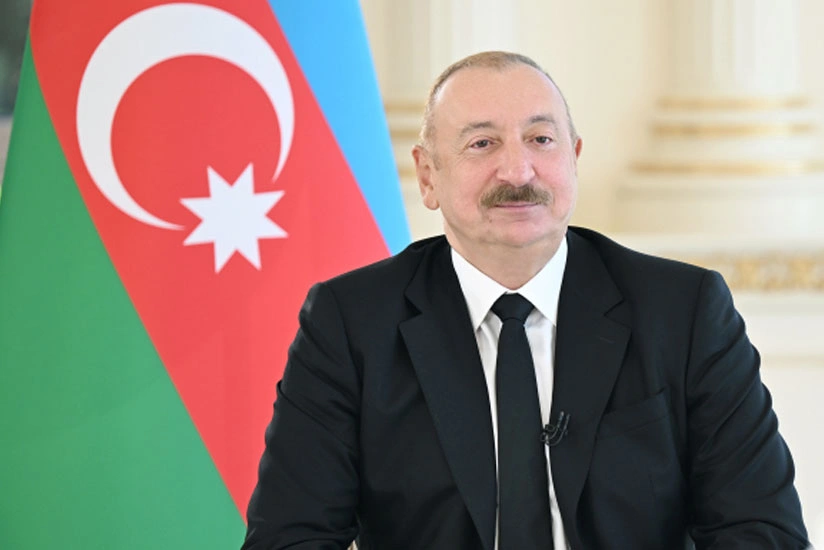
On the eve of his state visit to Kazakhstan, President Ilham Aliyev gave an exclusive interview to the Kazinform news agency, where he highlighted the exceptional level of trust between Azerbaijan and Kazakhstan, the rapid growth of cooperation in transport and energy, and the shared commitment to a “green” future within the Organization of Turkic States (OTS).
“Relations Built on Brotherhood and Strategic Trust”
“Our political relations today are defined by strength and mutual trust,” President Aliyev said. “Based on historic ties of brotherhood, friendship, and common Turkic identity, we have built truly strategic and allied relations.”
He noted that his upcoming visit will be his seventh to Kazakhstan in three years, while President Kassym-Jomart Tokayev has visited Azerbaijan six times in the same period – “a clear demonstration of mutual commitment to deepening comprehensive partnership.”
Aliyev praised Kazakhstan’s reform-driven modernization under President Tokayev and expressed gratitude for the Kurmangazy Children’s Creativity Center built in the liberated city of Fuzuli, describing it as a “symbol of solidarity and friendship between our peoples.”
The president underlined that the two countries have created a solid legal foundation with around 170 agreements, anchored by the Treaty on Strategic Partnership and Allied Relations, whose 20th anniversary was marked this year. The upcoming Supreme Interstate Council meeting in Astana, he said, will map new steps to expand cooperation across all areas.
Trade, Investment, and the Middle Corridor
Aliyev pointed to robust growth in bilateral trade, which reached $470 million in 2024 and $547 million between January and August 2025 – more than triple the figure for the same period last year. This progress, he noted, reflects the efficient use of the Middle Corridor and modernization of transport and logistics infrastructure.
About 250 Kazakh-capital companies are currently registered in Azerbaijan, while Azerbaijani investments in Kazakhstan total $225 million, and Kazakh investments in Azerbaijan $136 million. “These figures reflect mutual confidence and a shared vision of sustainable partnership,” Aliyev said.
Transit volumes between the two countries rose to 3.5 million tons in 2024, up 20% year-on-year, confirming the Middle Corridor’s role as a key route linking Europe and Asia. The “Road Map 2022–2027,” signed in Aktau, aims to coordinate infrastructure development, logistics centers, and unified tariff policies among Azerbaijan, Kazakhstan, and Turkey.
Aliyev also mentioned the construction of a subsea fiber-optic line across the Caspian Sea between Kazakhstan and Azerbaijan – a project launched in March 2025 and expected to be completed by the end of 2026. “It will enhance digital connectivity and strengthen the technological foundation of our cooperation,” he said.
In the energy sector, SOCAR and KazMunayGas are implementing a transit agreement for 1.5 million tons of Kazakh oil per year along the Aktau–Ceyhan route, with plans for gradual expansion and tariff reductions. Ports Alat and Aktau are being modernized to increase throughput and efficiency, reinforcing the Middle Corridor’s strategic position.
Green Energy and Digital Integration
The president emphasized that cooperation is also extending to renewable energy and digital innovation. In 2024, Azerbaijan, Kazakhstan, and Uzbekistan signed strategic memoranda to integrate energy systems and promote clean technologies.
“These initiatives reflect our shared vision for sustainable growth and ecological responsibility,” Aliyev said, calling green transition one of the defining pillars of regional cooperation.
Turkic Solidarity as a Strategic Force
Aliyev described the Organization of Turkic States, founded in 2009 in Nakhchivan, as a “vital platform for political dialogue, economic cooperation, and cultural unity.”
He recalled the Shusha Summit and the 12th OTS Summit in Gabala, which, he said, “helped strengthen the Turkic world’s cohesion, expanding its political and economic influence.”
Institutions such as the International Turkic Academy, TURKSOY, and TURKPA have, according to Aliyev, become essential for “building a community of trust and cooperation among Turkic nations.”
Looking ahead, he highlighted that 2026 will mark the 100th anniversary of the First Turkological Congress, held in Baku in 1926, which will be commemorated “as a milestone of Turkic scholarship and unity.”
Cultural Diplomacy and Shared Heritage
Cultural exchanges, Aliyev said, remain “a bridge between our peoples.” He noted that Days of Kazakh Culture were held in Baku in 2023, and Days of Azerbaijani Culture took place in Kazakhstan in 2024.
He also pointed to the Azerbaijani-language publication of Kemel Tokayev’s short-story collection “The Night Shot” and the joint conference in Baku dedicated to Kemel Tokayev’s 100th and Mir Jalal Pashayev’s 115th anniversaries as examples of deepening literary exchange.
Caspian Sea: “A Symbol of Shared Responsibility”
Turning to environmental issues, Aliyev warned that the Caspian Sea’s falling water level has become one of the region’s most acute ecological problems.
“The decline poses both environmental and economic threats,” he said. “It is essential for all littoral states to cooperate, share scientific data, and coordinate action to mitigate the impact.”
Aliyev urged Azerbaijan, Kazakhstan, and other Caspian states to take the lead in advancing regional and international initiatives.
“Amid growing transnational risks, the Caspian is no longer just a sea – it is a symbol of our collective responsibility and unity of purpose.”