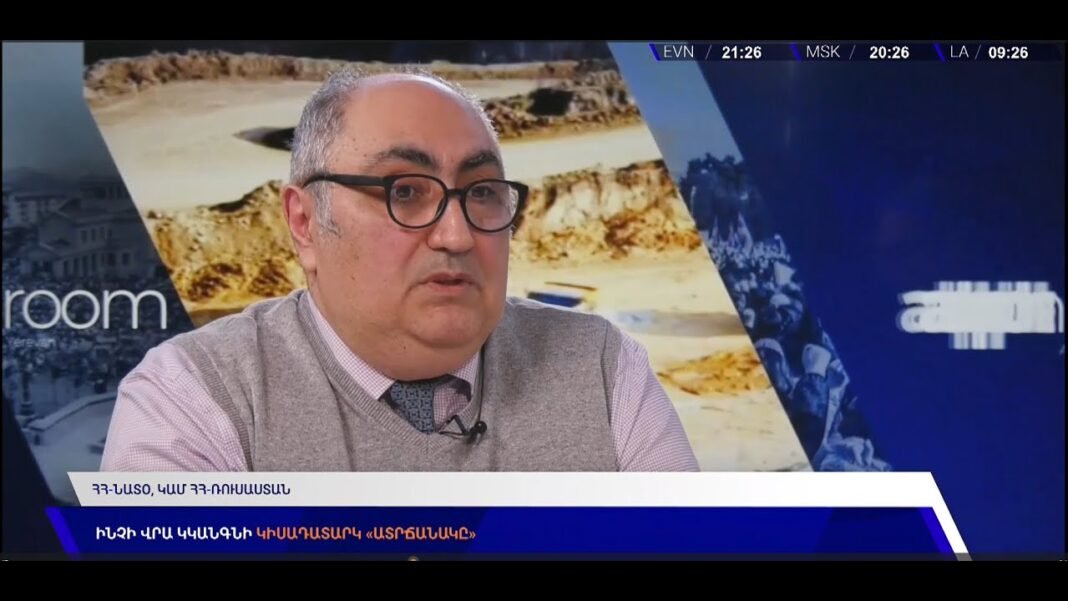
Appearing on the RIR-Politika YouTube channel, Russian commentator Rafael Ordukhanyan delivered a blistering critique of Armenian Prime Minister Nikol Pashinyan, alleging “incompetence” and predicting an “inevitable” political and economic collapse in Armenia.
Ordukhanyan said public opinion in Armenia “does not yet fully grasp” the scale of the crisis, and accused Pashinyan of “betraying” national interests.
In the wide-ranging remarks, Ordukhanyan argued that Yerevan’s moves to revise elements of the constitution and state symbols, along with its foreign-policy tilt away from Moscow, had destroyed Armenia’s standing in Russia.
“Armenia as an ally, as a friendly state for Russia, is over,” he said, adding that what he called “protocol smiles and handshakes” should not be mistaken for real alignment.
He claimed the Russian political establishment now views Armenia “totally negatively.”
Invoking a familiar adage-“those who choose disgrace over war get both”-Ordukhanyan said Pashinyan’s approach after battlefield setbacks had delivered neither security nor dignity.
He also mocked the optics of both Azerbaijan and Armenia allegedly putting forward the same figure for a peace prize, calling it emblematic of what he sees as Yerevan’s policy incoherence.
Ordukhanyan stressed that his impressions are formed from outside Armenia-he noted he is not permitted to enter the country-but insisted that “each new step” confirms his assessment. He suggested Armenian society is reluctant to acknowledge the trajectory he describes.
The commentary reflects a hardening line in parts of the Russian media ecosystem amid strained Moscow-Yerevan ties, as Armenia has sought to diversify security and diplomatic partnerships and has publicly criticized Russia’s defense guarantees.
Armenian officials and many analysts reject portrayals of a “collapse,” arguing that policy recalibration is aimed at safeguarding sovereignty after repeated security shocks.