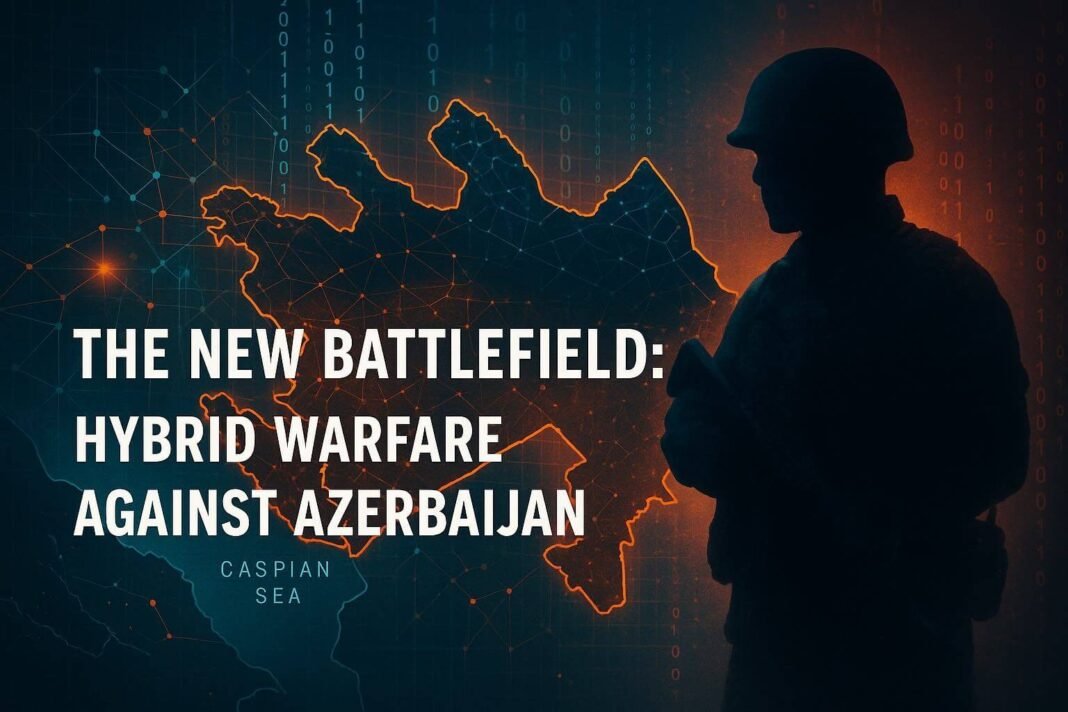
In the twenty-first century, wars no longer begin with declarations. They unfold quietly – through disrupted servers, distorted narratives, and manipulated public opinion. The age of hybrid warfare has blurred the line between peace and conflict, replacing traditional weapons with cyberattacks, propaganda, and political interference.
For Azerbaijan, this invisible front has grown increasingly active. A nation that has strengthened its sovereignty, energy influence, and regional weight after the Second Karabakh War now faces coordinated efforts to challenge its stability.
A War Without Frontlines
“Azerbaijan is confronting a hybrid or nonlinear form of confrontation that plays out on multiple levels – from cyberspace to information operations,” political analyst Orkhan Yolchiyev told Minval Politika.
He describes a campaign aimed not at conquering land but at eroding confidence – undermining public trust, weakening institutions, and damaging the country’s image abroad. Competing powers, he argues, use such tactics to influence the balance of power in the South Caucasus without direct confrontation.
Cyberattacks as Strategic Weapons
One of the most alarming tools in this hybrid campaign is the cyberattack. Earlier this year, Azerbaijan’s government IT systems faced a massive digital assault. According to Yolchiyev, that incident exposed the vulnerability of critical industrial and energy infrastructure.
“In a country that guarantees regional and European energy security, a single cyberstrike can ripple far beyond its borders,” he said. “Any disruption to our pipelines or control systems would be felt not only in Baku, but in European capitals as well.”
Disinformation: The Psychological Front
Yolchiyev identifies information warfare as the second major threat — a constant, often invisible assault on public consciousness.
“Fake accounts, aggressive Telegram channels, and coordinated YouTube narratives have become part of the toolkit,” he noted. “We’ve seen how certain Russian-language platforms incited hostility against Azerbaijani citizens and manipulated ethnic themes.”
These operations, he said, aim to sow division among communities and weaken social cohesion. “It’s an attack on perception – a slow attempt to fracture the unity that holds the state together.”
Targeting Peace and Regional Projects
The analyst believes that hybrid tactics also seek to derail Azerbaijan-Armenia normalization. Each time leaders in Baku and Yerevan signal readiness for peace, he says, waves of disinformation surge to discredit the process.
“For years, false claims spread that Azerbaijan planned to ‘seize Zangezur.’ The purpose was to isolate Baku diplomatically and portray it as an aggressor,” he explained.
The broader competition, Yolchiyev added, reflects the strategic contest among Russia, Iran, and Türkiye. With projects such as the Middle and Zangezur corridors reshaping Eurasian trade, external powers are racing to shape regional narratives.
“There were even attempts to suggest that Azerbaijan sought to bypass Georgia’s transit role – a fabricated claim meant to drive a wedge between two close partners,” he said.
Lawfare and Political Pressure
Hybrid tactics are not limited to media or cyberspace. Yolchiyev points to efforts to use international legal mechanisms as instruments of pressure – what he calls “legal terrorism.”
“Azerbaijan was accused of ethnic cleansing, of environmental harm – none of which was substantiated. These allegations were designed to create a negative information climate and undermine international confidence,” he said.
He also recalls the January 2023 attack on Azerbaijan’s embassy in Iran, calling it part of a wider backlash from forces unhappy with Baku’s post-war success and expanding transit network.
Building National Resilience
According to Yolchiyev, countering hybrid threats requires a whole-of-society approach:
Developing AI-based cybersecurity systems;
Establishing national hybrid-threat response centers;
Reinforcing internal stability through anti-corruption reforms and social equity;
Expanding strategic cooperation with Türkiye and Central Asia;
Coordinating media strategies to counter disinformation;
Supporting the parliamentary commission on hybrid threats, created in November 2024.
“Azerbaijan is not just an energy player,” he said. “It’s a cornerstone of South Caucasus stability. Protecting it from hybrid warfare is essential for the region’s sustainable future.”
The Real Target: Public Trust
In Yolchiyev’s view, the ultimate aim of hybrid war is to erode trust between citizens and the state.
“Hybrid warfare is not about tanks or missiles – it’s about shaping minds, undermining faith in institutions, and sowing doubt in the nation’s future,” he said. “Our defense lies in unity, fairness, and confidence. The stronger the bond between people and state, the weaker any external attack becomes.”

