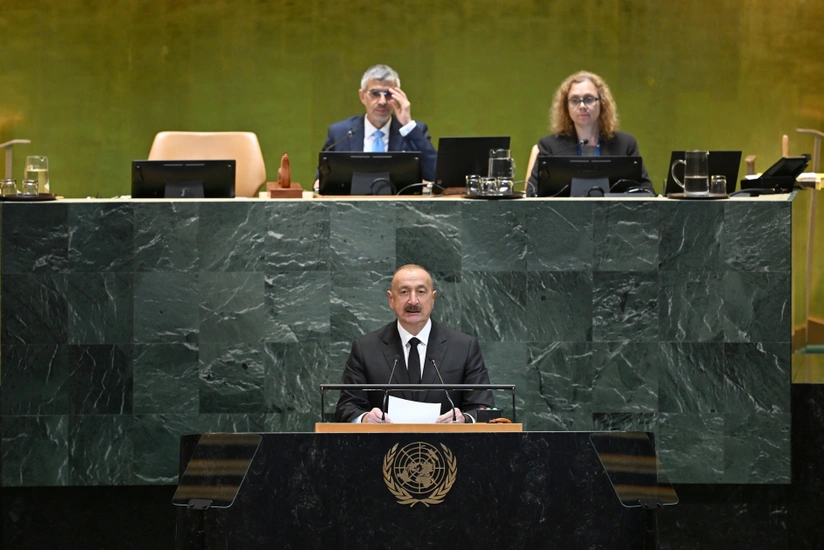
New York, Sept. 25, 2025
President Ilham Aliyev used his speech at the 80th session of the United Nations General Assembly to frame Azerbaijan’s post-war trajectory as a story of justice, reconstruction, and a new strategic partnership with the United States.
Aliyev reminded delegates that for nearly three decades, 20 percent of Azerbaijan’s sovereign territory remained under Armenian occupation despite four binding UN Security Council resolutions.
“Those resolutions were never enforced,” he said, accusing Yerevan of ethnic cleansing and war crimes that displaced one million Azerbaijanis.
He underlined that the 2020 war restored Azerbaijan’s territorial integrity “in full compliance with international law and UN resolutions.”
Unlike Armenia, he argued, Baku conducted operations with respect for humanitarian law: “We ensured the protection of civilians and avoided striking non-military infrastructure.”
Peace Process Anchored in Washington
Aliyev cast the August 8 Washington Summit as a turning point. At the White House, Azerbaijani and Armenian foreign ministers initialed a peace agreement, and Aliyev and Armenian Prime Minister Nikol Pashinyan signed a joint declaration witnessed by U.S. President Donald Trump.
He highlighted two breakthroughs: the closure of the defunct OSCE Minsk Group and the launch of the “Trump Route for International Peace and Prosperity” (TRIPP), a transport corridor through Zangezur that will link mainland Azerbaijan with Nakhchivan and extend the Middle Corridor between Asia and Europe.
“This marks not only peace between Armenia and Azerbaijan, but also the elevation of our relations with the United States to the level of strategic partnership,” Aliyev said. He welcomed Trump’s decision to suspend enforcement of Section 907 of the Freedom Support Act, long a source of friction in bilateral ties.
Rebuilding a Devastated Land
Aliyev described the large-scale reconstruction campaign underway in territories retaken from Armenian forces, where “hundreds of cities and villages were razed, and 65 mosques deliberately destroyed.” More than 50,000 people have already returned under the “Great Return” program.
Yet challenges remain: over 400 Azerbaijanis have been killed or maimed by mines since 2020, while nearly 4,000 Azerbaijanis remain missing from the 1990s conflict.
Global Agenda: Energy and Climate
Aliyev positioned Azerbaijan as both a reliable energy partner and a climate leader. The country now supplies natural gas to 14 states, making it “the world’s number one pipeline gas exporter by number of markets.” In August, Azerbaijan also began exporting gas to Syria via Turkey to ease post-war shortages.
He pointed to COP29 in Baku as a milestone where Azerbaijan brokered the “Baku Finance Goal,” a pledge to scale annual climate finance for developing countries from $100 billion to $300 billion by 2035.
“While committed to green transition, we must be realistic: the world cannot live without fossil fuels today or in the near future,” Aliyev told delegates. Azerbaijan, he added, is investing heavily in solar, wind, and hydropower to ensure that renewables account for 40 percent of national generation by 2030.
Economic Resilience and Credibility
Aliyev touted a poverty rate cut to 5 percent, foreign debt at only 6.5 percent of GDP, and currency reserves 16 times larger than external obligations. Moody’s and Fitch recently upgraded Azerbaijan’s credit rating, citing strong fiscal discipline and sovereign wealth.
He warned of ecological catastrophe in the Caspian Sea, which is “shrinking rapidly,” and called for joint action among littoral states with UN support.
Humanitarian Voice
Aliyev stressed Azerbaijan’s record of humanitarian aid, from pandemic relief to disaster response, as proof of a responsible global actor: “We ended occupation and began reconstruction. Justice prevailed, sovereignty was restored, peace is de facto achieved. This is not only Azerbaijan’s victory, but proof that international law ultimately triumphs.”