Baku, Sept. 18, 2025
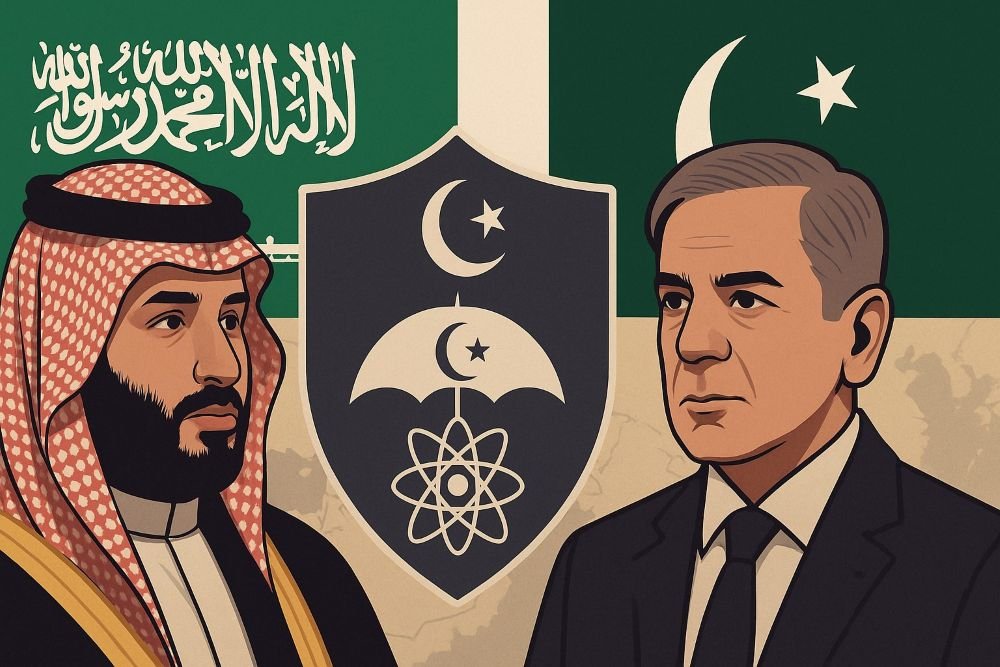
Pakistan and Saudi Arabia have signed a “Joint Strategic Defense Agreement” that experts in Baku are characterizing as a mutual – defense pact – and, in practical terms, a Saudi alignment with Pakistan’s nuclear deterrent.
The accord was sealed in Riyadh’s Al-Yamamah Palace by Crown Prince Mohammed bin Salman and Pakistan’s Prime Minister Shehbaz Sharif. According to participants, it formalizes joint defense cooperation and deterrence, with an understanding that an attack on one would be treated as aggression against both.
Speaking to Minval Politika, analyst Farhad Mammadov argued the deal is a direct response to heightened Middle East volatility. In his view, “each major Muslim country seeks a partner with a nuclear capability; today, that’s only Pakistan,” adding that massive Saudi purchases of U.S. weapons have not guaranteed protection from potential regional adversaries. Mammadov contends the pact “is, first and foremost, about nuclear deterrence,” implying Islamabad’s arsenal now underwrites Saudi security.
Mammadov also forecast closer economic ties – more trade, financial support and investment flows from Riyadh to Islamabad – paired with reciprocal political backing.
Political analyst Ilyas Guseynov called the agreement a signal of rising trust between two pivotal states of the Islamic world, with potential ripple effects across the wider region, including the South Caucasus. He noted both countries’ long-standing support for Azerbaijan’s territorial integrity and their refusal to recognize Armenia, citing the occupation of Azerbaijani territories as the reason no diplomatic relations were established.
Guseynov said the deepening Saudi – Pakistani axis “objectively strengthens Azerbaijan’s position,” arguing the partners will translate the pact into tangible military and diplomatic cooperation. He added that Baku’s balanced, multi-vector foreign policy remains focused on stability and security, and that Azerbaijan “welcomes a stronger partnership” between two friendly states.
Why it matters for Azerbaijan
Security geometry: A tighter Riyadh–Islamabad alignment could reinforce diplomatic and security backing for Baku on international platforms.
Regional deterrence: If interpreted as a Pakistani nuclear umbrella for Saudi Arabia, the pact could recalibrate deterrence calculations in the Gulf – indirectly affecting South Caucasus dynamics and great-power engagement.
Economic spillovers: Closer Saudi – Pakistani coordination may spur broader investment and connectivity initiatives that include Azerbaijan.